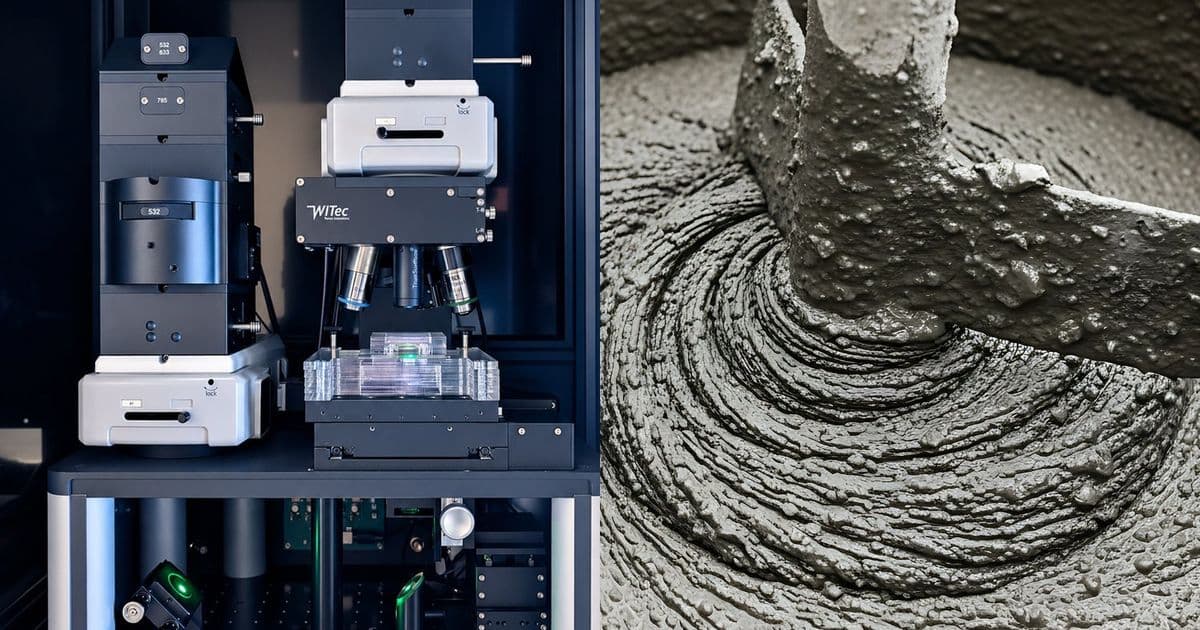
MIT researchers used real-time Raman spectroscopy to capture a fleeting silica gel that appears and vanishes within the first eight hours of CO₂-injected cement curing, explaining why the material gains strength faster and pointing toward a way to store carbon in the built environment.
For years, companies have been injecting carbon dioxide into fresh concrete and measuring the result: mixes that set faster, hit higher early strength, and lock away a small amount of CO₂ permanently as mineral. The commercial case was clear enough that a market grew around it. What was missing was a direct look at the chemistry. The reactions responsible moved too quickly and left too little behind for conventional analysis to catch them happening.
A team at the MIT Concrete Sustainability Hub has now watched those reactions unfold. In an open-access paper in the Journal of the American Ceramic Society, led by Associate Professor Admir Masic and first-authored by graduate student Marcin Hajduczek, the researchers describe a three-stage chemical sequence that begins the moment CO₂ meets cement paste. The centerpiece of their finding is a transient material, a silica gel network, that forms throughout the paste and then disappears almost entirely within hours, leaving behind a stronger, more uniform microstructure.
Why this was hard to see
Cement paste is the binder at the heart of concrete. It forms when water reacts with clinker, the fine powder produced by heating limestone and aluminosilicates in a kiln. As clinker dissolves, it releases calcium and silicates that recombine into calcium silicate hydrate, or C-S-H, the compound that actually holds hardened concrete together. This hydration process is well studied in ordinary cement. Add CO₂ to the mix and the picture changes, but the key intermediate phases were proposed mostly from theory and indirect evidence rather than direct observation.
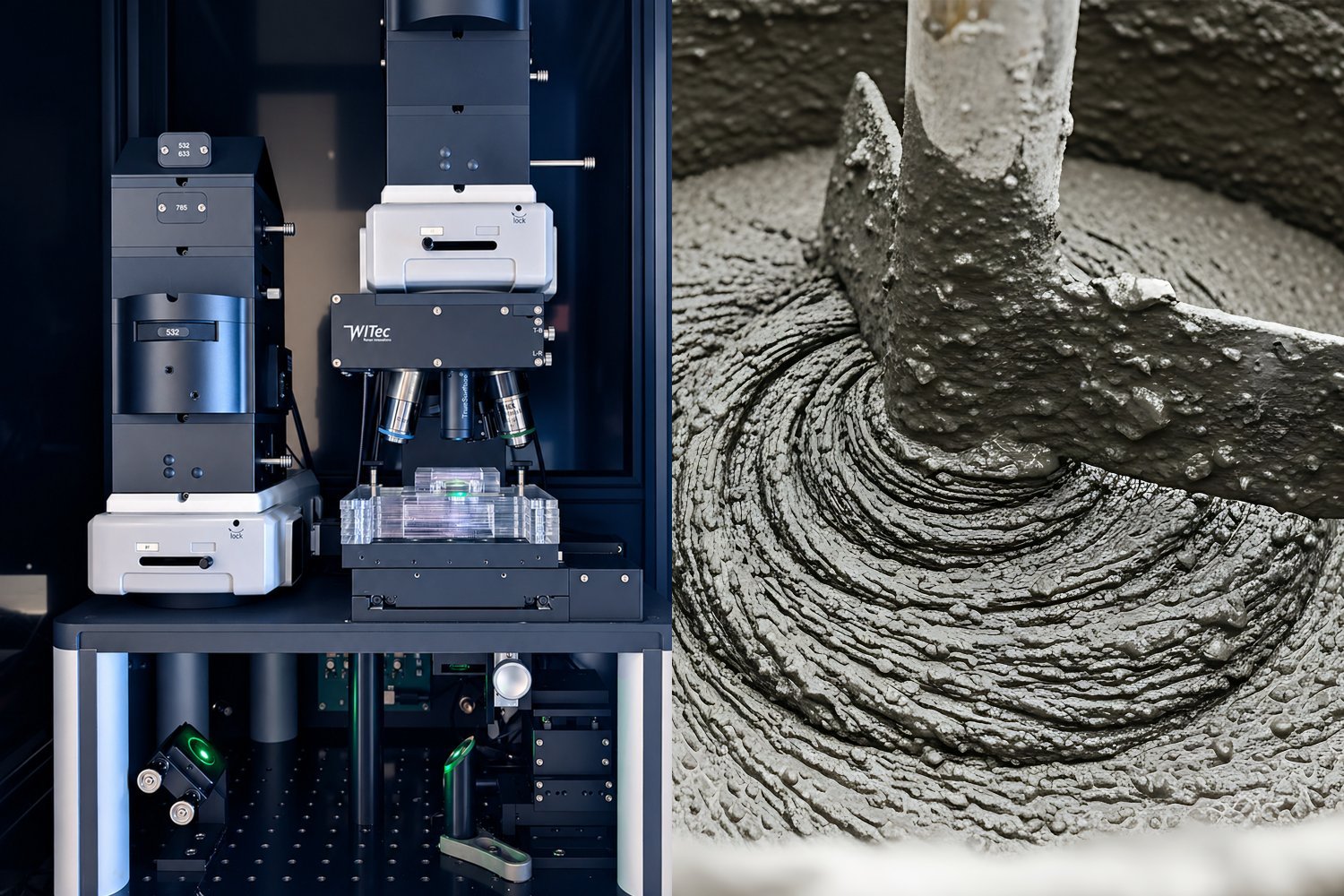
The instrument that made direct observation possible is a confocal Raman microscope. The principle behind it is straightforward. Illuminate a molecule with a laser, and a small fraction of the scattered light shifts in energy according to the vibrational modes of the chemical bonds it encounters. Those shifts form a spectral fingerprint specific to each phase, including amorphous and poorly crystalline materials that diffraction-based methods struggle with. That sensitivity to disordered phases is exactly what this problem required, because the intermediate the team was hunting for is amorphous and short-lived.
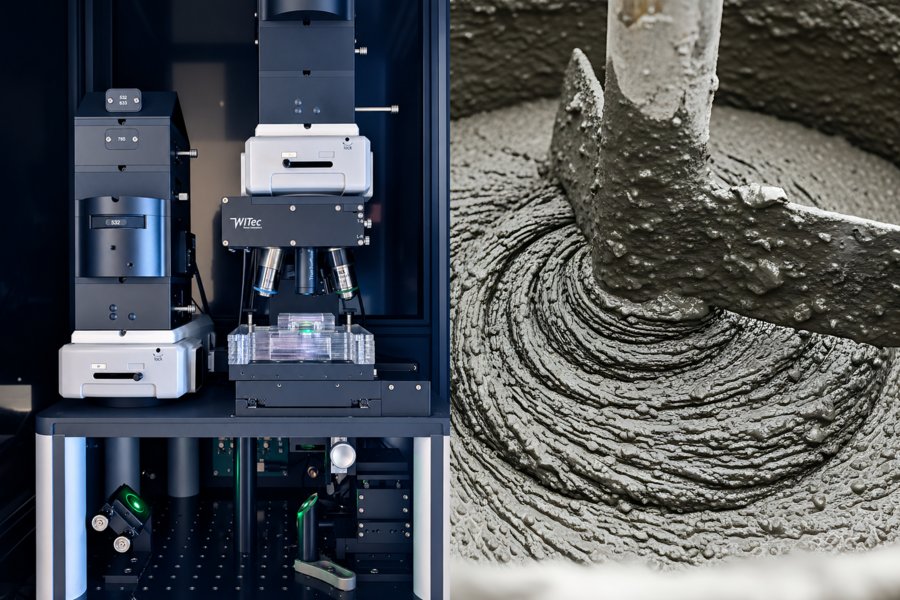
The sample preparation has a memorable detail. The researchers depressurized a tank of liquid CO₂, which froze instantly into solid flakes, a small indoor snowfall in MIT's Pierce Laboratory. Those flakes were blended into cement paste, pressed into dime-sized discs, and sealed with a thin layer of vegetable oil to hold water in and keep air out. A custom stage with a quartz window let the laser scan each disc from below, tracking its chemical evolution continuously over 24 hours.
Act one: the calcium gets captured
In ordinary hydration, calcium released by dissolving clinker stays local and feeds the gradual formation of binding phases right where the clinker particles are. CO₂ disrupts that. Within the first hour, injected CO₂ dissolves into the pore solution and reacts with available calcium, precipitating as calcium carbonate. That pulls calcium out of circulation and temporarily slows normal hydration, which depends on calcium to proceed.
Starved of calcium, the silicates from the clinker behave differently. Instead of forming binder near their source, they dissolve into the pore solution and precipitate at a distance, linking into chains that build an interconnected silica gel network spread throughout the paste. This gel is the intermediate that earlier studies could only infer. It depends on a specific condition to survive: the CO₂ has temporarily suppressed the paste's alkalinity, and that lower pH is the only thing holding the gel together.
Act two: the ghostly gel
Around four to five hours in, the injected CO₂ is fully mineralized and normal hydration resumes. Calcium hydroxide begins precipitating into the pore space, and where it meets the waiting silica gel, the two react immediately to form C-S-H. The distinguishing feature is geography. In conventional cement, C-S-H clusters around clinker particles. Here it forms wherever the silica gel had spread, which is to say nearly everywhere in the matrix.
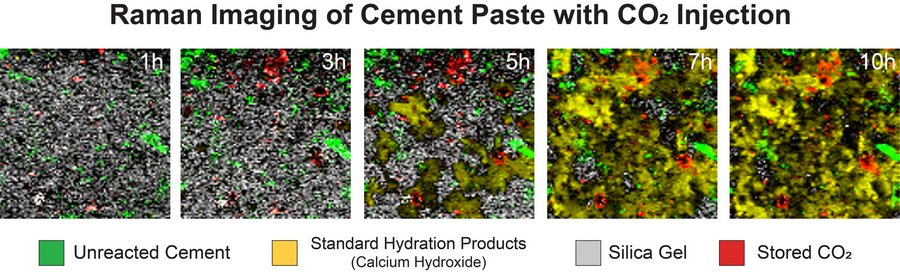
The reaction is self-reinforcing. As hydration produces calcium hydroxide, it drives the pH back up toward normal levels, and the higher pH accelerates the pozzolanic reaction that consumes the silica gel. Within eight hours the gel is almost entirely gone, converted into additional, well-distributed C-S-H. "At first, the fleeting nature of the silica gel looked like a fluke in the Raman data," says Hajduczek. "But it quickly became clear that its sudden disappearance was a consistent, undeniable feature of every CO₂-injected sample."
The Raman maps make the sequence legible at a glance: gray silica gel gives way to yellow hydration products as the paste sets, with unreacted cement in green and stored CO₂ in red.
Act three: a rewired matrix
Once the gel is consumed, the paste settles into conventional hydration, but the structure it leaves is measurably different. Because the binder formed evenly across the matrix rather than clustering, the resulting microstructure is stronger and more uniform at early ages. In the study, paste mixed with CO₂ at 1 percent by cement weight reached, on average, 13 percent higher compressive strength at 24 hours compared to reference mixes.
The result also corrects a common assumption. Calcium carbonate crystals had been suspected of seeding C-S-H growth and contributing directly to early strength. The Raman data suggests they are passive bystanders, embedded in the silica gel template rather than reacting to form binder. The strength gain traces to the distribution of C-S-H, not to the carbonate seeding it.
What it means in practice, and what it doesn't
This is where industry awareness matters more than enthusiasm. The headline number people will reach for is carbon offset. If the paste forms abundant C-S-H, it could in theory offset up to 40 percent of the process emissions from cement production, excluding the fossil fuels burned to run the kiln. The researchers are careful to note that the achievable figure in real mixes is likely a fraction of that, though still potentially meaningful. Treating the theoretical ceiling as a delivered result is the kind of mistake that erodes trust in carbon accounting.
Dosage is the practical knob, and it cuts both ways. Inject too much CO₂ and the calcium gets locked into carbonate before the silica gel can form and react, which is precisely the mechanism that produces the favorable microstructure. The benefit depends on staying in a window where calcium is temporarily borrowed rather than permanently sequestered as carbonate. That makes process control, not just process adoption, the real engineering target.
Several questions remain open. The silica gel template explains where the new C-S-H ends up, but the team has not yet directly measured the mechanical properties of that distributed binder, so the link between distribution and strength is well supported but not fully closed. The behavior across different clinker chemistries, water-to-cement ratios, and admixtures also remains to be mapped before the mechanism can be tuned reliably at plant scale.
"We've been injecting CO₂ into cement products for years without fully understanding what it was doing inside," says Masic. "Now that we can see it and understand the underlying mechanism that leads to improved performance, we can start to control it." The value of this work is less a new product than a new handle. A process that was tuned empirically now has a mechanism behind it, and a mechanism is something engineers can optimize against rather than guess at. For a material poured by the billions of tons, that shift from black box to observable chemistry is what turns an incremental strength gain into a design parameter.
The research connects to a broader effort at the Concrete Sustainability Hub and the MIT Department of Civil and Environmental Engineering to treat concrete as a tunable system rather than a fixed recipe, work that includes machine-learning approaches to mix design and studies of how cured concrete continues to absorb CO₂ over its service life. Co-authors on the paper include MIT's Santiago El Awad and Franz-Josef Ulm, with collaborators from IIT Jodhpur and CarbonCure Technologies.
Comments
Please log in or register to join the discussion