A fundamental rewrite of MSAA handling in Mesa's PanVK driver achieves revolutionary speedups for Vulkan rendering on Arm Mali GPUs, with 16x MSAA performance increasing by over 25 times.

The open-source PanVK Vulkan driver for Arm Mali GPUs has undergone transformative optimizations targeting multi-sample anti-aliasing (MSAA) performance. Merged into Mesa 26.1, Faith Ekstrand's architectural changes centered around frame-buffer abstraction and render-pass optimizations have produced unprecedented performance uplifts in Vulkan workloads.
Benchmark Results: Quantifying the Leap
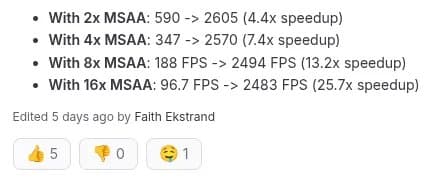
The most dramatic improvements appear in Sascha Willems' Vulkan MSAA demo, where frame rates skyrocketed across all sampling levels:
| MSAA Level | Previous FPS | New FPS | Speedup Multiplier |
|---|---|---|---|
| 2x | 590 | 2,605 | 4.4x |
| 4x | 347 | 2,570 | 7.4x |
| 8x | 188 | 2,494 | 13.2x |
| 16x | 96.7 | 2,483 | 25.7x |
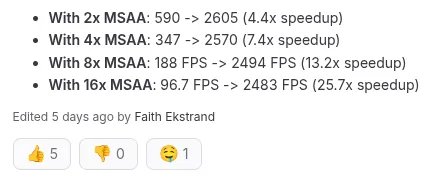 Visualization of MSAA performance gains (Source: PanVK merge request)
The exponential scaling reveals the optimization's efficiency: Higher sampling levels benefit most dramatically, with 16x MSAA rendering now running faster than 8x MSAA did previously. This fundamentally changes quality/performance tradeoffs for Mali GPU users.
Technical Breakdown: Frame Shaders & Render Pass Optimization
The breakthrough comes from deferred MSAA resolution logic. Previously, PanVK handled MSAA resolves through suboptimal pathways during rendering operations. The restructured approach:
- Frame Shader Integration: Implements MSAA resolution within specialized frame shaders
- Render Pass Timing: Defers resolution until render pass completion when possible
- Memory Efficiency: Reduces redundant operations through frame-buffer abstraction
This architectural shift minimizes costly data transfers and leverages the Mali GPU's tile-based rendering advantages. By batching resolution operations at the render pass conclusion, driver overhead drops significantly while maintaining visual fidelity.
Real-World Implications for Arm Builders
For homelab and embedded developers working with Mali GPUs:
- Visual Quality Upgrade: High-level MSAA (8x/16x) becomes viable where previously impractical
- Performance Headroom: Freed resources enable higher resolutions or complex effects
- Compatibility: Requires Mesa 26.1+ with PanVK driver enabled
- Platform Impact: Affects all modern Mali GPUs supporting Vulkan 1.1+
When upgrading to Mesa 26.1, users should validate Vulkan ICD selection via VK_ICD_FILENAMES environment variable pointing to panvk_icd.json. Performance testing indicates minimal regression in non-MSAA workloads.
This optimization exemplifies the maturation of open-source Arm graphics. The complete technical implementation is available in Mesa's GitLab. For Mali-based SBCs and embedded devices, these changes significantly narrow the performance gap with desktop-grade anti-aliasing experiences.
Comments
Please log in or register to join the discussion