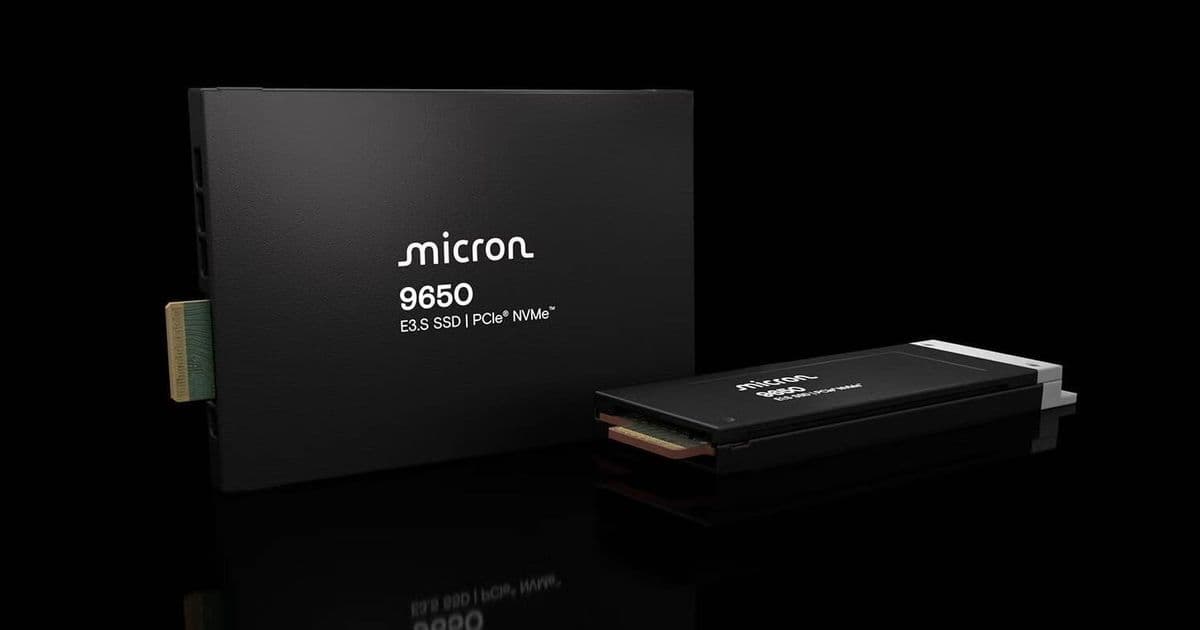
Micron launches its first PCIe 6.0 SSDs with 28 GB/s speeds, but they're designed for AI datacenters, not consumer laptops or desktops.
Micron has begun mass production of its first PCIe 6.0 solid-state drives, marking a significant leap in storage performance with sequential read speeds reaching up to 28 GB/s. However, consumers hoping to upgrade their personal computers with these blazing-fast drives will face a long wait, as the new SSDs are designed specifically for AI datacenters rather than home use.
Enterprise-Only Performance
The new Micron 9650 SSD represents a substantial performance improvement over previous generations. With sequential read speeds roughly double those of last-generation PCIe 5.0 drives, the 9650 achieves its impressive throughput by leveraging PCIe 6.0's doubled effective bandwidth per lane. Sequential write performance reaches a still-respectable 14 GB/s, while random read and write operations hit between 900,000 and 5.5 million IOPS.
These specifications translate to real-world benefits for AI workloads. High-speed storage has become a critical bottleneck in AI datacenters, particularly for offloading key-value caches that serve as models' short-term memory. This capability enables better interactivity during extended AI sessions, making the 9650 an attractive option for organizations building AI infrastructure.
Form Factors and Power Efficiency
Micron offers the 9650 in both air and liquid-cooled E1.S and E3.S form factors, with capacities ranging from 7.68 to 30.72 TB. This enterprise-focused approach contrasts sharply with typical consumer drives, which usually range from 1 to 4 TB. The 18-watt power envelope positions these drives squarely for datacenter duty, where thermal management and power efficiency are paramount concerns.
Interestingly, Micron claims the 9650 delivers twice the performance for the same power envelope compared to PCIe 5.0 NVMe drives, but this advantage applies primarily to streaming reads. Write efficiency, measured in bits per watt, shows more modest improvements of only 20 to 40 percent.
The Consumer Catch-22
Despite the impressive specifications, several factors prevent these drives from reaching consumer markets in the near term. First and foremost, there are currently no PCIe 6.0-compatible CPUs available for consumer platforms. While Intel, AMD, and Nvidia plan to release PCIe 6.0-capable datacenter processors later this year, consumer versions face significant delays.
Intel's next consumer-focused Nova Lake generation is expected to support PCIe 6.0, but AMD has not yet announced similar support for its upcoming Ryzen refresh. Even if AMD were to include PCIe 6.0 support, the economics present another barrier. At current memory pricing, a high-capacity PCIe 6.0 SSD could potentially cost more than the CPU itself.
Limited Consumer Need
The absence of immediate consumer applications for PCIe 6.0 extends beyond hardware compatibility. Many consumer use cases simply don't require the additional bandwidth. A single PCIe 4.0 x1 lane suffices for 10 GbE networking, while modern graphics cards increasingly shed lanes. Many new GPUs now connect via x4 or x8 PCIe 4.0 or 5.0 interfaces, as they derive minimal benefit from the full x16 slot bandwidth.
This trend reflects a broader shift in consumer computing, where storage and networking requirements have plateaued for typical users. While enthusiasts and professionals working with massive datasets might eventually benefit from PCIe 6.0 speeds, the technology's initial deployment focuses on specialized enterprise applications where the performance gains justify the investment.
Industry Context
The launch of PCIe 6.0 SSDs comes amid broader industry challenges. Memory supply shortages have driven DRAM prices expected to double in Q1, as AI ambitions push memory fabrication facilities to their limits. Server CPUs and memory components face similar supply constraints, contributing to price increases across the technology sector.
These market conditions suggest that even when PCIe 6.0 becomes available for consumer platforms, the associated costs may limit adoption to high-end systems and specialized applications. The technology's journey from datacenter exclusivity to mainstream consumer availability will likely mirror previous storage technology transitions, requiring both hardware ecosystem development and cost reductions to achieve widespread adoption.
The Micron 9650 represents the cutting edge of storage technology, but its immediate impact will be felt primarily in AI datacenters rather than home computers. As the industry continues to grapple with AI's insatiable appetite for high-speed storage and memory, enterprise-focused innovations like PCIe 6.0 SSDs will play a crucial role in enabling the next generation of AI applications.
Comments
Please log in or register to join the discussion