Microsoft has introduced Pacemaker HA Agent v2 for SQL Server on Linux, offering significant improvements in failover performance, health monitoring, and reliability compared to the previous generation.
What Changed: Evolution of SQL Server HA on Linux
Microsoft has announced the preview release of Pacemaker HA Agent v2, representing a substantial evolution in high availability solutions for SQL Server on Linux platforms. This new version addresses critical limitations of the original agent while introducing architectural improvements designed to enhance reliability and performance.
SQL Server on Linux differs from its Windows counterpart in its approach to high availability. While Windows deployments rely on Windows Server Failover Clustering (WSFC), Linux implementations require an external cluster orchestrator. Pacemaker HA Agent serves as this integration layer, enabling Pacemaker to understand SQL Server health and manage Availability Groups safely.
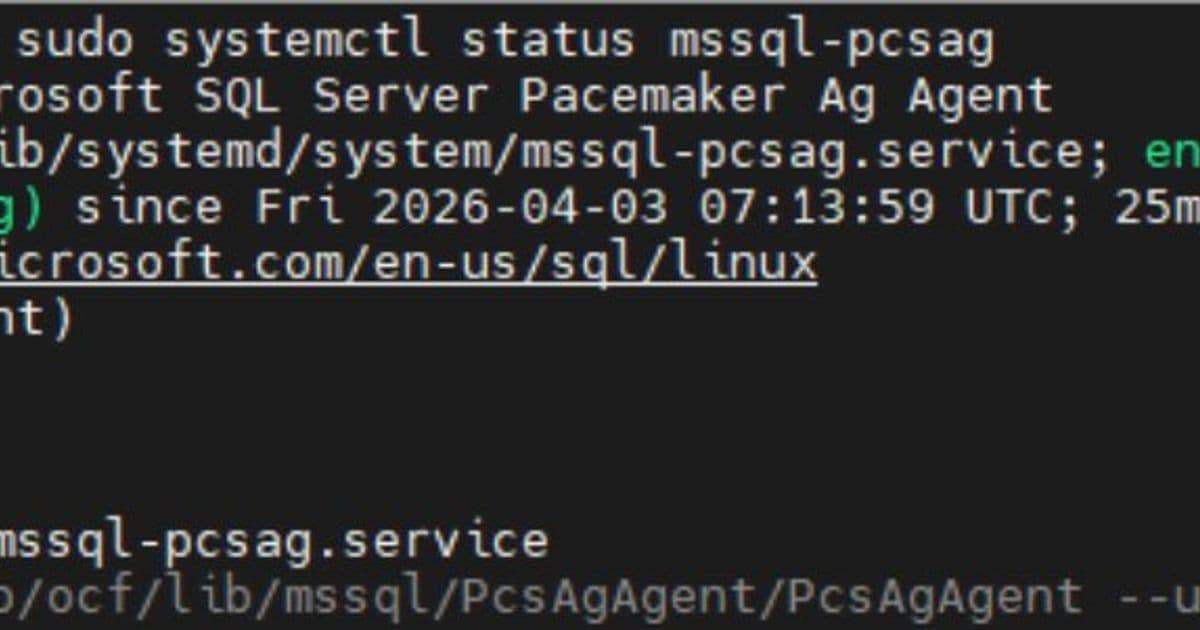
The v2 agent introduces a service-based architecture centered around the mssql-pcsag system service. This dedicated service handles SQL Server-specific high availability operations and communication with Pacemaker, offering administrators more granular control through standard system service management commands.
Provider Comparison: v1 vs. v2 Capabilities
The original Pacemaker HA Agent v1, while functional for basic high availability scenarios, presented several challenges for production environments:
- Extended failover delays ranging from 30 seconds to 2 minutes during planned or unplanned events
- Limited health detection capabilities, missing critical conditions such as I/O stalls and memory pressure
- Rigid failover behavior compared to the flexible policies available in Windows environments
- Incomplete write-lease handling, requiring custom implementations to prevent split-brain scenarios
- Lack of TLS 1.3 support for secure communications between Pacemaker and SQL Server
Pacemaker HA Agent v2 addresses these gaps through fundamental architectural improvements:
Enhanced Health Monitoring: The new agent moves beyond basic polling to implement a service-based health monitoring architecture. SQL Server can now report detailed diagnostic signals, improving detection speed and reducing failover delays in supported configurations.
Flexible Failover Policies: Drawing inspiration from the WSFC health model, v2 introduces failure-condition levels (1-5) and a health-check timeout model aligned with Windows AlwaysOn Availability Groups. This provides administrators with fine-grained control over failover sensitivity and enables detection of internal SQL Server conditions such as memory pressure, deadlocks, and engine-level failures.
Robust Write Lease Handling: The agent now actively evaluates write-lease validity before initiating transitions, supporting controlled role changes and improved data consistency during failover events.
Enhanced Security: Support for TLS 1.3-based communication for health checks and failover operations addresses security requirements for modern enterprise environments.
Business Impact: Strategic Advantages for Linux Deployments
The introduction of Pacemaker HA Agent v2 carries significant business implications for organizations running SQL Server on Linux:
Reduced downtime translates directly to improved service availability and business continuity. The faster failover capabilities minimize disruption during planned maintenance and unexpected failures, providing more consistent performance for applications dependent on SQL Server.
The enhanced health monitoring provides administrators with greater visibility into SQL Server conditions, enabling proactive issue resolution before they escalate to failover events. This diagnostic capability aligns with modern observability practices and reduces the operational burden on database administrators.
The alignment with Windows AlwaysOn Availability Group policies simplifies cross-platform database strategies. Organizations maintaining both Windows and Linux deployments can now implement more consistent high availability configurations, reducing training requirements and operational complexity.
For enterprises with compliance requirements, TLS 1.3 support ensures that SQL Server high availability communications meet current security standards, reducing potential audit findings and security vulnerabilities.
The preview availability for SQL Server 2025 CU3 and later on supported RHEL 9 and Ubuntu 22.04+ platforms allows organizations to evaluate the improvements in non-production environments. The migration path from v1 to v2 involves dropping and recreating the AG resource, a manageable process for most deployments.
As organizations continue to expand their Linux database deployments, enhancements like Pacemaker HA Agent v2 demonstrate Microsoft's commitment to providing feature parity between Windows and Linux SQL Server environments, supporting hybrid and multi-cloud strategies that leverage the strengths of both platforms.
The preview release of Pacemaker HA Agent v2 represents a significant step forward in SQL Server high availability on Linux, addressing critical limitations of the previous generation while introducing capabilities that bring Linux deployments closer to the maturity of their Windows counterparts.
For organizations evaluating the migration, Microsoft provides documentation on creating and configuring Availability Groups for SQL Server on Linux through their official Learn documentation. The preview upgrade guidance offers a clear path for non-production environments to validate the improvements before implementing in critical systems.
As with any preview release, organizations should carefully evaluate the new agent in test environments before production deployment. However, the architectural improvements and focus on addressing real-world limitations suggest that this release will become the recommended approach for SQL Server high availability on Linux platforms.
Comments
Please log in or register to join the discussion