Microsoft unveils DirectStorage 1.4 at GDC 2026, adding Zstandard compression support and the Game Asset Conditioning Library to improve game asset streaming performance on Windows PCs.
Microsoft used its DirectX "State of the Union" session at GDC 2026 to introduce DirectStorage 1.4, the latest update to its storage API designed to accelerate game asset streaming on Windows PCs. The headline feature is support for Zstandard (Zstd) compression, alongside a new toolset called the Game Asset Conditioning Library, or GACL.
(Image credit: Microsoft)
Zstandard Compression Arrives for DirectStorage
If you've never heard of Zstd before, don't feel bad; most haven't. Developed at Facebook (now Meta), Zstd is a modern compression algorithm designed to strike a balance between compression ratio and decompression speed. It's already widely used in places like Linux distributions and cloud infrastructure because it compresses data well but also decompresses extremely quickly, which is a very important trait when you're trying to stream gigabytes of textures and geometry off an SSD while a game is running.
So, DirectStorage 1.4 adds native support for Zstd-compressed assets on both CPU and GPU paths, allowing developers to decompress data either on the CPU or through GPU compute shaders. The update does not replace or deprecate Microsoft's earlier GDeflate compression format, which debuted alongside GPU decompression in DirectStorage 1.1. Instead, Zstd simply becomes another supported option for developers building DirectStorage pipelines.
DirectStorage's Mixed Track Record
DirectStorage itself has had a somewhat underwhelming run so far. Despite early demos promising dramatic improvements to loading and asset streaming, only a handful of PC games have meaningfully adopted the technology, and in practice, DirectStorage sometimes improves load times, but it can actually cost a bit of frame rate. The reason is simple: GPU decompression isn't free. When the GPU is spending time unpacking texture data, that's compute time and power budget it can't spend on rendering frames. Since GPU time is usually the most precious resource in a modern game, the benefits of DirectStorage depend heavily on how much spare GPU compute capacity a system has.
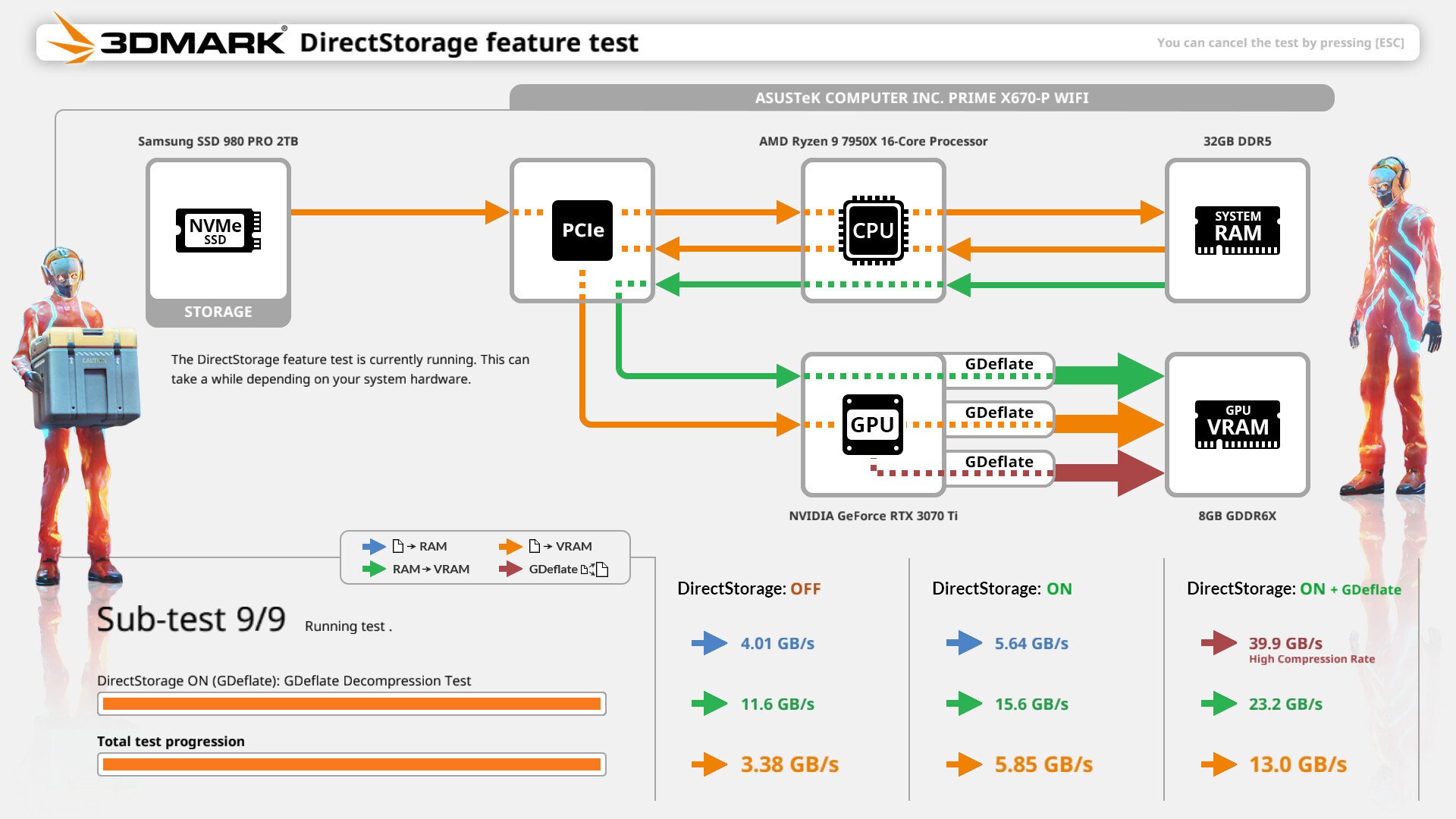
3DMark's DirectStorage Feature Test shows the potential of the tech, but it hasn't really materialized in games yet. (Image credit: 3DMark)
Technical Improvements for GPU Scheduling
Another technical change in the update may help with that. DirectStorage 1.4 adds global D3D12 CreatorID support to the EnqueueRequests function. CreatorIDs allow different GPU workloads to identify themselves to the driver, enabling smarter scheduling decisions when multiple queues are competing for GPU resources. In practical terms, this could help drivers better coordinate DirectStorage decompression work with traditional rendering and compute tasks, reducing the risk that asset streaming workloads interfere with frame rendering.
Game Asset Conditioning Library (GACL)
Arguably, the more interesting addition, though, is GACL, the Game Asset Conditioning Library. GACL is an attempt to standardize the asset pipeline around DirectStorage so developers can ship more compact game data that still streams quickly. Specifically, it's a build-time tool that preprocesses game assets before they're compressed. By reorganizing and transforming asset data using techniques like data shuffling and entropy reduction, it can significantly improve how well the data compresses with Zstd. Microsoft says the conditioning step can dramatically improve compression efficiency for certain asset types while keeping decompression costs low. DirectStorage then reverses those transformations automatically when the data is loaded.
Future Potential for DirectStorage
While DirectStorage hasn't yet transformed PC gaming the way Microsoft once suggested it might, the technology still has potential, particularly for future titles designed around its streaming model from the start. Updates like DirectStorage 1.4, with improved compression support and a more sophisticated asset pipeline, suggest Microsoft is still laying the groundwork for that possibility. We're not holding our breath, but we're not counting the technology out just yet, either.
Comments
Please log in or register to join the discussion