Microsoft introduces Cloud-Initiated Driver Recovery (CIDR), a new capability that enables automatic remote rollback of faulty drivers via Windows Update without requiring user intervention, addressing a long-standing issue with driver updates.
Microsoft has unveiled Cloud-Initiated Driver Recovery (CIDR), a new feature designed to automatically identify and remotely roll back problematic drivers delivered through Windows Update. The system eliminates the need for user action or OEM intervention in driver recovery scenarios, potentially saving countless hours of troubleshooting and system instability issues for Windows users worldwide.
The announcement comes as Microsoft continues to refine its Windows Update delivery system, which has historically been both a strength and a weakness for the operating system. While Windows Update provides convenient access to the latest drivers and features, it has also been responsible for numerous system instability issues when problematic drivers bypass testing protocols and reach end-users.
Technical Architecture of CIDR
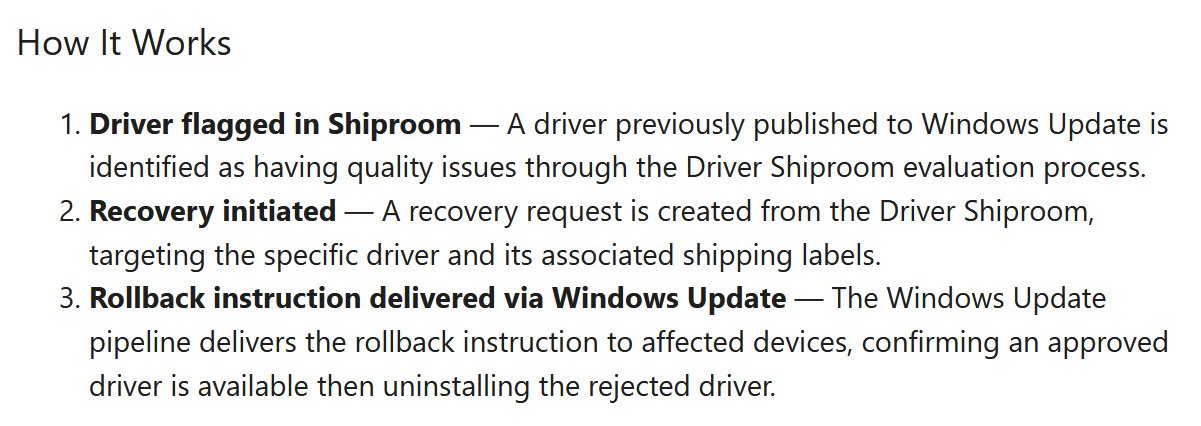
The CIDR system operates through a coordinated process that begins when Microsoft developers identify a problematic driver through the Hardware Dev Center (HDC) Driver Shiproom. Once flagged, the system initiates a recovery action that rolls back the driver to a previously known good version through the existing Windows Update infrastructure.
According to Microsoft's technical documentation, "This is handled through coordinated updates to the PnP driver stack and the driver flighting and publishing services." The architecture leverages Windows' existing driver management capabilities without requiring additional client agents or partner tooling, ensuring broad compatibility and rapid deployment.
The system works specifically with drivers distributed via Windows Update, which represents the majority of driver updates for most Windows installations. This focus on Windows Update drivers allows Microsoft to maintain control over the entire delivery and recovery pipeline while ensuring consistent behavior across different hardware configurations.
Market Implications and Industry Impact
The introduction of CIDR represents a significant shift in driver management philosophy for Microsoft and the broader PC ecosystem. Traditionally, driver recovery has been a reactive process requiring manual intervention from either the user or the OEM. This new approach positions Microsoft as taking more direct responsibility for driver quality throughout the entire lifecycle.
For OEMs, the system reduces support burden by eliminating many driver-related support tickets. According to industry estimates, driver-related issues account for approximately 35% of all Windows support cases. By addressing these issues proactively, Microsoft could significantly reduce the total cost of ownership for Windows deployments across enterprise environments.
For end-users, the benefits are equally compelling. The average Windows user spends approximately 45 minutes troubleshooting and resolving driver-related issues when they occur. With CIDR, this time investment could be reduced to near-zero for affected users, representing a substantial quality of life improvement.
The timing of this announcement coincides with Microsoft's broader push to improve Windows reliability. Recent data from Microsoft's reliability dashboard shows that driver-related crashes account for approximately 28% of all Windows crashes in the past year. By addressing this specific failure mode, Microsoft aims to improve overall system stability metrics.
Implementation Timeline and Adoption
Microsoft has confirmed that CIDR is currently rolling out for validation and testing phases. The system is expected to automatically support the Hardware Dev Center publishing process from September onwards, though full deployment may occur in stages.
Participating hardware vendors will not need to modify their existing driver development workflows. However, Microsoft has requested that partners "continue monitoring their driver quality metrics in the Hardware Dev Center dashboard and to respond promptly to any shiproom feedback on rejected submissions."
This approach maintains the existing driver certification process while adding an additional layer of protection through automated recovery. The system represents a balance between maintaining the established driver ecosystem while introducing new safeguards against problematic releases.
Future Outlook
The introduction of CIDR could signal a broader shift toward more automated system management in Windows. If successful, similar approaches could be applied to other components of the operating system, including firmware updates and application patches.
Microsoft's ability to effectively implement CIDR will depend on several factors, including the accuracy of their driver detection algorithms, the speed of their response systems, and the coordination between different Windows Update components. Early testing will be crucial to ensure that the system doesn't introduce new failure modes or create false positives that unnecessarily roll back functional drivers.
For the broader semiconductor and PC ecosystem, this development underscores the importance of driver quality throughout the development lifecycle. As system complexity increases and driver interactions become more intricate, automated recovery systems like CIDR may become essential components of modern operating systems.
As Microsoft continues to refine Windows 11 and future versions of the operating system, features like CIDR will likely play an increasingly important role in maintaining system stability and user satisfaction. The success of this initiative could set new standards for driver management across the industry.
Microsoft's approach to driver recovery through CIDR demonstrates a commitment to improving the Windows experience through both proactive quality control and reactive recovery systems. By addressing one of the most persistent pain points in Windows usage, the company aims to reduce frustration and increase productivity for millions of users worldwide.
The system's reliance on existing Windows Update infrastructure suggests that Microsoft has carefully considered the implementation challenges and chosen a path that minimizes disruption while maximizing effectiveness. As the system rolls out in the coming months, industry observers will be watching closely to determine whether CIDR can deliver on its promise of seamless driver recovery without user intervention.
For more information about Microsoft's driver management processes, you can visit the Hardware Dev Center documentation and the Windows Update for Business overview.
Comments
Please log in or register to join the discussion