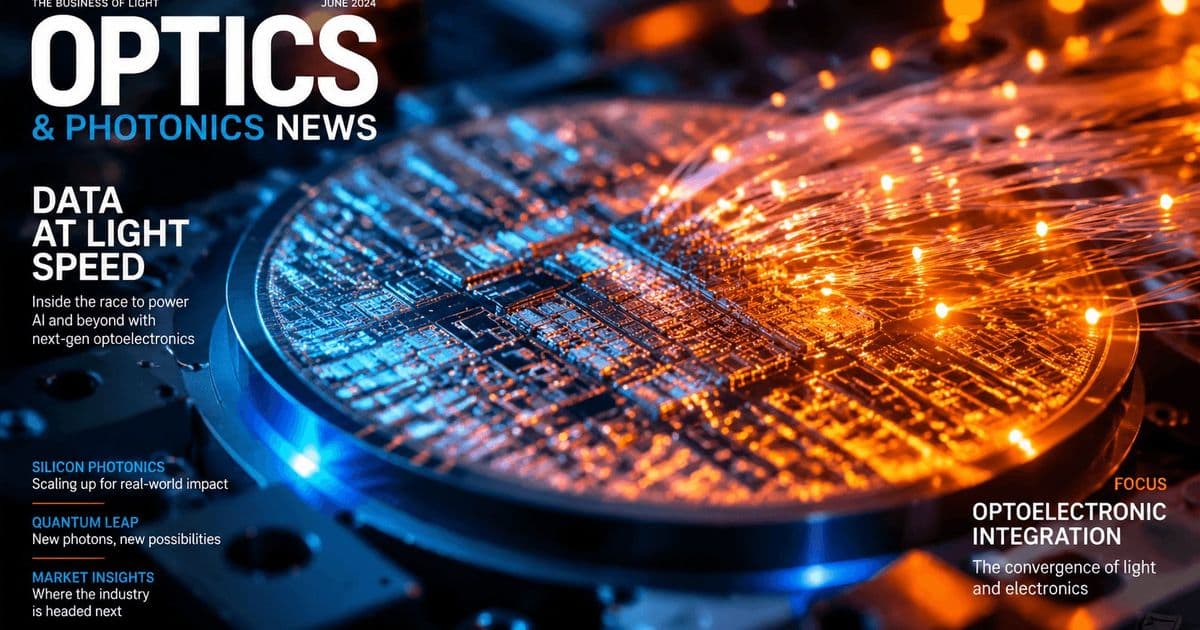
China's industry ministry wants faster R&D on co-packaged optics, all-optical switching, and 800Gbps backbone links. The plan reads less like an AI breakthrough and more like an admission that interconnect and bandwidth, not model architecture, are the binding constraints on large-scale training clusters.
China's Ministry of Industry and Information Technology (MIIT) has published the "AI + Information Communication" Innovation Development Implementation Opinions (2026-2028), a three-year policy document that pushes for accelerated work on high-end optoelectronic chips, co-packaged optics, and faster backbone transmission networks. The framing is AI, but the substance is plumbing: the components and links that move data between and inside computing clusters.
What's claimed
The document spans the full stack from individual chips to national network architecture. At the component level it names high-speed optoelectronic chips, high-speed forwarding and switching chips, all-optical switching devices, and co-packaged optics (CPO). MIIT calls for technology demonstration and validation projects plus pilot trials for hybrid optoelectronic networking.
On infrastructure, the plan mandates deployment of 400Gbps and 800Gbps backbone transmission, optimization of data channels between China's eastern, central, and western national hub nodes, and rollout of metropolitan 400Gbps systems with all-optical cross-connect technology. There is also language about wide-area lossless networks, task-based scheduling, and AI-powered network operations and maintenance agents, with the stated goal of cutting per-bit bandwidth costs and building metropolitan millisecond-level low-latency computing access.
This is policy, not product. MIIT is setting direction and signaling where state-backed funding and procurement attention should go, not announcing shipping silicon. That distinction matters for reading any of these targets.
What's actually new
The interesting part is the emphasis on co-packaged optics and photoelectric interconnect for AI supercomputing clusters. This tracks a real shift happening across the industry, not just in China.
The problem CPO addresses is concrete. In a conventional design, the optical transceiver that converts electrical signals to light sits on the faceplate of a switch, and electrical traces carry the signal from the switch ASIC across the circuit board to that transceiver. At 800Gbps and above, pushing electrical signals even a few centimeters across a board burns significant power and degrades signal integrity. Co-packaged optics moves the optical engine into the same package as the switch or accelerator chip, shrinking the electrical path to millimeters. The payoff is lower power per bit and higher bandwidth density. For a training cluster where thousands of accelerators need to exchange gradients constantly, interconnect power and bandwidth are first-order costs, not afterthoughts.
The mention of all-optical switching and all-optical cross-connect points the same direction. Keeping data in the optical domain instead of repeatedly converting back to electrical signals at each hop saves power and latency. Google has publicly described using optical circuit switches in its TPU pods for exactly this reason, so the underlying engineering case is well established.
What is genuinely notable here is that the policy treats the network as the bottleneck. The framing of "wide-area intelligent computing" and improving scheduling between clusters reflects China's east-to-west computing strategy, where data centers are placed in the energy-rich western regions while demand concentrates in the east. That geographic split makes long-haul, high-bandwidth, low-latency transport a strategic dependency rather than a convenience.
Limitations
The gap between a policy target and working hardware is large, and CPO is a good example of why. Co-packaged optics has been demonstrated by Broadcom and others, but volume manufacturing faces real obstacles: thermal management of optics sitting next to a hot ASIC, the difficulty of repairing or replacing a failed optical engine that is now soldered into an expensive package, and yield on assembly. These are the reasons CPO has stayed mostly in demonstrations rather than displacing pluggable transceivers in production. A government calling for breakthroughs does not dissolve those engineering tradeoffs.
There is also the supply question the document does not address directly. High-end optoelectronic chips depend on photonics fabrication, advanced packaging, and laser sources, areas where the supply chain is global and where export controls have already complicated China's access to leading-edge tooling. "Strengthen R&D" is partly an acknowledgment that domestic capability in these components is not yet where the planners want it.
Finally, the AI-for-network-operations language (the "network operations and maintenance agents" and task-based scheduling) is the vaguest part of the plan. Using ML for traffic engineering and anomaly detection is real and useful, but it is also the kind of phrasing that gets attached to infrastructure documents because AI is the funding keyword of the moment. Nothing in the released text specifies what those agents would actually do beyond existing telemetry-driven automation.
The through-line is worth keeping in view. The constraint on training ever-larger models has shifted from raw accelerator FLOPS toward how fast you can move data between chips, racks, and sites. MIIT's plan is a national-scale bet on that being the durable bottleneck. Whether the optoelectronic component targets are met on schedule is a separate and much harder question than whether the strategic read is correct. The official notice is available through the MIIT site for those tracking the specific milestones.
Comments
Please log in or register to join the discussion