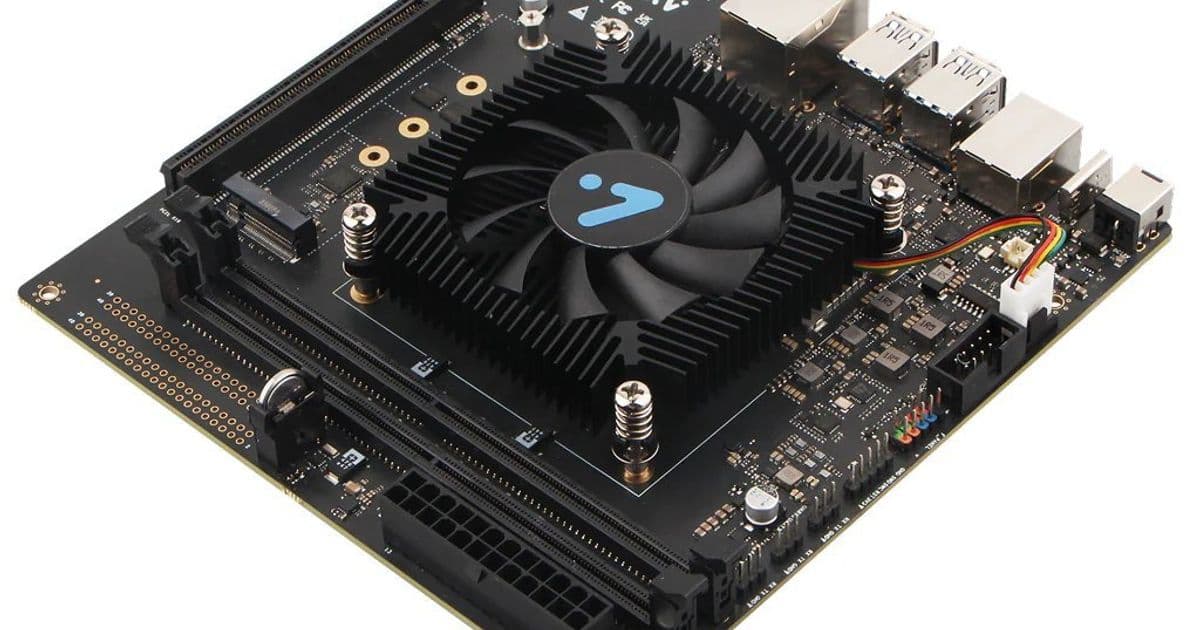
The Milk-V Titan brings RISC-V to the standard desktop form factor with a Mini ITX motherboard featuring an octa-core processor, full PCIe 4.0 support, and enough RAM capacity for serious development work.
The Milk-V Titan represents a meaningful step toward making RISC-V viable for desktop computing. This Mini ITX motherboard measures 170 x 170mm, fitting into standard PC cases, and pairs a UR-DP1000 octa-core RISC-V processor with features you'd expect from conventional x86 boards: PCIe 4.0 x16 slot, support for up to 64GB of DDR4 memory, and M.2 NVMe storage.

The board is now available for pre-order through ARACE at $279 with coupon code ARACE-TITAN, down from the $329 list price. That pricing positions it as a developer tool rather than a consumer product, which makes sense given the current state of RISC-V software support.
Hardware Specifications
The heart of the board is the UltraRISC UR-DP1000 processor, featuring eight CP-100 cores based on the RV64GCBH architecture. Clock speeds reach up to 2.0GHz. According to CNX Software, this chip delivers single-core performance roughly equivalent to a Raspberry Pi 4, with multi-core performance closer to a Raspberry Pi 5. While not bleeding-edge, this represents solid progress for RISC-V.
Memory support is robust: two DIMM slots handle up to 64GB of DDR4-3200 RAM, with ECC support included. That's significant headroom for development environments, virtualization, or memory-intensive applications.
Storage options include a single M.2 connector supporting PCIe 4.0 x4 NVMe SSDs. The PCIe 4.0 x16 slot provides expansion capabilities for graphics cards, AI accelerators, or high-speed networking cards.
Connectivity includes:
- Four USB 3.2 Gen 2 Type-A ports (5 Gbps)
- One USB 2.0 header
- One USB Type-C port for debugging
- One Gigabit Ethernet port
- 24-pin ATX power connector
Platform Considerations
The Titan supports Ubuntu, Debian, and Fedora Linux distributions. This Linux support is crucial for developer adoption, as it provides a familiar environment and access to existing toolchains.
An optional BMC (Baseboard Management Controller) module adds:
- 10/100 Ethernet port
- USB 2.0 port
- microSD card reader
Other features include an RTC socket for CR1220 battery, PWM fan connector, and standard power management.
Developer Impact
For mobile and embedded developers, the Titan offers a unique testing platform. You can develop and test RISC-V code on actual hardware rather than emulation, which matters for performance profiling and low-level optimization.
The standard Mini ITX form factor means you can integrate this into existing development workflows. Use your current case, power supply, and peripherals. The PCIe slot allows for GPU acceleration if you're working on graphics or compute workloads.
However, software maturity remains the primary limitation. RISC-V support in mainstream libraries and frameworks is still evolving. Many projects require source compilation or patches. Container support is improving but not universal. GPU drivers for RISC-V are works in progress.
Cross-Platform Context
This board sits at an interesting intersection between embedded development and desktop computing. For developers maintaining both iOS and Android apps, RISC-V represents a potential future architecture for mobile devices. While ARM dominates mobile today, RISC-V's open licensing model makes it attractive for manufacturers.
Testing on RISC-V hardware now prepares you for potential future platforms. The Titan provides a realistic environment for porting code, testing compatibility, and understanding performance characteristics.
Trade-offs and Realistic Expectations
The Titan is not a replacement for x86 development machines. Performance gaps exist, and software compatibility requires work. But as a targeted development platform for RISC-V, it fills a gap between expensive enterprise hardware and limited single-board computers.
The $279 entry point with pre-order pricing makes it accessible for individual developers and small teams. For organizations exploring RISC-V adoption, it's a low-risk way to evaluate the platform.
Migration Path
Developers interested in the Titan should start with standard Linux development workflows. Most open-source tools compile for RISC-V with minimal changes. The main work involves:
- Testing existing code: Compile and run your applications to identify architecture-specific dependencies
- Performance profiling: Understand how your code performs on RISC-V vs. ARM or x86
- Dependency evaluation: Check if your libraries support RISC-V or need porting
- Container strategy: Verify Docker or Podman support for your workflow
The Titan's standard form factor and expansion capabilities mean you can scale up testing as needed. Add GPUs, storage, or networking without platform constraints.
Availability and Pricing
Pre-orders are open now through ARACE. The $279 price with coupon ARACE-TITAN represents a $50 discount from list price. Actual shipping dates and final specifications may vary, as this is a pre-order for a platform still maturing.
For developers committed to RISC-V or exploring its potential, the Milk-V Titan provides a practical, affordable entry point to real hardware development. Just temper performance expectations and budget time for software integration work.


Comments
Please log in or register to join the discussion