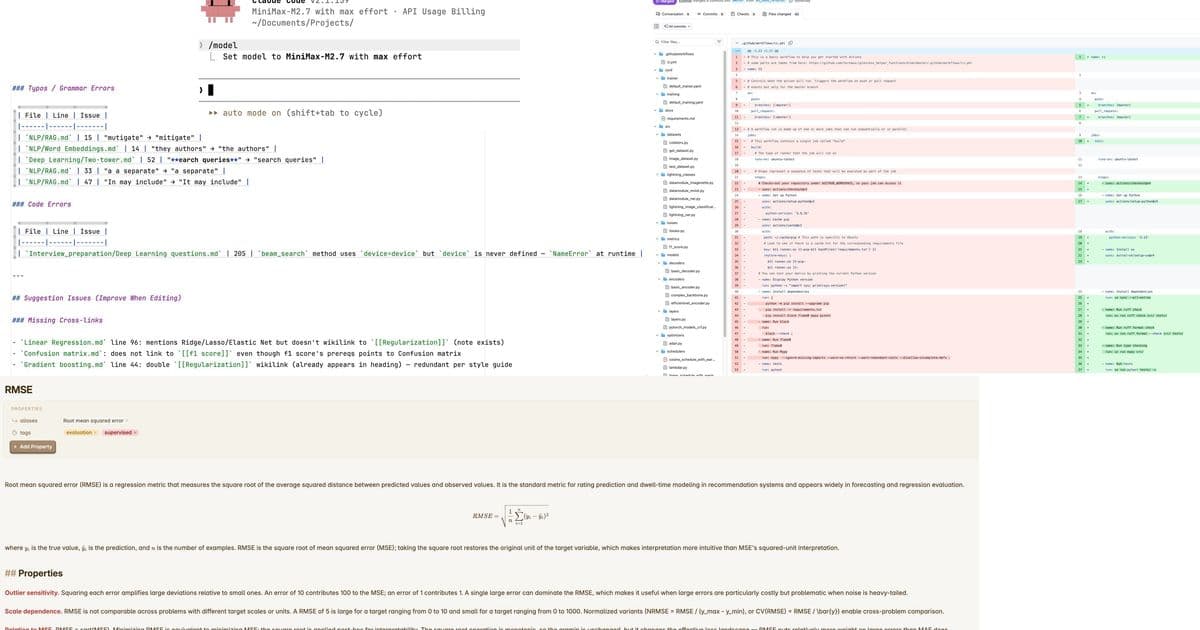
A comprehensive evaluation of MiniMax M2.7 API against Claude Opus 4.7 across three real-world workflows reveals a cost-effective alternative for supervised tasks with explicit constraints, though it struggles with implicit context inference.
The recent emergence of MiniMax M2.7 as a competitive alternative to established models like Claude Opus 4.7 deserves attention from the developer community. This evaluation, based on practical testing across three distinct workflows, provides valuable insights into where this new model excels and where it falls short. The results suggest a nuanced position in the AI landscape—not a replacement for top-tier models in all scenarios, but a compelling option for specific use cases where cost and iteration speed matter.
The testing methodology involved integrating MiniMax M2.7 into Claude Code with a custom configuration that routes API calls through MiniMax's infrastructure. The author used the Plus tier ($40/month) which provides sufficient throughput for multi-step agentic work. This setup allowed for direct comparison with Opus 4.7 on three representative tasks: code refactoring, knowledge base creation, and machine learning competition participation.
The first workflow focused on refactoring an old PyTorch project. M2.7 performed admirably when given explicit, step-by-step instructions. It successfully updated dependencies, modernized tooling, and cleaned up code issues. The model's approach aligned well with developers who prefer supervisory control over their codebases—breaking tasks into small, manageable steps and reviewing each change before proceeding. This granular control represents a significant advantage for developers who remain cautious about fully autonomous code modification.
For knowledge base creation in Obsidian, M2.7 demonstrated solid technical accuracy in first drafts. The model produced well-structured notes with proper formatting and useful visualizations. However, it occasionally made citation errors and occasionally deviated from style guidelines. Notably, when asked to audit existing notes, it found numerous formatting issues but also incorrectly inferred tagging rules that didn't exist in the author's taxonomy. This reveals a pattern: M2.7 performs well when constraints are explicit but struggles when it must infer rules from context.
The Kaggle competition participation highlighted both strengths and limitations. M2.7 effectively created a scaffold for future work, setting up basic validation and starting feature engineering. However, it failed to understand Kaggle-specific mechanics around kernel-only competitions—both it and Opus 4.7 incorrectly used exposed target values in feature engineering. This demonstrates that neither model reliably infers platform-specific constraints unless explicitly stated.
The cost analysis reveals a significant advantage for M2.7. The author estimated that M2.7 usage cost approximately $8 for processing 91M tokens, compared to an estimated $80 for equivalent Opus 4.7 usage. Combined with faster response times (subjectively around 2x), this creates a compelling case for M2.7 in scenarios requiring rapid iteration.
Counter-perspectives emerge when considering open-ended tasks. The author notes that for open-ended ML competition strategy or reference-heavy technical writing without verification, M2.7 falls short. The same prompts that caused issues for M2.7 also challenged Opus 4.7, though Opus performed better in inferring missing constraints. This suggests that while M2.7 offers impressive cost efficiency, it may not yet replace more advanced models in complex, ambiguous scenarios.
The evaluation reveals an important insight about the relationship between model quality and harness design. Many failures stemmed from prompts that didn't explicitly state constraints, causing the model to fill gaps with plausible defaults. This highlights that effective AI workflows depend on both model capabilities and careful prompt engineering.
Looking at the broader landscape, MiniMax M2.7 represents a significant step forward in making advanced AI capabilities more accessible through cost-effective pricing. The testing suggests it's particularly well-suited for supervised workflows with explicit evaluation criteria and concrete output requirements. As developers continue to integrate AI into their workflows, the trade-offs between cost, speed, and capability will become increasingly important considerations.
The author's conclusion—that M2.7 is the right tool when constraints can be defined but requires supervision when tasks require inferring unstated context—provides a balanced perspective that acknowledges both the model's strengths and limitations. This nuanced evaluation helps developers make informed decisions about when and how to incorporate MiniMax M2.7 into their workflows.
Comments
Please log in or register to join the discussion