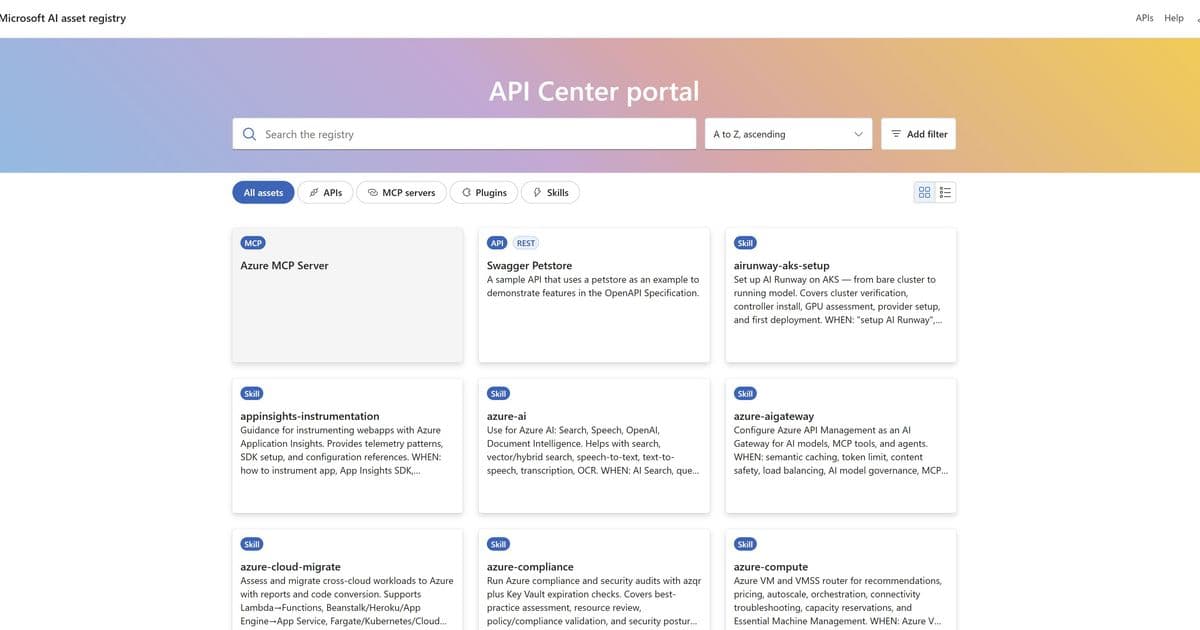
Microsoft's Azure API Center portal now generally available, offering unified discovery and management for APIs, AI assets, and MCP servers across enterprise environments.
Microsoft has announced the general availability of the Azure API Center portal, a significant advancement in enterprise API management that addresses the growing complexity of managing both traditional APIs and AI-native integrations in multi-cloud environments. This release comes as organizations increasingly grapple with the challenge of maintaining visibility and control over their expanding API ecosystems.
What Changed: A Unified Approach to API and AI Asset Management
The Azure API Center portal represents a fundamental shift from fragmented API management approaches toward a centralized, organization-wide view of all API and AI assets. Generally available since May 1st, 2026, this Azure-managed solution provides developers with a single destination to discover, explore, and consume APIs, AI plugins, Model Context Protocol (MCP) servers, and skills.
The platform distinguishes itself through several key capabilities:
AI-assisted semantic search: Beyond basic filtering, developers can use natural language queries to find relevant APIs based on intent rather than exact terminology. For example, searching "Enable cloud migration" surfaces the Azure cloud migration skill and associated MCP server even when these exact terms don't appear in asset names or descriptions.
Rich API details at a glance: The portal provides comprehensive API information including endpoints, methods, parameters, and response formats. Developers can download API definitions or open them directly in Visual Studio Code without leaving the portal.
MCP server discovery and testing: As AI-powered applications become more prevalent, the platform supports discovery of MCP servers, which are essential for modern copilots and agents. Users can browse MCP servers, view details like URL endpoints and tool schemas, and install them directly into Visual Studio Code.
Skills assessment: The portal includes built-in assessment capabilities for skills, providing teams with immediate visibility into the quality and readiness of each skill without requiring additional tooling.
Comparative Analysis: Azure vs. Competitors
In the competitive landscape of API management platforms, Azure's offering distinguishes itself through several key differentiators:
AWS API Gateway vs. Azure API Center: While AWS API Gateway provides robust REST and WebSocket API management, it lacks the integrated AI asset discovery and semantic search capabilities that Azure offers. AWS customers typically need to combine API Gateway with additional services like AWS Lambda for similar functionality, creating a more complex architecture.
Google Cloud API Gateway vs. Azure API Center: Google's solution focuses primarily on RESTful API management with strong integration with Google Cloud services. However, it doesn't provide the same comprehensive approach to AI asset discovery and MCP server management that Azure's platform offers.
MuleSoft Anypoint Platform vs. Azure API Center: MuleSoft provides strong API lifecycle management capabilities but operates as a separate platform requiring separate licensing and integration. Azure's approach is more tightly integrated with the Azure ecosystem, potentially reducing complexity for organizations already invested in Microsoft's cloud services.
Business Impact and Strategic Considerations
The general availability of Azure API Center portal has several significant business implications:
Reduced API sprawl: By providing a unified catalog, organizations can gain better control over their API inventories, reducing the risk of duplicate or inconsistent API implementations.
Accelerated AI integration: The platform's support for MCP servers and skills assessment directly addresses the challenge of integrating AI capabilities into existing systems, potentially reducing development time for AI-powered applications.
Improved developer productivity: The semantic search capabilities and integration with development tools like Visual Studio Code can significantly reduce the time developers spend discovering and understanding APIs.
Enhanced governance: With customizable visibility rules and role-based access control, organizations can ensure that APIs reach the right audiences while maintaining appropriate security and compliance standards.
Migration and Implementation Considerations
For organizations considering adopting the Azure API Center portal, several factors should be considered:
Pricing Model: While the exact pricing wasn't detailed in the announcement, the mention of a "Standard plan" for AI-assisted semantic search suggests a tiered pricing model. Organizations should evaluate their needs against potential costs, particularly if requiring advanced AI capabilities.
Integration Complexity: The portal can be deployed with minimal configuration through the Azure portal, but organizations with existing API management solutions will need to consider migration strategies and potential integration points.
Hybrid Deployment Options: The platform supports both Azure-managed hosting and self-hosting options, providing flexibility for organizations with specific security or compliance requirements.
Skill Development Needs: While the platform simplifies API discovery, organizations should assess whether their development teams need additional training to fully leverage the semantic search and MCP server capabilities.
Strategic Recommendations
For organizations navigating the multi-cloud landscape, the Azure API Center portal offers several strategic advantages:
Start with a pilot program: Before full deployment, consider implementing the portal for a specific department or project to demonstrate value and identify potential challenges.
Establish API governance policies early: The platform's customizable visibility rules work best when paired with clear governance policies about API lifecycles, security requirements, and quality standards.
Leverage the semantic search capabilities: Invest in properly tagging and documenting APIs to maximize the value of the AI-assisted search features.
Plan for AI asset integration: As the platform supports both traditional APIs and AI assets, develop a strategy for how these will be managed together to support your organization's AI initiatives.
The Azure API Center portal represents Microsoft's response to the evolving needs of API management in an increasingly AI-driven landscape. By providing a unified platform for both traditional and AI-native assets, it offers organizations a potential solution to the growing complexity of API governance in multi-cloud environments.
For organizations already invested in the Azure ecosystem, the portal provides a natural extension of existing capabilities. For those considering multi-cloud strategies, it offers a compelling option that bridges traditional API management with the emerging requirements of AI application development.
To learn more about implementing the Azure API Center portal, visit the setup documentation and explore the overview of Azure API Center to understand how it can help manage your organization's full API and AI asset inventory.
Comments
Please log in or register to join the discussion