MIT researchers have developed a soft, flexible gel that dramatically changes its conductivity when exposed to light, potentially enabling new human-machine interfaces and soft robotics applications.
MIT engineers have developed a revolutionary soft gel that dramatically changes its electrical conductivity when exposed to light, potentially creating a bridge between rigid electronics and the soft, squishy world of biological systems. This breakthrough in ionotronics—a field that transfers data through ions rather than electrons—could transform everything from wearable technology to human-machine interfaces.
The Challenge of Bridging Electronics and Biology
The fundamental difference between living systems and electronics has long posed a challenge for researchers: biological tissues are soft and flexible, while electronic devices are typically hard and rigid. This mismatch has limited the development of seamless interfaces between humans and machines.
"We've found a mechanism to dynamically control local ion population in a soft material," explains Thomas J. Wallin, the John F. Elliott Career Development Professor in MIT's Department of Materials Science and Engineering. "That could allow a system that is self-adaptive to environmental stimuli, in this case light."
How It Works
The MIT team's innovation centers on a class of materials called photo-ion generators (PIGs). When incorporated into polyurethane rubber, these materials can become up to 1,000 times more conductive upon exposure to light. The researchers developed a method to dissolve PIG powder into a solvent and then use a swelling technique to embed it into the rubber.
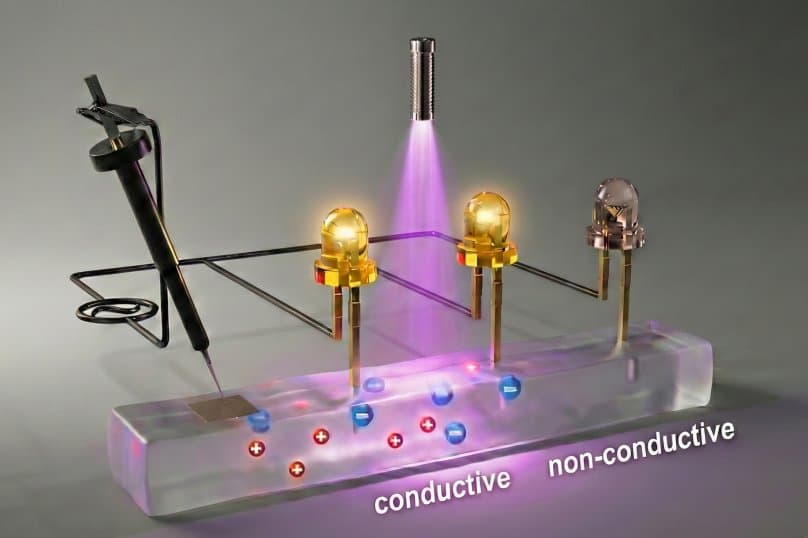
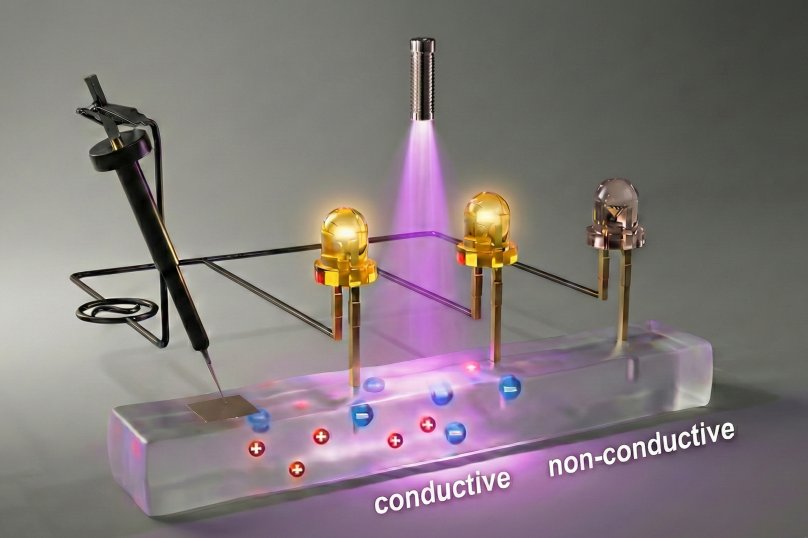
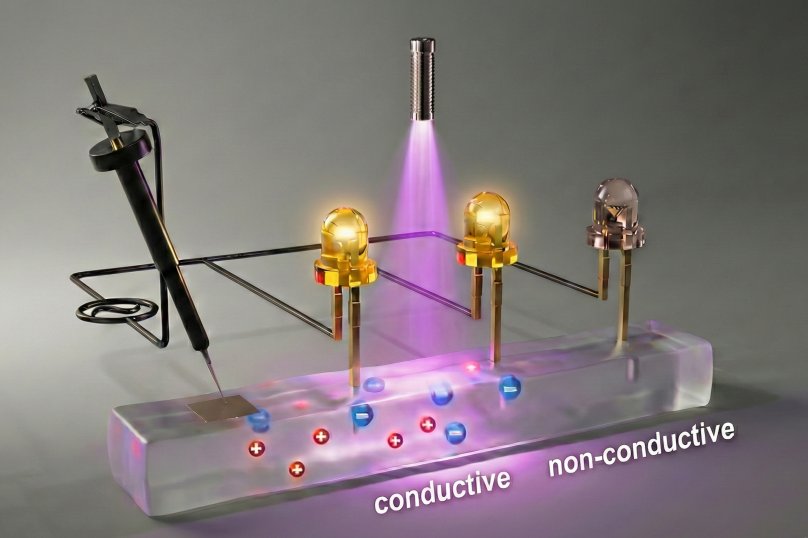
The result is a soft, stretchable circuit that can be selectively activated. As demonstrated in their experimental setup, when light shines on specific areas of the gel, those regions become conductive and can power connected devices—like turning on lightbulbs at designated "stations" along the material. Areas not exposed to light remain nonconductive.
Real-World Applications
This technology opens doors to numerous applications:
Soft Robotics: Robots with soft, adaptive components that can change their electrical properties based on environmental conditions
Wearable Technology: Flexible devices that conform to the body while maintaining electronic functionality
Human-Machine Interfaces: More natural interfaces between biological systems and electronic devices
Biomedical Devices: Biocompatible materials that can interact with living tissue
Adaptive Materials: Self-adjusting systems that respond to environmental stimuli
The Future of Ionotronics
While the current material demonstrates irreversible changes in conductivity, the research team is optimistic about developing versions that can switch back and forth between insulating and conducting states. Xu Liu, first author of the paper and former MIT postdoc now at King's College London, notes that the current work used only one type of PIG, polymer, and solvent—leaving vast potential for optimization.
"We're inspired to do more work in this field by changing the driving force from light to other forms of environmental stimuli," Liu says. "Our work has the potential to lead to the creation of a subfield that we call soft photo-ionotronics."
The team envisions expanding beyond light-responsive materials to develop soft materials that respond to heat, magnetism, or other environmental factors. This could enable entirely new classes of soft machines and adaptive technologies.
Technical Details and Publication
The research was published in Nature Communications in an open-access paper titled "Soft photo-ionotronics." The work was conducted by a team including Thomas J. Wallin, Xu Liu, Steven M. Adelmund, Shahriar Safaee, and Wenyang Pan of Reality Labs at Meta.
This breakthrough represents a significant step forward in the field of ionotronics, which has been growing but faced limitations due to the lack of controllable conductivity in existing materials. By achieving a 400-fold increase in conductivity through light activation, the MIT team has demonstrated a practical path toward integrating soft, biological-compatible materials with electronic functionality.
As the field continues to evolve, this research could lead to the development of soft machines that seamlessly integrate with biological systems, opening up new possibilities in robotics, wearable technology, and human-machine interaction.
For more information about this research, visit the MIT News article or read the full paper in Nature Communications.
Comments
Please log in or register to join the discussion