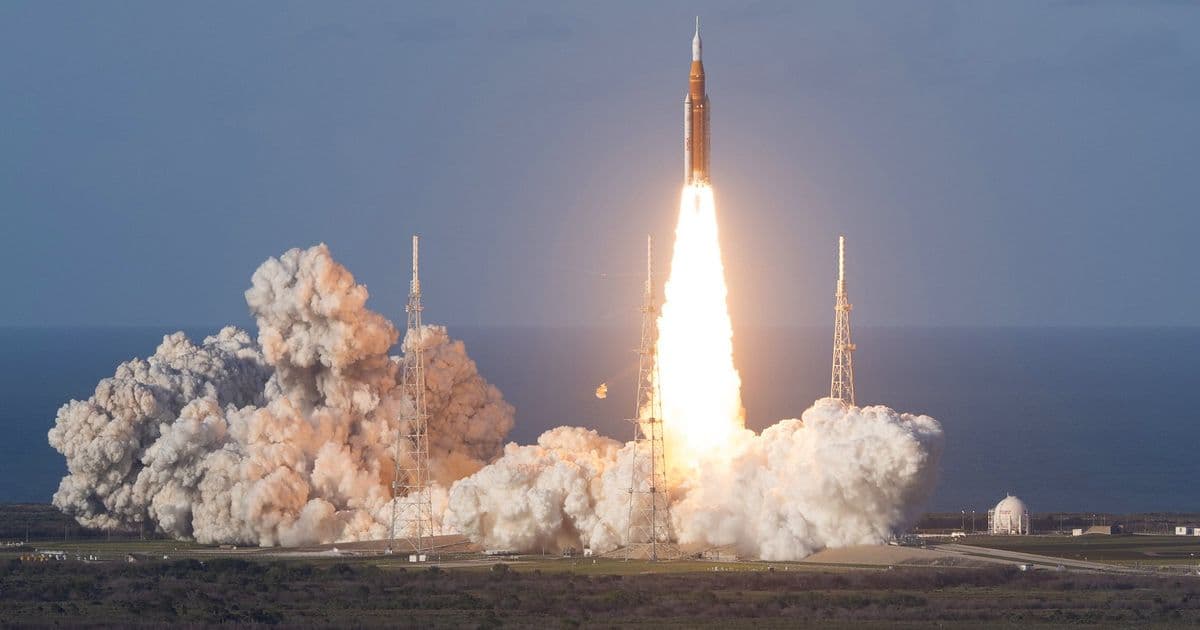
The MAScOT laser communications terminal developed by MIT Lincoln Laboratory in collaboration with NASA Goddard Space Flight Center has launched aboard the Artemis II Orion spacecraft, marking the first use of laser communications on a crewed lunar mission.
The MAScOT laser communications terminal developed by MIT Lincoln Laboratory in collaboration with NASA Goddard Space Flight Center launched aboard the Artemis II Orion spacecraft on April 1 from Launch Complex 39B at NASA's Kennedy Space Center in Florida. Credits : Photo: Joel Kowsky/NASA
In a historic milestone for space communications, the Artemis II mission launched yesterday with four astronauts aboard the Orion spacecraft, marking humanity's return to lunar exploration after more than five decades. As the spacecraft orbits the moon, it will carry a revolutionary optical communications system developed by MIT Lincoln Laboratory in partnership with NASA Goddard Space Flight Center.
This mission represents not only a renewal of human exploration beyond Earth but also the first crewed lunar flight to demonstrate laser communications technologies. The Orion Artemis II Optical Communications System (O2O) is capable of higher-bandwidth data transmissions from space compared to traditional radio-frequency systems, using laser beams to send high-resolution video and images of the lunar surface back to Earth.
"Space-based communications has always been a big challenge," explains Farzana Khatri, lead systems engineer and senior staff member in Lincoln Laboratory's Optical and Quantum Communications Group. "RF communications have served their purpose well. However, the RF spectrum is highly congested now, and RF does not scale well to longer distances across space. Laser communication [lasercom] is a solution that could solve this problem, and the laboratory is an expert in the field, which was really pioneered here."
At the heart of O2O is the laboratory-developed Modular, Agile, Scalable Optical Terminal (MAScOT). About the size of a house cat, MAScOT features a 4-inch telescope mounted on a two-axis pivoted support (gimbal) with fixed backend optics. The gimbal precisely points the telescope and tracks the laser beam through which communications signals are emitted and received in the direction of the desired data recipient or sender. Underneath the gimbal, in a separate assembly, are the backend optics, which contain light-focusing lenses, tracking sensors, fast-steering mirrors, and other components to finely point the laser beam.
MAScOT's architecture, which was recognized with a 2025 R&D 100 Award, made its debut in space as part of the laboratory's Integrated Laser Communications Relay Demonstration (LCRD) LEO User Modem and Amplifier Terminal (ILLUMA-T), which launched to the International Space Station in November 2023. Over the following six months, the laboratory team performed experiments to test and characterize the system's basic functionality, performance, and utility for human crews and user applications. Initially, the team checked whether the ILLUMA-T-to-LCRD optical link was operating at the intended data rates in both directions: 622 Mbps down and 51 Mbps up. In fact, even higher data rates were achieved: 1.2 Gbps down and 155 Mbps up.
"Our success with ILLUMA-T laid the foundation for streaming HD [high-definition] video to and from the moon," says Jade Wang, assistant leader of the Optical and Quantum Communications Group. "You can imagine the Artemis astronauts using videoconferencing to connect with physicians, coordinate mission activities, and livestream their lunar trips."
The implications for future space exploration are profound. "The Orion spacecraft collects a huge amount of data during the first day of a mission, and typically these data sit on the spacecraft until it splashes down and can take months to be offloaded," Khatri explains. "With an optical link running at the highest rate, we should be able to get all the data down to Earth within a few hours for immediate analysis. Furthermore, astronauts will be able to communicate in real-time over the optical link to stay in touch with Earth during their journey, inspiring the public and the next generation of deep-space explorers, much like the Apollo 11 astronauts who first landed on the moon 57 years ago."
A dedicated operations team from Lincoln Laboratory is following the 10-day Artemis II mission from ground stations in Houston, Texas, and White Sands, New Mexico, and even as far as an experimental ground station in Australia, which allows for a better view of the spacecraft from the Southern Hemisphere. Leading up to the launch, the operations team had been making monthly trips to the Houston and White Sands ground stations to perform maintenance and simulations of various stages of the Artemis mission — from prelaunch to launch to the journey to the moon and back to the splashdown at the end of the mission.
"Doing these monthly simulations is important so we all stay fresh and engaged, especially when there is a launch delay," says Khatri, who adds that team members have had the opportunity to meet and speak with the four astronauts several times during these trips.
The Artemis program represents NASA's ambitious plan to travel farther into space and explore more of the moon while creating an enduring presence in deep space and a legacy for future generations. Lessons learned throughout the Artemis II mission will pave the way for humans to return to the lunar surface and beyond, eventually to Mars.
O2O is funded by the Space Communication and Navigation (SCaN) program at NASA Headquarters in Washington. The system was developed by a team of engineers from NASA's Goddard Space Flight Center and Lincoln Laboratory. This partnership has led to multiple lasercom missions, such as the 2013 Lunar Laser Communication Demonstration (LLCD), the 2021 LCRD, the 2022 TeraByte Infrared Delivery (TBIRD), and the 2023 ILLUMA-T.
As humanity prepares to return to the moon, the successful demonstration of laser communications on Artemis II could revolutionize how spacecraft communicate across the vast distances of space, enabling faster data transmission, real-time communication, and the ability to handle the growing demands of deep-space exploration.
Comments
Please log in or register to join the discussion