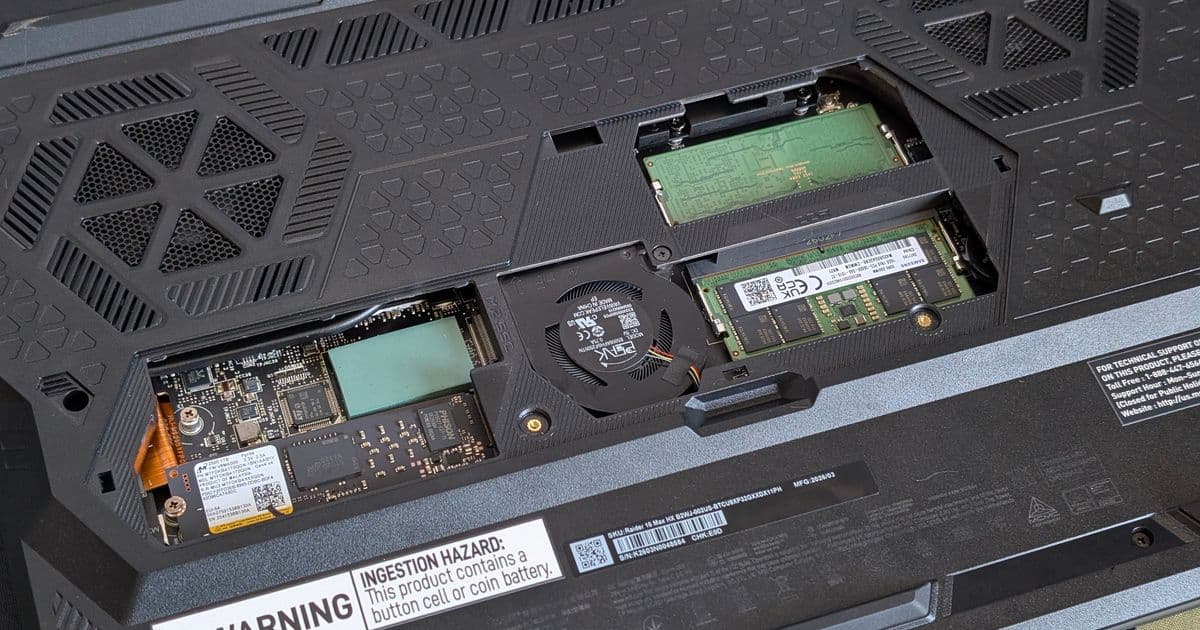
MSI's first 16-inch Raider debuts at CES 2026 with a clever bottom-panel cutout that makes SSD and RAM upgrades a two-screw job. It's a small design choice that solves a problem most gaming laptops still ignore.
The MSI Raider 16 Max HX arrived at CES 2026 as the first 16-inch entry in MSI's Raider lineup, and the more interesting story isn't the chassis size. It's a single access door on the underside that does something most gaming laptops still refuse to do: make upgrades painless.
What's new
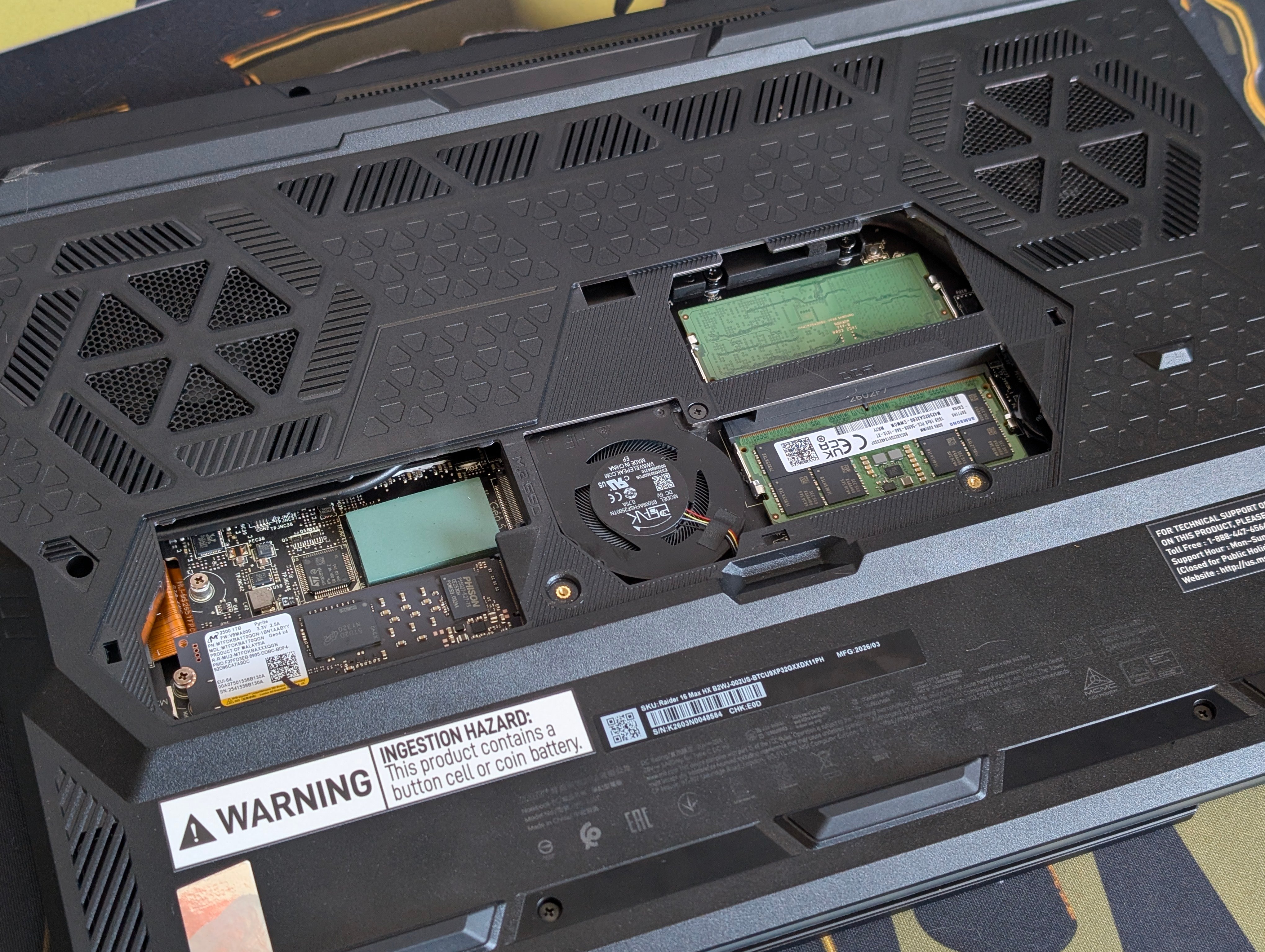
Rather than shrinking the existing 18-inch Raider 18 HX into a smaller shell, MSI built the Raider 16 Max as a separate design. The headline change for anyone who plans to keep a laptop for more than a single GPU generation is the dedicated subpanel cut into the bottom cover. Behind it sit the two M.2 SSD slots and two DDR5 SO-DIMM slots, the components owners are most likely to touch over a machine's lifespan.
On the vast majority of laptops, reaching those slots means removing the entire bottom panel. That involves backing out a dozen or more screws, prying plastic or metal clips that flex and crack if you rush, and often peeling back a warranty seal in the process. The Raider 16 Max replaces all of that with two screws. Loosen them, lift the door, and the storage and memory are exposed.
How it compares
User-serviceable hatches used to be common on bulky desktop replacements a decade ago, then largely vanished as manufacturers chased thinner profiles. Framework brought modularity back into the conversation on the thin-and-light side, but high-end gaming laptops mostly went the opposite direction, gluing batteries down and burying RAM under full-width covers. Against that backdrop, MSI reviving a proper access door on a flagship is the more practical move.
The predecessor Raider 18 HX lacks this feature entirely, so the smaller model genuinely improves on its larger sibling here instead of cutting corners. Compared to most competing 16-inch performance machines from Razer, Asus, and Lenovo, where memory and storage live under the main panel, the Raider 16 Max lowers the barrier for a first-time upgrader who has never opened a laptop before. The smaller the door, the less there is to damage, and accidental cracked clips or stripped screws become far less likely when you're only dealing with two fasteners.
There's a warranty angle too. Older MSI models, like many gaming laptops, shipped with warranty stickers spanning the seam of the bottom cover, and breaking one to install an SSD put coverage in a gray area. The subpanel sidesteps that problem because the main cover stays sealed during routine storage and memory work.
The access isn't total. The subpanel does not reach the M.2 WLAN card, the main Li-Ion battery, or the cooling assembly. Those still require pulling the full bottom panel, though MSI says that cover comes off with relative ease when deeper service is needed. So this is a convenience feature aimed squarely at the two upgrades buyers actually perform, not a fully modular redesign.
Who it's for
This matters most to the buyer who treats a laptop as a platform rather than a sealed appliance. If you expect to start with a single SSD and one stick of RAM, then expand later as prices drop, the subpanel turns a 20-minute teardown into a 2-minute task and removes most of the risk. Anyone nervous about voiding a warranty or snapping a clip gets a much friendlier entry point.
The trade-off is that the Raider 16 Max remains a premium machine, with the HX configuration running over $3,000 and notably skipping Advanced Optimus despite the price. The subpanel doesn't change that calculus on its own. What it does is set an example worth copying. A two-screw upgrade door costs manufacturers almost nothing and saves owners real time and worry, and it's the kind of small, sensible engineering decision more laptops should adopt. Full testing details are available in Notebookcheck's complete Raider 16 Max review.
Comments
Please log in or register to join the discussion