
Nuveen moved internal communications off email and onto Viva Engage, posting 2.5 million impressions across a 3,700-person unit. The case study is less about one company's wins and more about how Microsoft is positioning its Viva suite against standalone collaboration tools, and what that means for organizations weighing where their employee experience stack should live.
What changed
At the Microsoft 365 Community Conference, Nuveen, a TIAA company, walked through a deliberate move away from email-driven internal communications toward Viva Engage, Microsoft's enterprise social and employee communications layer. Dan Mulcahey, VP of Internal Comms, framed it as a strategic shift rather than a tooling swap: email volume was high, open rates were falling, and leaders needed a channel that behaved more like the consumer apps employees already use.
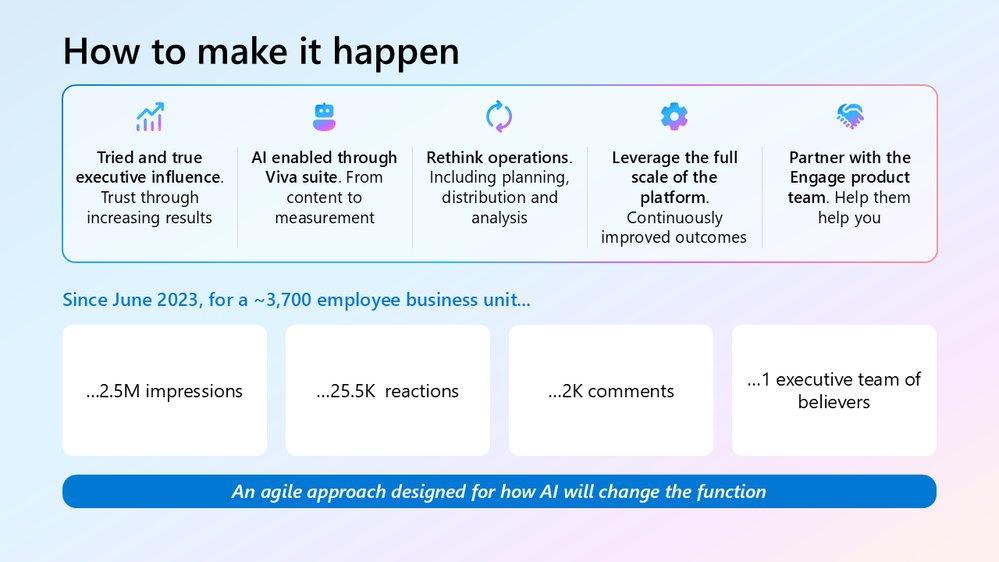
The operational story is straightforward. Nuveen piloted Engage in one business area, proved reach quickly, then expanded to a 3,700-person business unit community, grew to ten more communities, and eventually scaled to the TIAA all-company level. Since June 2023, that single business unit generated 2.5 million impressions, 25.5K reactions, and 2K comments. The team's own summary of the approach was "start small and send wins up the chain."

The detail worth pulling out for anyone planning a similar move is the timing split Mulcahey called out. "We proved the reach first," he said, "but you need patience for the engagement." Distribution metrics move fast because they follow account provisioning and community membership. Genuine participation lags because it depends on content actually being built for the medium. Nuveen's CEO launched a recurring "Fun with Facts" series using humor and short video to make compliance training watchable. Copying email copy into a social feed produces email results in a social wrapper.
Provider comparison
The more useful lens here is where Viva Engage sits relative to the alternatives, because that is the decision most organizations are actually making.
Viva Engage is the rebranded successor to Yammer, now folded into the broader Microsoft Viva suite alongside Viva Connections, Viva Insights, and Viva Learning. Its central advantage is not features in isolation. It is that the data, identity, and licensing already live inside Microsoft 365. For an organization standardized on Entra ID, Teams, and SharePoint, Engage inherits the directory, compliance boundaries, and admin tooling that are already in place. There is no separate identity provider to integrate, no parallel data residency question, and no new vendor contract to negotiate.
The most direct historical competitor, Workplace from Meta, is exiting the market, with Meta winding the product down and pushing customers toward migration by 2026. That retirement has quietly handed Microsoft a large pool of organizations that built internal community programs on a platform now reaching end of life, and Engage is the natural landing spot for any of them already paying for Microsoft 365.
Slack remains the obvious alternative for chat-centric collaboration, but it solves a different problem. Slack optimizes for real-time, channel-based team conversation. Engage optimizes for broadcast-to-many leadership communication with a social feed model: campaigns, storylines, leader corner, and analytics built for communicators rather than engineers. An organization can run both, and many do, but they are not substitutes. The Nuveen case is specifically about the leadership-to-employee broadcast problem that chat tools handle poorly.
On pricing, the economics favor whatever you already own. Viva Engage's core communities and conversations capability is included with most Microsoft 365 commercial suites, while the premium Viva Suite add-on (roughly $12 per user per month at list, often less through enterprise agreements) unlocks advanced analytics, campaigns, and the leadership engagement features. Standalone platforms carry their own per-seat cost on top of the Microsoft licensing an enterprise is likely already paying. For a Microsoft-committed organization, the marginal cost of adopting Engage is frequently close to zero, which reshapes the build-versus-buy math entirely.
Business impact
For a cloud strategy, the Nuveen example illustrates a pattern that goes beyond communications. Microsoft is steadily converting adjacent functions, including employee experience, learning, and analytics, into reasons to consolidate on the Microsoft 365 platform rather than assemble a best-of-breed stack. Each function that moves inside the suite raises the switching cost of the whole environment. Josh Shamansky, Nuveen's CHRO, captured the stickiness directly: "It is hard to remember that we did it any other way."
That consolidation cuts both ways, and it is the trade-off to weigh before following the same path. The upside is real: unified identity, one compliance and eDiscovery surface, shared analytics, and no integration tax between tools. The cost is concentration. Organizations pursuing a genuine multi-cloud or multi-vendor posture should recognize that moving internal communications into Viva deepens dependence on a single provider for yet another business-critical workflow. If a future renewal, a licensing change, or a strategic pivot ever makes leaving Microsoft 365 attractive, the employee communications history, the community structures, and the engagement data all live inside that boundary. Migration off a social communications platform is harder than migration off email precisely because the value is in the accumulated conversation, not the messages themselves.
The practical guidance for teams evaluating this is to separate the two decisions Nuveen actually made. The first was a communications strategy decision: stop treating broadcast email as the primary leadership channel and build content for how employees consume information. That logic holds regardless of vendor. The second was a platform decision to place that strategy inside Microsoft 365, which is the right call for organizations already committed to the suite and a more deliberate bet for those keeping their options open.
Nuveen's phased rollout also offers a transferable migration playbook. Starting in one ready business area, proving reach as the early metric, and using leadership advocacy to spread the model is the same pattern that works for most platform adoptions where success depends on behavior change rather than provisioning. The reach-then-engagement sequencing in particular is a useful expectation to set with stakeholders, who tend to read flat early engagement numbers as failure when they are simply the normal lag of a channel that has to earn its audience.
Microsoft is recapping more of the Engage Track sessions throughout June on the Viva Engage Blog, and the conference materials cover the newer campaign and analytics features that the Nuveen team relied on. For organizations mapping their employee experience stack, the case is worth reading not as a vendor testimonial but as a concrete example of how the consolidation decision plays out in practice, costs and lock-in included.
Comments
Please log in or register to join the discussion