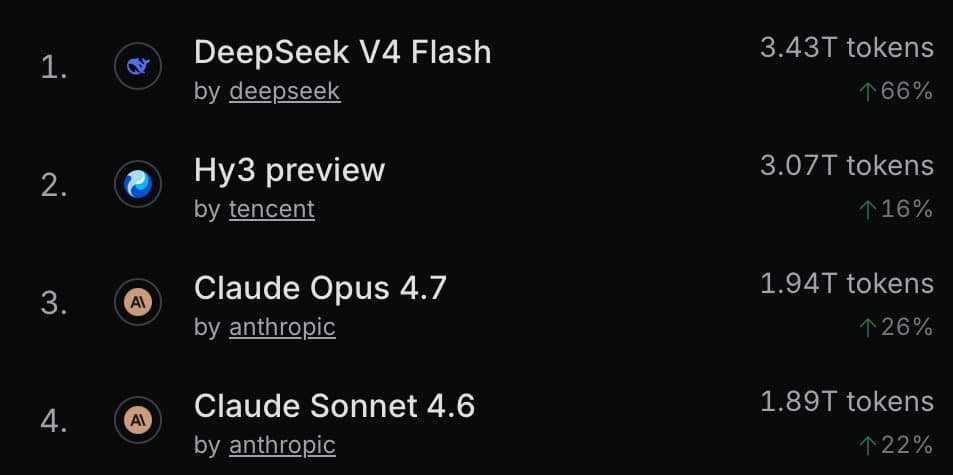
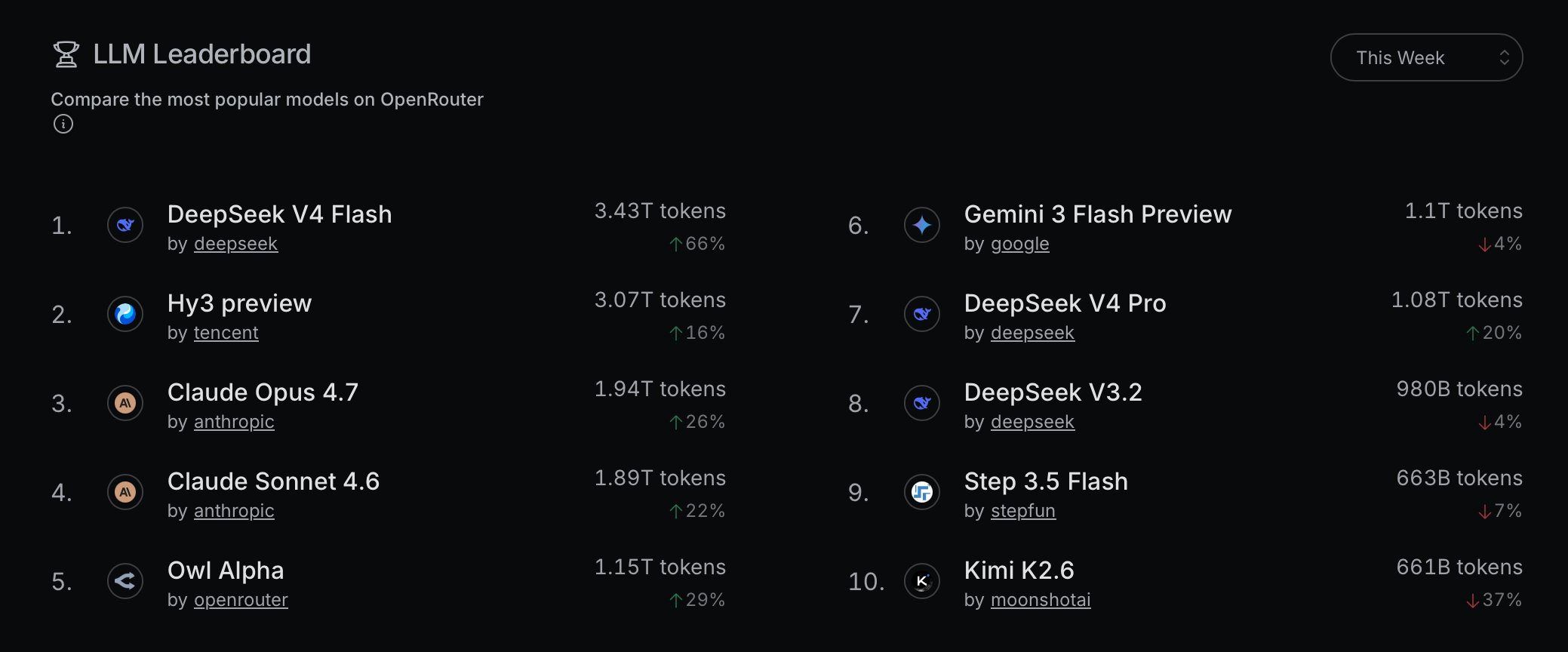
An obscure Chinese LLM called Hy3 preview has unexpectedly topped OpenRouter's model rankings by a significant margin, despite limited documentation and performance benchmarks that don't match its popularity. The mystery deepens when analyzing actual usage patterns and effective pricing.
OpenRouter has emerged as a crucial intermediary in the rapidly evolving LLM landscape, providing developers with unified access to most major language models through a single API. This position gives OpenRouter unique insights into how developers actually use these models, which the company shares through its AI Model Rankings page—a refreshing transparency compared to the typically secretive data practices of the model providers themselves.
Recently, these rankings revealed an unexpected development: two new models have surpassed Claude in token usage by more than 50%. One of these, DeepSeek Flash V4, makes sense as an open-source model that offers strong performance at a low cost point. But the other, Hy3 preview, remains a mystery. A search for information about Hy3 reveals little beyond an announcement from Chinese tech giant Tencent about its open-source release. The Hugging Face model page is notably sparse and includes benchmark results that are unflattering compared to other Chinese open-source models.
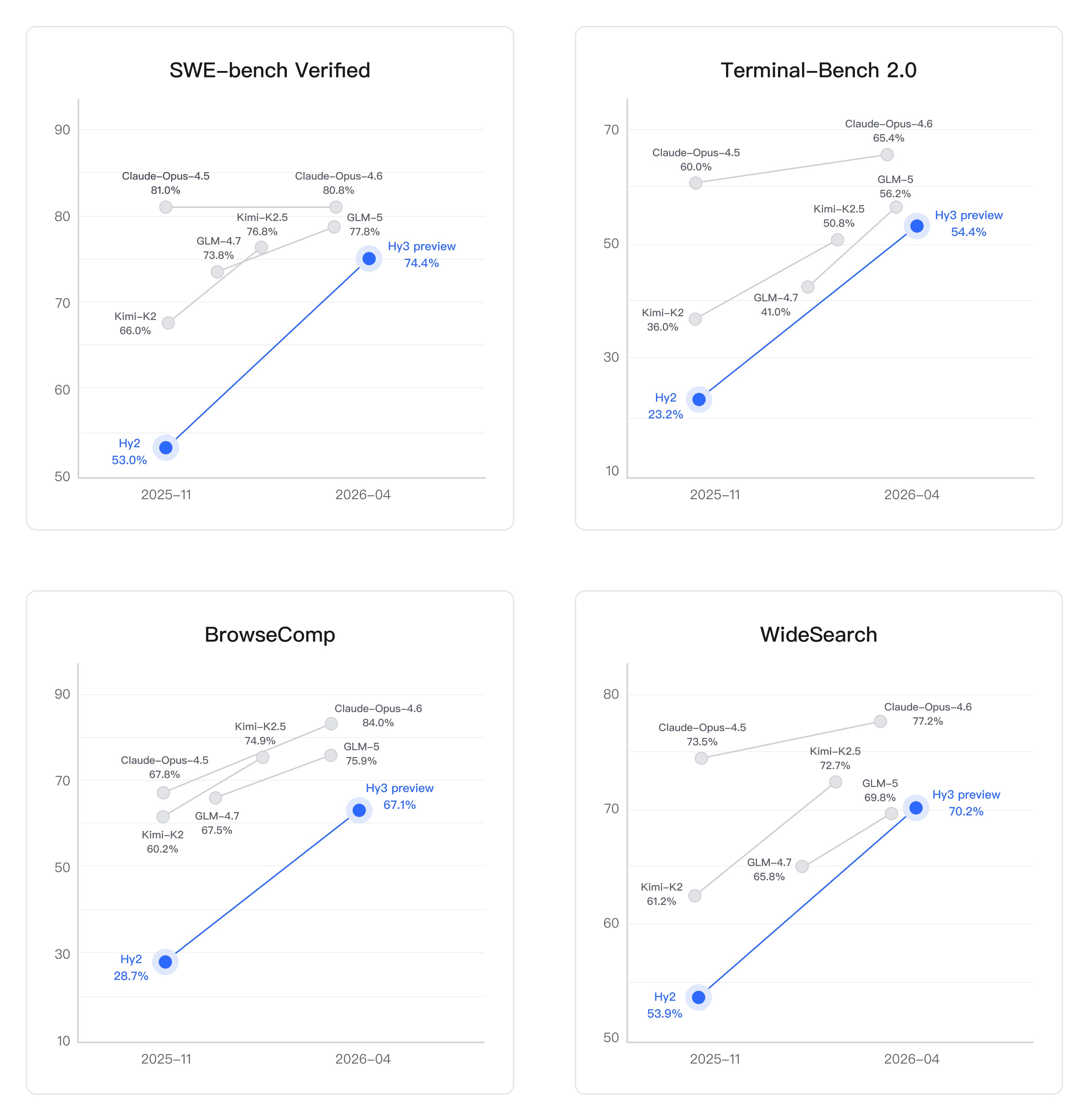
Coding-oriented benchmark results for Hy3 from Tencent's Hugging Face repo.
The lack of public discussion about Hy3 is striking. Hacker News contains virtually no mentions, and Reddit discussions focus primarily on the open-weights release rather than the model's capabilities. One Reddit thread did note Hy3's rise, but traced it back to May 6 when OpenRouter offered the model for free. That free endpoint has since been discontinued, meaning the current rankings reflect usage from paying customers.
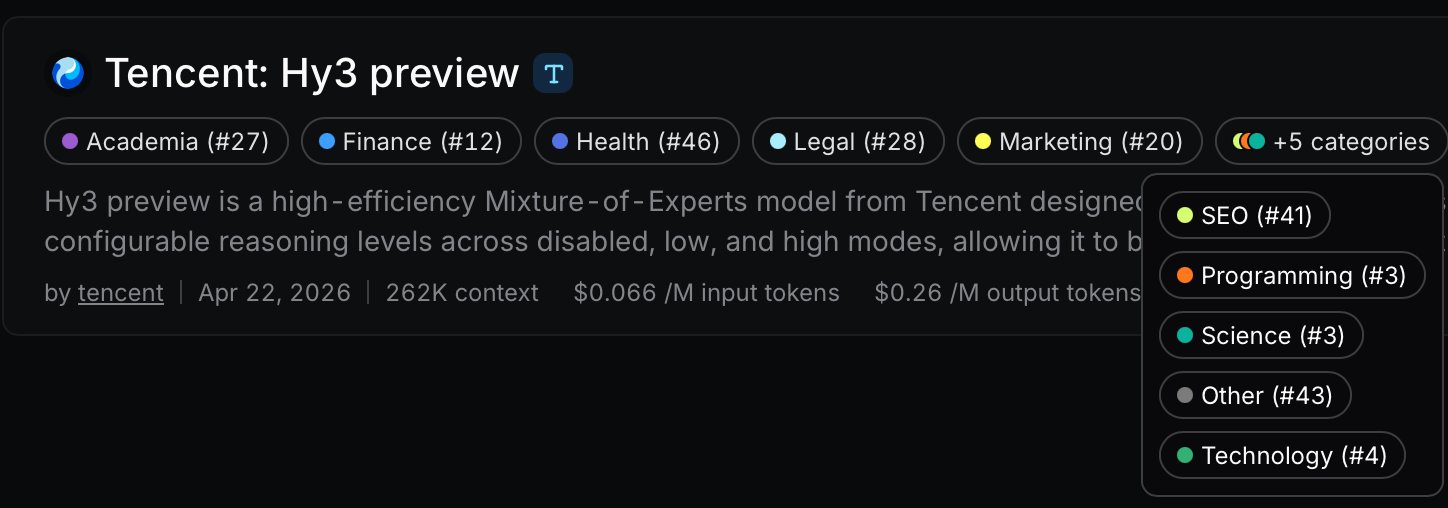
Retrieved May 25, 2026.
After testing the model firsthand, the author confirms that Hy3's quality is comparable to other Chinese models but doesn't approach the performance of leading models like Claude Opus 4.7 or GPT 5.5. This raises the question: what's driving Hy3's unexpected popularity?
Several factors might explain Hy3's position in the rankings. The model is available through OpenRouter at $0.066 per 1M input tokens, making it cheaper than the top-ranked DeepSeek V4 Flash at $0.10 per 1M tokens. In an era of rapidly increasing LLM costs, especially for coding agents, price sensitivity is understandable. However, the quality gap suggests price alone shouldn't account for such a significant lead.
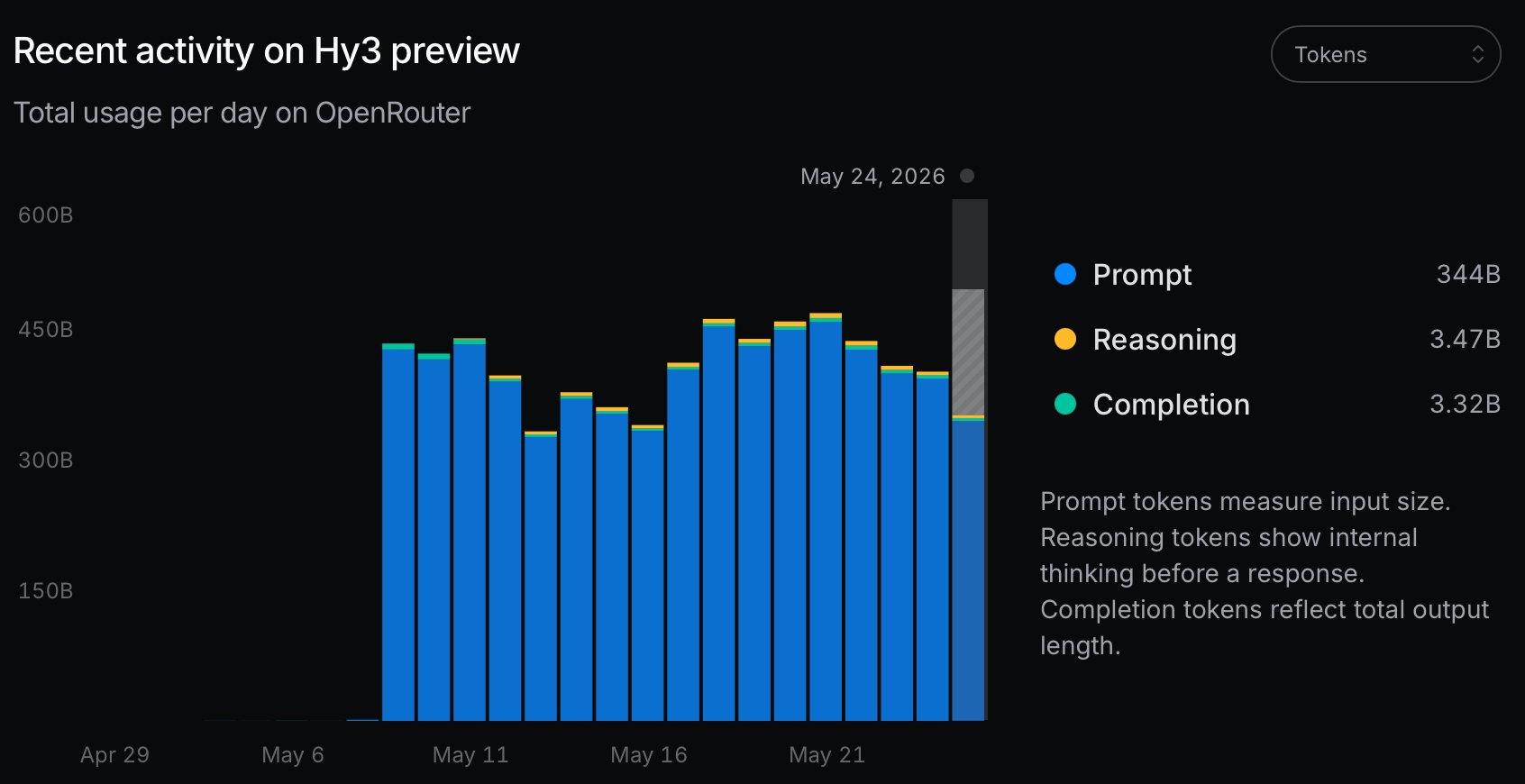
Hy3 preview has no usage data before May 8, suggesting that's when the model transitioned from free to paid. Usage has remained steady since then, indicating organic adoption rather than a temporary spike. Notably, the input-to-output token ratio in LLM API calls is now 98% input, 2% output, reflecting how modern AI applications primarily process large context windows.
Unlike many models that experience popularity spikes when specific applications switch their defaults, Hy3's adoption doesn't appear to be driven by any single app. The top 5 applications account for less than 1% of all activity to Hy3 preview. Instead, the model's popularity appears more distributed across many users.
Another peculiarity is that despite having open weights, Hy3 preview is only available from one provider on OpenRouter: Singapore-based SiliconFlow. This contrasts with DeepSeek V4 Flash, which has 13 providers. SiliconFlow's usage page shows relatively little activity outside of Hy3, suggesting the model is their primary differentiator.
Retrieved May 25, 2026.
The analysis becomes more complex when examining LLM economics, particularly prompt caching. Most providers implement caching to reuse input tokens processed earlier in conversations, which saves both time and compute costs. Cache read costs typically range from 10-50% of input costs, with lower percentages being more advantageous to users.
Here, DeepSeek has implemented a novel caching approach with V4 that gives it a significant advantage. When accessed directly from DeepSeek, the model has a cache read cost of just 2%, resulting in an effective price of $0.018 per 1M tokens—far lower than Hy3's $0.034 effective price when accounting for SiliconFlow's 44% cache read cost.
OpenRouter now provides effective pricing tables that account for cache hit rates, revealing significant discrepancies between stated prices and actual costs. For DeepSeek V4 Flash, effective pricing varies by provider, with DeepSeek itself offering the most economical option at $0.018 per 1M tokens.
This creates a paradox: Hy3 appears to be winning on price, but DeepSeek V4 Flash actually offers better economics when accounting for caching. The author speculates that a single large, unaffiliated application might be using Hy3 as its data-processing backbone, explaining the sustained popularity despite the model's average performance.
Another consideration is that DeepSeek is a China-based company, which may deter some users due to data privacy concerns or legal restrictions. Tencent's Hy3, while also Chinese, might be perceived differently by certain markets.
As the LLM market continues to evolve, particularly in the agentic AI space, pricing strategies will likely become increasingly complex. The unexpected success of Hy3 preview highlights how adoption doesn't always align with technical superiority, suggesting that factors like provider relationships, specific use cases, and market positioning play significant roles in the competitive landscape.
The author predicts that DeepSeek V4 Flash may see a spike in usage as developers become more aware of its superior effective pricing, especially as OpenRouter continues to refine how it presents cost information to users. Meanwhile, the mystery of Hy3's popularity remains a fascinating case study in how the LLM ecosystem actually operates beneath the surface of technical benchmarks and marketing claims.
Comments
Please log in or register to join the discussion