
A passenger information screen on Line 11 of the Paris Metro ditched transit data and ads in favor of an exposed directory listing, the latest reminder that public-facing displays are just web servers waiting to misbehave.
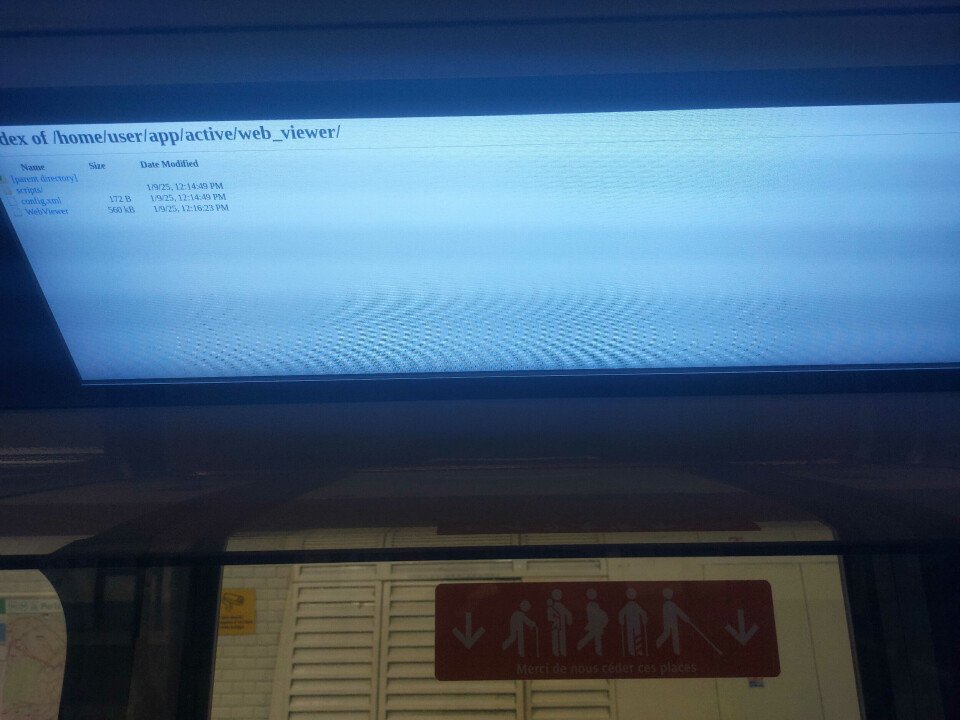
A passenger display aboard a Paris Metro carriage decided to skip the usual transit information and advertising last week, instead treating riders to something far more revealing: a bare directory browser, the kind of file listing you normally only see when a web server has nothing better to show you.
The screen, spotted on a Line 11 carriage at the Châtelet terminus in early June by a Register reader, looked like a classic case of a web server falling over and exposing its internals. Rather than a polished interface telling passengers where they were headed, the display offered up the raw contents of a directory, the digital equivalent of a building with its scaffolding still up.
What actually went wrong
Most modern transit displays are not bespoke hardware running custom software. They are, at heart, networked computers rendering content in a browser or a browser-like shell, pulling layouts and data from a server somewhere on the back end. When that server hiccups, or when the content management layer fails to load the intended page, the system often falls back to whatever the web server will serve by default. If directory listing is enabled and no index file loads, you get exactly what Paris riders got: a plain list of files and folders.
This is a common failure mode, and it is usually harmless to look at, but it points to a configuration worth tightening. Directory listing left switched on means that anyone who can reach the server, or in this case anyone standing on the platform, gets a peek at how the system is organized. File names, folder structures, and occasionally version numbers or asset paths can all leak from a stray listing. None of that is catastrophic on its own, but it is information that a public display has no business broadcasting.
Why it kept happening
The reader who caught the borkage wondered whether a recent heatwave had cooked the hardware, or whether over-enthusiastic football fans celebrating PSG's Champions League win had something to do with it. Line 11 has a reputation for heat that makes even hardened commuters wince, thanks to its older rolling stock and rubber-tired trains, so the thermal theory is not unreasonable. Displays packed with electronics do not enjoy high ambient temperatures any more than the passengers do.
The more likely explanation is simpler. A back-end process failed, nobody rushed to restart it, and the screen sat there displaying its file system until someone got around to it. A quick reboot would almost certainly have cleared it, but a borked display on a metro line rarely jumps to the top of anyone's task list.
Line 11 itself has an interesting history. It was one of the least-used lines on the network until a recent extension gave it new life, and it runs along part of the former route of the Belleville funicular, a street-running cable system that stopped operating just over a century ago in 1924. The line proper was approved in 1935, making it one of the last to be carved through central Paris.
The practical takeaway
For anyone running public-facing displays, the lesson is straightforward. Disable directory listing on the serving host, configure a sensible fallback page so a failed load shows a neutral holding screen rather than the raw file system, and build in a watchdog that restarts the display process when content fails to render. These are small changes that turn an embarrassing public exposure into a quiet, invisible recovery.
The charm of the whole episode is that it is so ordinary. A web server did what web servers do when left to their own devices, and a busy public space briefly became a window into someone's file structure. As the reader who reported it put it, perhaps the train's IT systems simply went on strike, like any good French worker. Whatever the cause, the fix was never more than a restart away.
Comments
Please log in or register to join the discussion