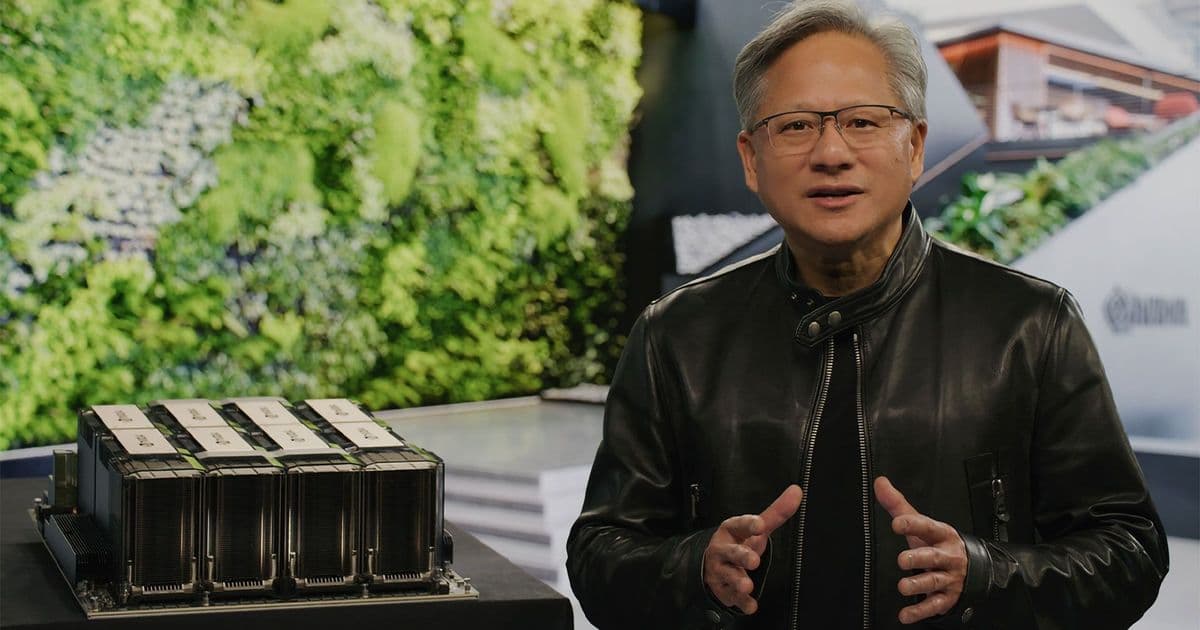
At the World Economic Forum 2026, Nvidia's CEO outlined how AI infrastructure investment will drive unprecedented demand for skilled trade workers, while warning of disruption in white-collar sectors.
Nvidia chief executive Jensen Huang projected that artificial intelligence will create a historic surge in demand for skilled trade workers, positioning construction workers, electricians, plumbers, and network technicians at the center of what he called "the largest infrastructure buildout in human history."
Speaking at the World Economic Forum 2026 in a conversation with BlackRock CEO Laurence D. Fink, Huang described how AI infrastructure requirements are already reshaping labor markets. "We are going to have plumbers, electricians, construction and steel workers, network technicians, and people who install and fit out the equipment," Huang said. "In the United States we are seeing quite a significant boom in [these areas]: salaries have gone up, nearly doubled. We are talking about six-figure salaries for people who are building chip factories or computer factories or AI factories. We have a great shortage in that."
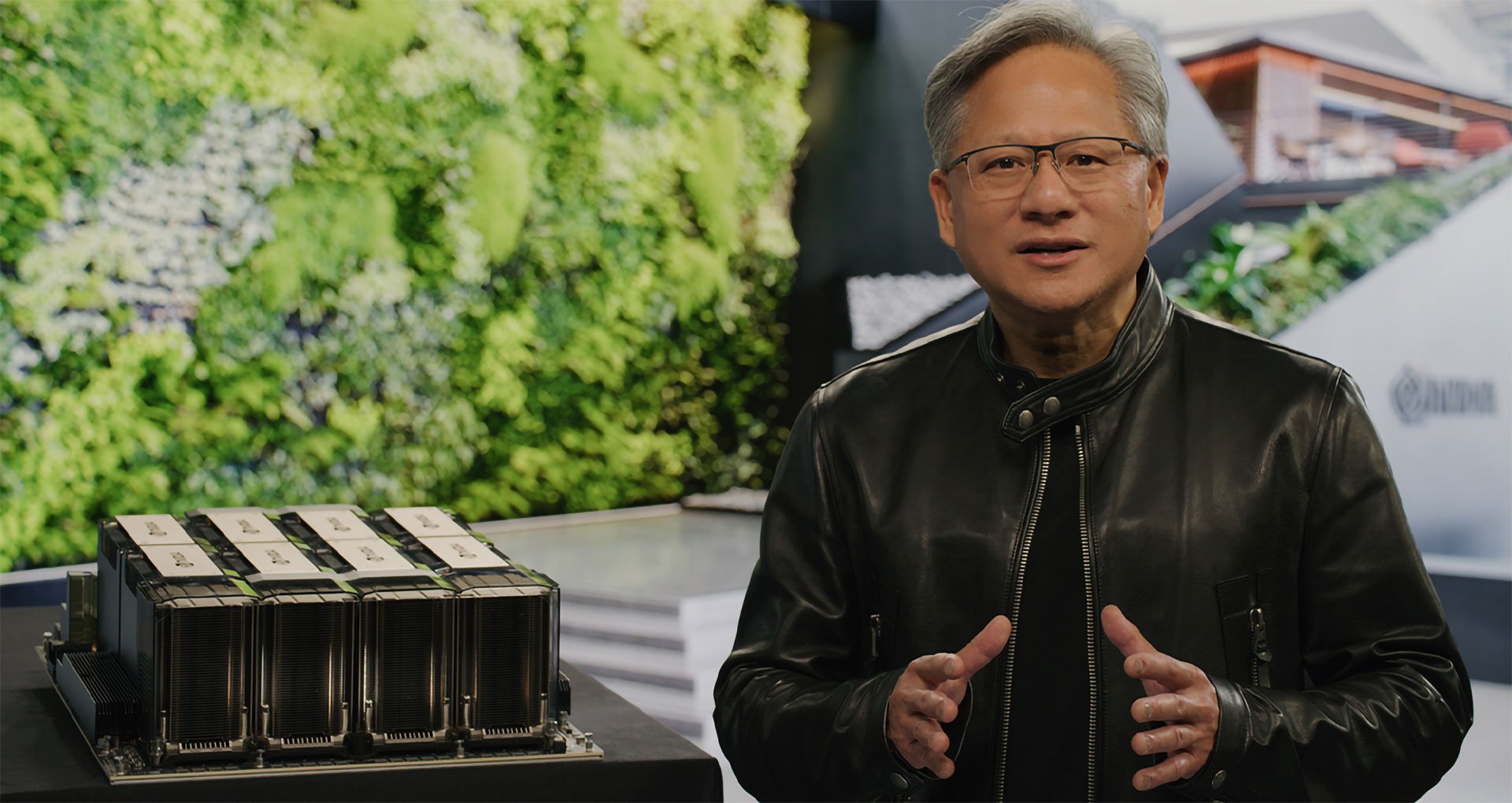
The comments come amid accelerating investment in AI data centers, semiconductor fabrication plants, and supporting infrastructure. Major technology companies and chip manufacturers have announced hundreds of billions of dollars in capital expenditures for new facilities, creating intense competition for skilled tradespeople. The construction of a modern semiconductor fab, for example, requires thousands of workers across dozens of specialized trades, from electricians who install sophisticated power distribution systems to plumbers who handle ultra-pure water delivery and chemical handling.
Uneven Distribution Across Labor Markets
While Huang emphasized opportunities in infrastructure and trades, the broader AI impact on employment remains highly uneven. Anthropic CEO Dario Amodei has warned of a "white-collar bloodbath," predicting AI-enabled automation could eliminate up to 50% of entry-level office positions within five years. Amodei specifically cited coding tasks, where Anthropic's Claude AI has demonstrated capabilities that could displace junior software developers and reduce demand for portions of senior engineering work.
This divergence reflects a fundamental pattern in how AI transforms work. Roles involving physical manipulation of the environment, complex coordination across changing conditions, and direct human interaction remain difficult to automate. Meanwhile, tasks centered on information processing, pattern recognition within structured data, and routine digital workflows face immediate disruption.
Huang pointed to radiology as a case study in how AI integration can increase rather than decrease employment in affected professions. "Ten years ago, one of the first professions that everybody thought was going to get wiped out was radiology," he noted. "The reason for that was that the first thing AI [was] superhuman in capability was computer vision, and one of the largest applications of computer vision is studying scans by radiologists."
Despite AI's ability to analyze medical images faster and more accurately than human radiologists, the profession has grown. Huang explained that AI enables radiologists to spend more time on patient interaction, diagnosis explanation, and collaboration with other clinicians. "The fact that they are able to study scans now infinitely fast allows them to spend more time with patients diagnosing their disease, interacting with the patients, interacting with other clinicians," he said. "As a result of that, the number of patients that the hospital can see has gone up, [driving revenues of hospitals]."
Infrastructure Requirements Drive Specific Skill Demand
The AI buildout requires specialized infrastructure that goes beyond traditional data centers. Modern AI factories need:
Power Distribution: AI accelerators consume massive amounts of electricity, requiring industrial-scale power infrastructure. Electricians must install and maintain high-voltage distribution systems, backup power systems, and sophisticated power management equipment.
Cooling Systems: AI chips generate enormous heat density. Advanced liquid cooling systems, chilled water infrastructure, and thermal management require skilled plumbers and HVAC technicians.
Network Infrastructure: Connecting thousands of accelerators in high-bandwidth, low-latency configurations demands specialized network technicians who can install and configure optical interconnects, high-speed switches, and custom cabling systems.
Physical Construction: Semiconductor fabs and AI data centers require precision construction with cleanroom environments, vibration isolation, and environmental controls that exceed typical commercial building standards.
Historical Context of Technological Transformation
Huang positioned AI's impact as comparable to the cumulative effect of electricity, automobiles, computers, broadband internet, and telecommunications combined, but compressed into a much shorter timeframe. Each previous technological wave eliminated certain jobs while creating others, often in greater numbers. Electricity didn't just replace gas lighting; it enabled entirely new industries and professions. The automobile eliminated horse-related occupations but created manufacturing, maintenance, and transportation jobs on a massive scale.

The key difference with AI is the speed of transformation. Previous technological shifts unfolded over decades, allowing labor markets to adjust gradually. AI's impact is occurring across multiple industries simultaneously, with capabilities improving rapidly year-over-year.
Short-Term Disruption vs. Long-Term Adaptation
Both Huang and Amodei acknowledge significant near-term challenges. Amodei's warning about entry-level white-collar positions reflects concerns that AI could eliminate the traditional pathways through which professionals develop expertise. If AI can handle routine coding, document review, or data analysis tasks that junior employees traditionally performed, how will the next generation gain experience?
Huang's response emphasizes adaptation and new opportunity creation. He argues that AI will augment rather than replace many professions, particularly those requiring physical skills, complex real-world problem-solving, or deep human interaction. The radiologist example demonstrates how AI can free professionals from routine tasks to focus on higher-value activities that require human judgment and interpersonal skills.
Economic Implications
The wage increases Huang cited for skilled trade workers reflect real supply-demand imbalances. Construction wages have risen nearly 100% in some markets, with experienced electricians and plumbers commanding six-figure compensation. This trend is driven by multiple factors: an aging skilled trade workforce retiring faster than replacements enter, decades of emphasis on four-year college degrees over vocational training, and now the sudden surge in infrastructure demand.
For workers considering career paths, the message is clear: physical infrastructure and skilled trades offer growing opportunities, while routine information work faces increasing automation pressure. However, the transition won't be seamless. Geographic mismatches (infrastructure jobs may be in different locations than displaced office workers), skill gaps (retraining takes time), and income disparities (trade wages may not match previous white-collar salaries for some workers) all present challenges.
Looking Ahead
The AI infrastructure buildout shows no signs of slowing. Major chip manufacturers continue expanding capacity, cloud providers are investing billions in new data centers, and supporting industries from power generation to network equipment are scaling up. This construction wave will likely continue for years, creating sustained demand for skilled workers.
At the same time, AI capabilities continue advancing. The next five years will determine whether Amodei's warnings about white-collar displacement or Huang's optimism about job creation proves more accurate. The reality may be both: significant disruption in some sectors alongside robust growth in others, with the net effect depending heavily on how quickly workers can retrain, how effectively AI augments rather than replaces human capabilities, and whether economic policies support smooth transitions.
What seems certain is that the physical infrastructure enabling AI will require human hands to build, maintain, and operate for the foreseeable future. The question is whether the opportunities in construction, electrical work, plumbing, and related trades can absorb workers displaced from other sectors, and whether society can manage the transition without leaving large portions of the workforce behind.
The shortage of skilled trade workers that Huang identified represents both a challenge and an opportunity. For workers willing to enter these fields, the compensation and job security look strong. For the economy as a whole, it suggests that AI's impact may be less about eliminating work and more about shifting where human labor is most valuable—from routine cognitive tasks to complex physical and interpersonal work.
Sources: World Economic Forum 2026, Bloomberg reporting, Anthropic statements, industry labor market data.
Comments
Please log in or register to join the discussion