Nvidia's Blackwell GPUs reportedly deliver 10,000x better path tracing performance than Pascal, with future GPUs aiming for 1,000,000x improvements using AI.
Nvidia's Blackwell GPUs have achieved a remarkable milestone in graphics rendering, with the company claiming they deliver 10,000x better path tracing performance compared to the Pascal architecture from 2016. This announcement came during GDC 2026, where Nvidia's Dev & Performance VP John Spitzer outlined the company's vision for the future of gaming graphics.
The comparison between Blackwell and Pascal represents nearly a decade of graphics technology advancement. The Pascal architecture, which debuted with the GTX 1080 in 2016, was groundbreaking for its time, introducing technologies like simultaneous multi-projection and improved VR performance. However, Nvidia's latest Blackwell GPUs have pushed the boundaries far beyond what was possible a decade ago.
Spitzer's presentation included a chart demonstrating this 10,000x improvement in path tracing capabilities. Path tracing, a rendering technique that simulates the physical behavior of light, has become increasingly important in modern game development as developers strive for photorealistic visuals. The technology traces the path of light as pixels in an image plane and simulates the effects of its encounters with virtual objects.
The AI Revolution in Graphics Processing
What makes Nvidia's claims particularly interesting is the company's assertion that future GPUs will achieve 1,000,000x better path tracing performance through AI-driven optimizations. This ambitious goal comes with a bold statement from Spitzer: "Moore's Law is dead."
The traditional approach to improving GPU performance has relied heavily on hardware advancements - packing more transistors into smaller spaces, increasing clock speeds, and adding more processing cores. However, Nvidia is now betting on artificial intelligence to drive the next wave of graphics innovation.
This AI-centric approach represents a fundamental shift in how graphics processing might evolve. Instead of solely relying on raw hardware power, Nvidia plans to use machine learning algorithms to optimize rendering processes, predict visual elements, and intelligently manage computational resources.
What This Means for Gamers
The implications of these advancements are significant for gamers and game developers alike. If Nvidia can deliver on its promise of film-quality visuals without performance penalties, we could see a new era of gaming where the line between interactive entertainment and cinematic experiences becomes increasingly blurred.
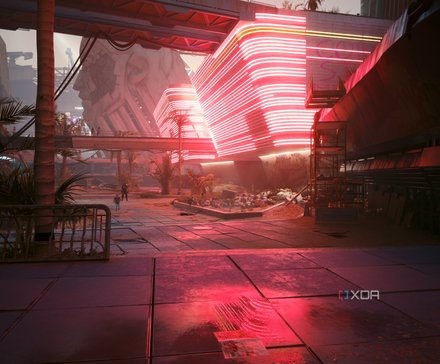
Path tracing has already begun making its way into mainstream games, with titles like Cyberpunk 2077 and Portal RTX showcasing the technology's potential. However, the computational demands of path tracing have often required significant hardware investments and performance trade-offs.
With AI-driven optimizations, Nvidia aims to make these high-quality rendering techniques more accessible and practical for a wider range of hardware configurations. This could democratize access to cutting-edge graphics technology, allowing more players to experience visually stunning games without requiring top-tier hardware.
The Technical Challenges Ahead
While the 10,000x improvement claim is impressive, it's important to understand what this comparison entails. The Pascal architecture was state-of-the-art in 2016, but graphics technology has evolved significantly since then. Modern games have much more complex lighting models, higher resolution textures, and more sophisticated rendering techniques.
The path to achieving 1,000,000x improvement will likely involve several technological breakthroughs. AI algorithms will need to become increasingly sophisticated at predicting and generating visual content, potentially even creating entire scenes or environments based on learned patterns.
Industry Context and Competition
Nvidia's bold claims come at a time when the graphics card market is more competitive than ever. AMD and Intel are both pushing their own innovations in graphics technology, and the race to deliver the best visual experiences continues to intensify.
The company's focus on AI-driven graphics processing could give it a significant advantage, especially as machine learning becomes more integrated into game development pipelines. However, competitors are also investing heavily in AI and machine learning technologies for graphics processing.
Looking Ahead
The journey from Pascal to Blackwell represents more than just incremental improvements - it's a fundamental reimagining of how graphics processing works. As we look toward the future, the integration of AI into graphics processing could transform not just how games look, but how they're developed and experienced.
For developers, this could mean new tools and workflows that make it easier to create visually stunning games. For players, it could mean more immersive experiences that blur the line between reality and virtual worlds. And for the industry as a whole, it could represent a new paradigm in graphics processing that extends far beyond traditional gaming applications.
Whether Nvidia can truly achieve 1,000,000x improvement remains to be seen, but the company's commitment to pushing the boundaries of what's possible in graphics processing is clear. As AI continues to evolve and integrate with graphics technology, we may be witnessing the early stages of a revolution in visual computing that will shape the next decade of digital experiences.
Comments
Please log in or register to join the discussion