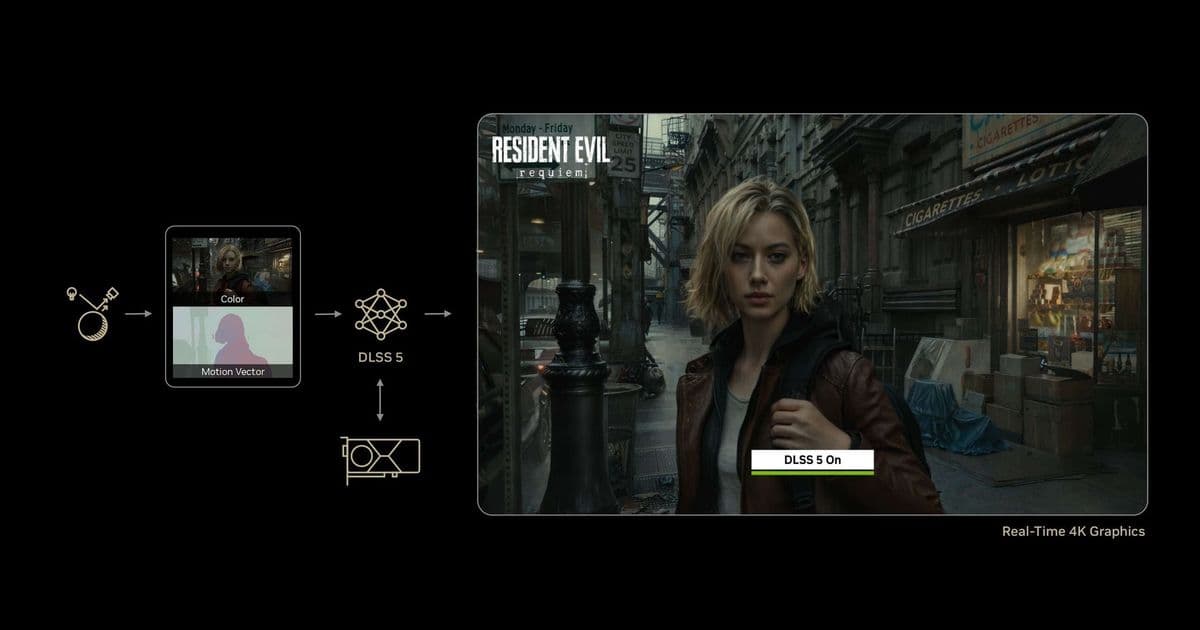
Nvidia's DLSS 5 represents a major leap in neural rendering technology, using AI to enhance lighting, shadows, and character details in real-time games. Our hands-on preview reveals impressive results but also highlights challenges around consistency and hardware requirements.
Nvidia's DLSS 5 neural rendering technology represents a fundamental shift in how real-time graphics are created, moving beyond traditional rasterization to AI-powered pixel generation. At GTC, we had the opportunity to preview this technology in five games, and the results were both impressive and thought-provoking.
The Evolution of Neural Rendering
Neural rendering—using AI models to create pixels—has already become familiar through DLSS upscaling and frame generation. These applications leverage Nvidia's Tensor Cores to generate additional pixels and frames at surprisingly low computational cost. But DLSS 5 takes this concept much further, aiming to replace portions of the traditional graphics pipeline entirely.
Unlike prompt-driven generative AI, DLSS 5 is deeply integrated with game engines and assets. The model is trained to understand how complex scene features like characters, skin, hair, and environmental lighting "should" appear in reality based on game engine inputs including color buffers and motion vectors. This semantic understanding allows DLSS 5 to enhance visual fidelity while respecting the artistic intent embedded in game environments.
Hands-On Impressions
In games like Hogwarts Legacy, DLSS 5 creates noticeably more convincing lighting effects. Students standing before sunlit windows display realistic rim lighting around hair and clothing edges that's absent without the technology. Improved ambient occlusion darkens folds in robes and adds depth to every nook and cranny of Hogwarts' architecture. Even everyday objects like couches appear better integrated into scenes through more accurate shadows.
For games without ray tracing, like Starfield, the improvements are equally dramatic. DLSS 5 adds sophistication to environmental appearances and character faces, transforming the flatly lit, dead-eyed characters into something resembling actual humans rather than aliens wearing human skin suits.
The technology's ability to infer realistic lighting interactions is particularly impressive. In Oblivion Remastered, DLSS 5 correctly casts shadows from flowing hair even when the game's native lighting model fails to do so. Water reflections become more convincing, and spaces under wooden docks and architectural details on bridges and buildings all benefit from enhanced rendering.
The Uncanny Valley Challenge
However, DLSS 5's enhancements aren't uniformly positive. When applied to games with exaggerated or outdated character models, the technology can create unsettling results. The uncanny valley becomes more like an uncanny Grand Canyon when cinematic detail is applied to comically exaggerated facial features. This highlights a crucial philosophical challenge: as the gap between reality and rendering capabilities narrows, artistic consistency becomes even more important.
Nvidia acknowledges these challenges and provides controls for color grading, intensity, and masking to fine-tune DLSS 5's effects. The technology will be toggle-able like previous DLSS features, allowing users to disable it if they prefer the original appearance. The company also notes that while modders could potentially implement DLSS 5 in unsupported games, the results would be their responsibility, not Nvidia's or the developers'.
Hardware Requirements and Performance
During our preview, all demos ran on systems with dual RTX 5090 GPUs—one for the game itself and one dedicated to accelerating the DLSS 5 model. This represents a massive amount of compute power, though Nvidia says performance optimizations haven't begun yet. The company hasn't specified which RTX architectures will be compatible with DLSS 5, leaving questions about accessibility for users without top-tier hardware.
The Road Ahead
Nvidia claims over a dozen games will support DLSS 5 at launch this fall, with that number expected to grow significantly given the widespread adoption of DLSS technology generally. The AI nature of DLSS 5 means it can be continually fine-tuned and improved, similar to how DLSS upscaling has progressed over time.
The technology represents an alternate path forward compared to brute-force increases in compute resources. As AI continues to crowd out leading-edge fab capacity and next-gen gaming GPU silicon becomes less likely to arrive soon, neural rendering offers a way to achieve photorealistic results without requiring exponentially larger dies and power envelopes.
While DLSS 5 isn't perfect yet, it's an exciting glimpse at the future of real-time graphics. The technology's ability to enhance lighting, shadows, and character details while respecting artistic intent suggests a future where the gap between game graphics and reality becomes increasingly narrow. As developers and Nvidia continue to refine the technology, we're cautiously optimistic about the changes expanded neural rendering holds for gaming graphics.
Comments
Please log in or register to join the discussion