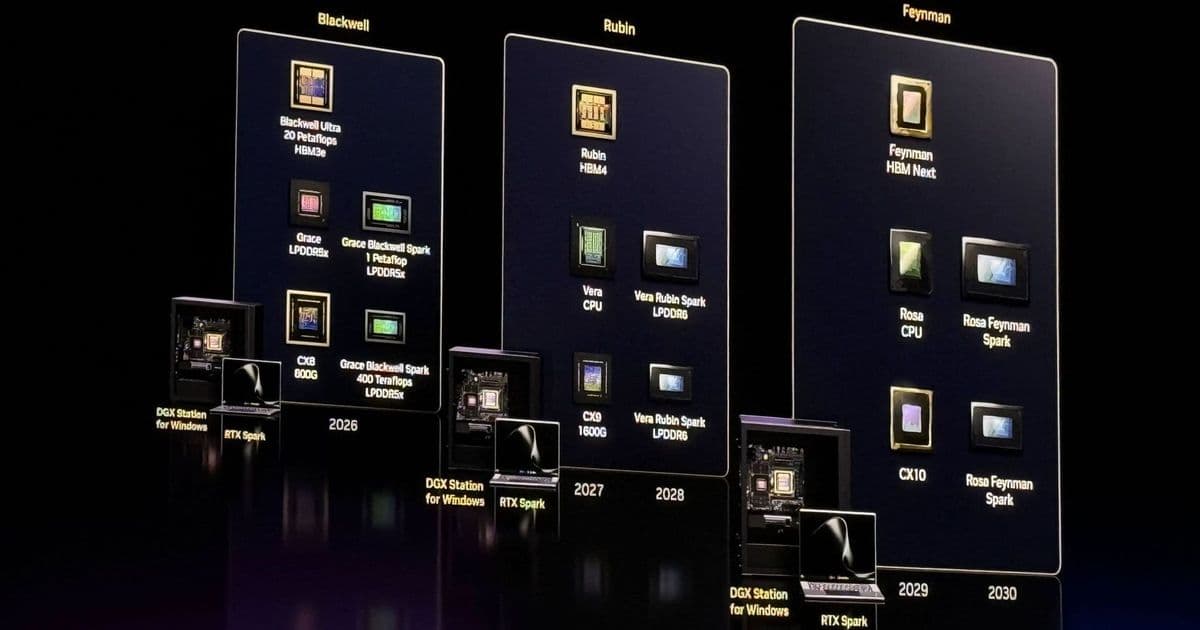
Nvidia has laid out an ambitious three-generation roadmap for its RTX Spark platform, signaling a major commitment to transforming Windows PCs for the agentic AI era with Grace Blackwell, Vera Rubin, and Rosa Feynman architectures.
At Computex 2026, Nvidia CEO Jensen Huang revealed a comprehensive vision for the future of AI computing in Windows PCs, outlining a multi-generational roadmap for the company's RTX Spark platform. The announcement marks a significant strategic commitment from the semiconductor giant to establish a lasting ecosystem for AI-capable computing beyond traditional x86 architectures.
The RTX Spark roadmap spans three distinct generations, beginning with the current Grace Blackwell architecture and extending through future Vera Rubin and Rosa Feynman iterations. This multi-generational approach provides crucial visibility for OEM partners and software developers, addressing a common challenge in emerging computing platforms.
Technical Specifications and Architecture Evolution
The first-generation RTX Spark platform, Grace Blackwell, consists of two main components: the top-end RTX Spark Superchip and a smaller, as-yet-undetailed variant. The Superchip combines a 72-core Grace CPU with 496GB of LPDDR5X memory paired with a Blackwell Ultra GPU featuring 252GB of HBM3e memory. This configuration delivers up to 15 PFLOPS of FP4 performance without sparsity, positioning it as a formidable solution for AI workloads.
Looking ahead, Nvidia has committed to a second-generation Vera Rubin platform that will utilize LPDDR6 memory, representing a significant leap in memory bandwidth and power efficiency compared to the current LPDDR5X implementation. While specific performance figures for the Vera Rubin generation remain undisclosed, the transition to LPDDR6 typically delivers approximately 30% higher bandwidth and 20% lower power consumption compared to previous generations.
The third generation, Rosa Feynman, is planned with an unspecified memory technology that promises even higher performance characteristics. The naming convention suggests Nvidia may continue to honor influential physicists and mathematicians, following the pattern established with Grace Hopper and Vera Rubin.
Supply Chain and Ecosystem Strategy
Nvidia's commitment to at least three generations of RTX Spark platforms addresses a critical concern in the semiconductor supply chain. For OEM partners to invest resources in developing new systems, they require assurance that the platform will have sufficient longevity to justify development costs and product lifecycle planning.
"Building a full product and partner ecosystem is a much larger challenge than simply building and shipping a chip," the article notes, highlighting the complexity of establishing a new computing ecosystem. Nvidia appears to have addressed this challenge through extensive partnerships with major OEM manufacturers and deep integration with Microsoft's Windows platform.
In addition to consumer and prosumer laptops and desktops, Nvidia is developing Windows on Arm-compatible versions of its DGX Station high-performance computing systems. These systems, built around the GB300 Superchip, target the professional AI development market and will also see future generations according to Nvidia's roadmap.
Market Implications and Competitive Positioning
The RTX Spark initiative represents Nvidia's most ambitious effort yet to establish a meaningful presence in the Windows PC market beyond its traditional graphics card dominance. The company positions this as fundamentally different from previous attempts at creating alternative ecosystems to x86 processors, claiming that "RTX Spark can succeed because our full effort is behind this platform and bringing it to market."
While competitors like Apple and AMD have developed similar SoCs with powerful GPUs and large memory pools, Nvidia emphasizes its software foundation as a key differentiator. The company has invested heavily in developing not only hardware but also high-quality open models and the entire underlying stack to run them, creating a comprehensive ecosystem that competitors would need years to replicate.
The timing of this announcement coincides with growing demand for AI-capable computing devices across all market segments. As AI models become more sophisticated and compute-intensive, the need for specialized hardware that can efficiently run these workloads becomes increasingly critical. Nvidia's RTX Spark platform appears designed to address this need specifically within the Windows ecosystem, which has historically been dominated by x86 processors from Intel and AMD.
Performance Considerations and Process Node Evolution
While specific process node details for the RTX Spark chips were not fully disclosed in the announcement, the Grace Blackwell architecture likely leverages TSMC's 4N or 5nm process technology, similar to other recent Nvidia products. The transition to future generations will likely involve process node improvements, potentially moving to 3nm or 2nm technologies, which would contribute to both performance gains and power efficiency improvements.
The memory subsystem represents a key differentiator for the RTX Spark platform. The current implementation's 496GB of LPDDR5X memory provides substantial bandwidth for AI workloads, while the planned transition to LPDDR6 in the Vera Rubin generation will further enhance capabilities. The Rosa Feynman generation's unspecified memory technology could potentially introduce innovations like integrated photonics or other advanced memory architectures that could dramatically increase bandwidth while reducing power consumption.
Industry Impact and Future Outlook
Nvidia's multi-generational commitment to RTX Spark sends a strong signal to the industry about the future direction of AI computing in Windows environments. The company's position as the most valuable company in the world, combined with its leading role in both AI hardware and software, gives it significant influence in shaping this emerging market segment.
The success of the RTX Spark platform will depend on multiple factors, including adoption rates by OEM partners, software developer support, and ultimately, consumer acceptance of AI-enhanced PCs. Nvidia's aggressive roadmap suggests the company is prepared to invest heavily in establishing this new computing paradigm.
As the industry continues to evolve toward increasingly sophisticated AI applications, platforms like RTX Spark may become essential infrastructure for both consumer and professional computing. Nvidia's commitment to multiple generations indicates confidence that AI-enhanced computing represents not just a temporary trend but a fundamental shift in how personal computers are designed and utilized.
The full extent of Nvidia's RTX Spark vision will likely become clearer as additional details emerge during Computex 2026. With the first generation already in development and plans extending to at least Rosa Feynman, Nvidia appears to be positioning itself for a long-term play in the next evolution of personal computing.
Comments
Please log in or register to join the discussion