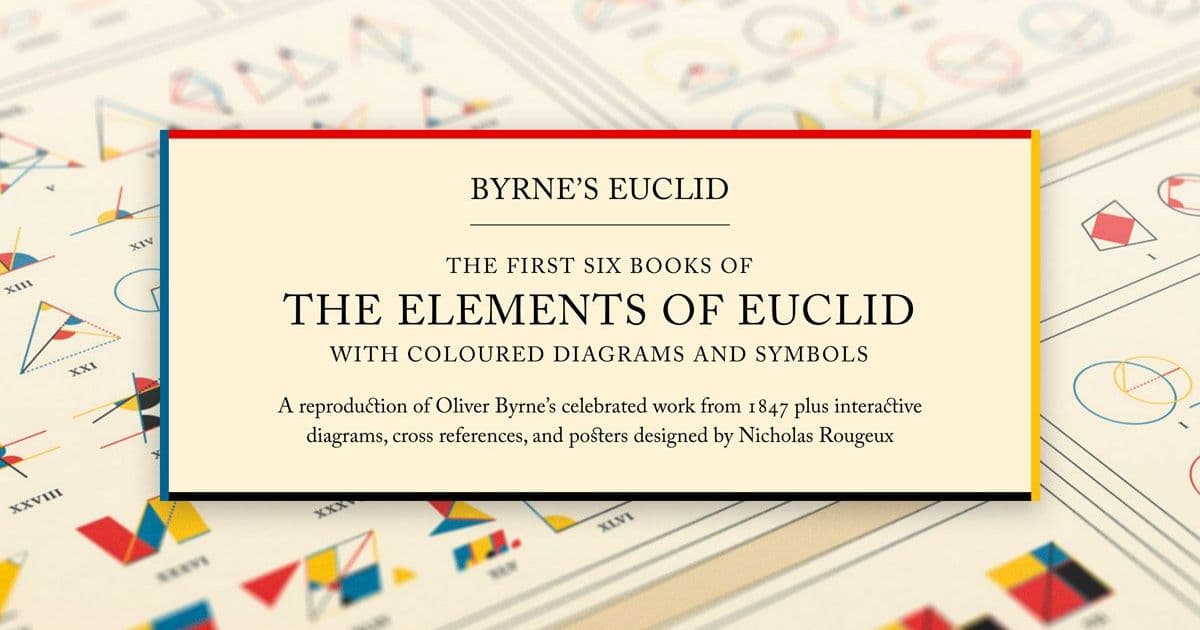
A modern website revives the 1847 illustrated edition of Euclid’s Elements, adding interactive diagrams, cross‑references, and printable posters, sparking both enthusiasm for visual math education and debate over its practical impact.
A bright revival of a historic math classic
The Oliver Byrne edition of Euclid’s Elements, first published in 1847, is famous for replacing the usual black‑and‑white figures with vivid, hand‑colored diagrams and for using symbols instead of prose explanations. A new web project, curated by designer Nicholas Rougeux, brings this landmark work into the digital age with interactive diagrams, cross‑references, and printable posters. The site lets users explore the first six books—plane geometry, geometric algebra, circles and angles, regular polygons, ratios and proportions, and geometric proportions—through a blend of historical fidelity and modern usability.
Community sentiment: excitement for visual learning
Among educators and hobbyist mathematicians, the reaction has been largely positive. Threads on the r/math subreddit and the Math Stack Exchange highlight how the colored diagrams make abstract concepts more approachable for high‑school students. A teacher on Twitter (now X) wrote, “My class finally sees Euclid the way Byrne intended—colorful, intuitive, and less intimidating.” The project's GitHub repository (https://github.com/nrougeux/byrne-euclid) has gathered over 1.2 k stars, indicating a healthy level of interest from developers who want to contribute additional interactivity or adapt the assets for classroom tools.
Adoption signals: early integration and derivative works
Several online learning platforms have already embedded the interactive diagrams into their geometry modules. Khan Academy linked to the site in a recent lesson on polygon construction, and the OpenStax community has referenced the posters as supplemental material for their free textbooks. Moreover, the Creative Commons‑licensed posters are being used by makerspaces to create classroom décor, and a handful of puzzle manufacturers have announced limited‑run jigsaw puzzles featuring Byrne’s illustrations, showing a nascent commercial ecosystem around the project.
Counter‑perspectives: questions of utility and accessibility
Despite the enthusiasm, some voices caution against over‑hype. A post on Hacker News argued that the interactive features, while visually appealing, add little pedagogical value beyond what a well‑written textbook already provides. Critics also note that the site’s reliance on JavaScript and SVG may hinder access for users on low‑bandwidth connections or with assistive technologies. Furthermore, a few mathematicians point out that Byrne’s original symbolic notation, though innovative, can be confusing for learners accustomed to modern notation, potentially creating a new barrier rather than lowering an existing one.
Balancing the view
The project sits at an intersection of historical appreciation, design, and education technology. Its open‑source nature invites the community to address the accessibility concerns—by adding ARIA labels, offering a low‑bandwidth mode, or providing alternative text‑only versions of the diagrams. At the same time, the enthusiasm for visual learning suggests a genuine demand for resources that make classical mathematics feel fresh and engaging.
What’s next?
The roadmap posted on the project’s roadmap page (https://byrne-euclid.c82.net/roadmap) includes plans for:
- Extending interactivity to Books VII‑XII, completing the full Elements.
- Adding a collaborative annotation layer so teachers can embed notes directly on diagrams.
- Developing a mobile‑first UI to improve accessibility on tablets and phones.
If the community continues to contribute code and feedback, Byrne’s Elements could become more than a digital museum piece—it might evolve into a living teaching tool that bridges 19th‑century visual ingenuity with 21st‑century learning practices.
*For those interested in exploring the original 1847 edition, the full text and high‑resolution scans are available on the C82 Euclid project site.*
Comments
Please log in or register to join the discussion