OpenCV 5.0 brings a completely rewritten DNN engine, enhanced ONNX support, and native integration with LLM and VLM models, representing a significant leap forward for computer vision applications.
OpenCV 5.0 Released With Rewritten DNN Engine, Built-In LLM & VLM Support
The open-source computer vision community received a major update today with the release of OpenCV 5.0, a version that fundamentally transforms the library's capabilities while maintaining its position as the go-to solution for real-time computer vision and machine learning applications.
Major Architecture Changes
The most significant improvement in OpenCV 5.0 is the complete rewrite of its deep neural network (DNN) engine. This isn't just a minor optimization but a fundamental restructuring designed to improve performance, compatibility, and extensibility. The new DNN engine demonstrates remarkable progress in ONNX (Open Neural Network Exchange) compatibility, with coverage now surpassing 80%. This means developers can import and use a wider range of pre-trained models with fewer compatibility issues.
The library now features a new hardware abstraction layer that provides more efficient access to specialized processing units. This abstraction allows OpenCV to better leverage hardware acceleration across different platforms without requiring developers to write platform-specific code.
Enhanced Model Support
Perhaps the most exciting new features in OpenCV 5.0 are the built-in support for large language models (LLMs) and vision language models (VLMs). This integration bridges the gap between traditional computer vision and modern AI language models, enabling more sophisticated multimodal applications.
Developers can now easily combine visual input with language understanding within a single framework. This capability opens up numerous possibilities for applications that require both visual recognition and natural language processing, such as advanced image captioning, visual question answering, and context-aware object recognition.
Performance Optimizations
OpenCV 5.0 delivers substantial performance improvements through several optimized code paths:
- Intel IPP with SSE/AVX-optimized kernels: Maximizes performance on Intel processors
- Arm KleidiCV: Optimized for Arm-based processors including mobile and embedded devices
- Qualcomm FastCV: Enhanced support for Qualcomm Snapdragon processors
- RISC-V Vector RVV: Early support for emerging RISC-V architecture with vector extensions
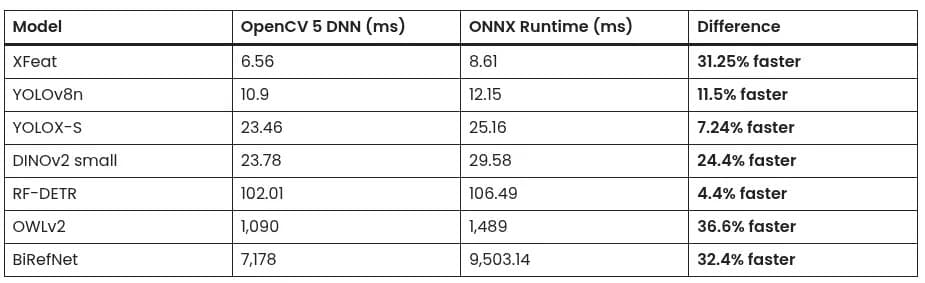
Benchmark comparisons against Microsoft ONNX Runtime show OpenCV 5.0 performing competitively, often matching or exceeding the performance of specialized inference engines in certain workloads. The rewritten DNN engine particularly excels in memory efficiency and reduced overhead for model loading and inference.
3D Vision Enhancements
The 3D vision toolkit has received significant improvements in OpenCV 5.0. These enhancements include better algorithms for depth estimation, point cloud processing, and 3D reconstruction. The improvements make it easier for developers to implement applications that require understanding of spatial relationships and 3D environments.
Future Development Roadmap
Looking ahead, the OpenCV development team has already outlined their priorities for future versions. The most significant upcoming feature is native GPU support within the new DNN engine. Currently, OpenCV can utilize GPU acceleration through third-party backends like CUDA and OpenCL, but native GPU integration promises better performance and reduced complexity.
The team is also working on expanding the ONNX coverage even further, with a goal of reaching near-complete compatibility with the ONNX standard. This would make OpenCV an even more versatile platform for deploying models trained in various frameworks.
Practical Implications for Developers
For developers working on computer vision projects, OpenCV 5.0 represents both opportunities and considerations:
- Migration path: While the library maintains backward compatibility for most APIs, the rewritten DNN engine may require adjustments for some applications that heavily customized the previous DNN implementation
- Performance gains: Most applications should see immediate benefits from the optimized kernels and improved memory management
- New capabilities: The LLM and VLM support opens entirely new application domains
- Hardware flexibility: The improved hardware abstraction makes it easier to deploy applications across different platforms
Build Recommendations
For developers planning to adopt OpenCV 5.0, here are some build recommendations based on the new features:
For maximum performance on Intel systems: Build with Intel IPP support enabled and ensure SSE4.2, AVX2, and AVX-512 optimizations are activated where available
For mobile and embedded applications: Utilize the Arm KleidiCV backend and consider NEON optimizations for ARM processors
For AI-powered applications: Enable the experimental LLM and VLM support, which requires additional dependencies like onnxruntime and specific model files
For 3D vision applications: Ensure proper build configuration for the enhanced 3D vision modules, which may require additional libraries like Eigen
For GPU acceleration: While native GPU support is coming soon, current builds should still utilize CUDA or OpenCL backends for GPU acceleration
Conclusion
OpenCV 5.0 marks a significant evolution in the open-source computer vision landscape. The rewritten DNN engine, enhanced model support, and improved hardware abstraction position OpenCV to remain relevant in an increasingly AI-driven world. For developers, this release not only improves performance but also expands the scope of what's possible with computer vision technology.
The integration of LLM and VLM support particularly demonstrates how traditional computer vision libraries are adapting to incorporate modern AI capabilities. This convergence is likely to accelerate, with future versions potentially seeing even tighter integration with transformer-based models and multimodal architectures.
For those interested in exploring the new capabilities, the official OpenCV 5.0 announcement provides comprehensive details about the release, while the GitHub repository contains the source code and build instructions.
{{IMAGE:2}}
Comments
Please log in or register to join the discussion