
OpenRun’s service bindings treat database credentials as something the platform should create, isolate, inject, and govern, shifting app deployment away from manual DBA queues and one-database-per-app sprawl.

Thesis
OpenRun’s new service binding model is best understood as a quiet infrastructure argument: the hard part of deploying internal tools is often not the web app itself, but the disciplined creation of the surrounding permissions, schemas, credentials, staging equivalents, and shared access patterns that let the app touch state without turning the database into an unmanaged commons.
The feature, described in OpenRun’s article on service bindings, gives code-first internal tools a platform-level mechanism for requesting access to shared services, especially databases, while preserving isolation at the credential and schema level. Instead of every application arriving with its own database instance, or every developer waiting for a database administrator to manually create accounts, OpenRun lets an app declare that it needs a service. During installation, the platform connects with administrative credentials, creates the app-specific database identity, and injects the resulting credentials into the app environment.
That sounds operational, almost mundane, but it points at a larger philosophy of internal software platforms: the best developer experience is not the absence of governance, it is governance encoded into repeatable machinery.
Key Arguments
The Database Is Shared, But Access Is Individualized
Traditional deployment patterns tend to choose between two imperfect defaults. In the Docker Compose or Helm chart style, each app brings its own database. This makes local reasoning easy, but it multiplies the operational surface area: backups, monitoring, capacity planning, upgrades, and security reviews all become per-app concerns. In larger organizations, the opposite pattern emerges. Databases are professionally managed, but access becomes a ticket-driven workflow in which developers ask a database team for accounts, permissions, and credentials, then wait.
OpenRun’s service bindings sit between those poles. A database instance can remain a managed shared service, perhaps an AWS RDS database, a company-managed Postgres cluster, or another externally operated service, while each app receives its own isolated schema and role. For MySQL, the equivalent would be a database and user. The service remains outside OpenRun’s direct lifecycle management, but the access relationship between app and service becomes declarative.
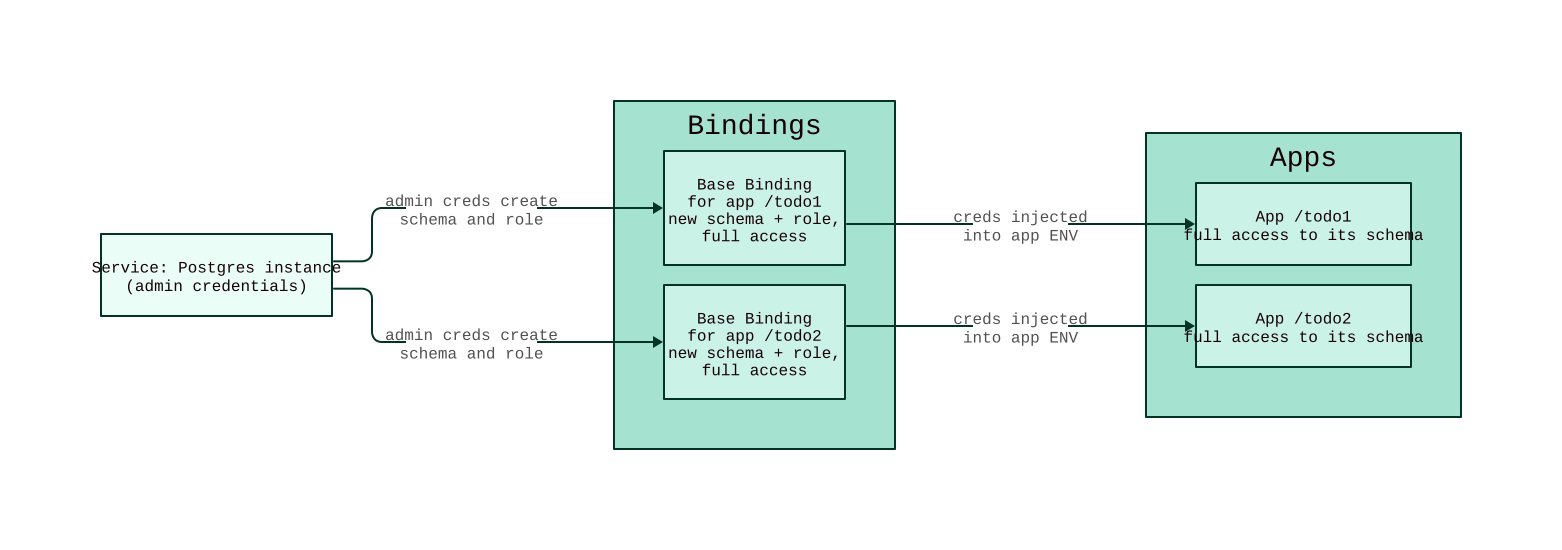
This distinction matters because isolation is not a single thing. There is credential isolation, schema isolation, performance isolation, and operational isolation. OpenRun’s base bindings provide the first two, while explicitly not pretending to provide the third. If ten apps share one database instance, they still share capacity. A noisy query in one app can affect another unless the underlying database is sized, monitored, and governed accordingly. The advantage is that this monitoring and capacity work happens once at the service level, instead of being rediscovered separately for every internal tool.
Credentials Become Installation Artifacts, Not Human Secrets
The most consequential part of the model is that credentials are created when the app is installed and passed through the environment, which is still the ordinary way many applications consume configuration. The application code does not need to know that OpenRun created a schema, role, password, or grant set. It reads environment variables and connects to the database as usual.
This is a strong design choice because it avoids making the application framework itself special. A Python Flask app, a Node service, or a small Go dashboard can all consume database credentials without adopting a new database access library. The platform owns the ceremony around credential creation, while the app owns its normal runtime behavior.
The pattern also echoes earlier platform ideas. Cloud Foundry service bindings used the language of binding apps to service instances, while Kubernetes has explored similar ideas through the Service Binding Specification. The important point is not that every implementation agrees on one universal standard. It is that mature platforms keep rediscovering the same need: applications should declare dependencies, and platforms should deliver connection details in a controlled way.
Staging Becomes Less Fragile Because It Is Derived From the Same Rule
Internal tools often accumulate staging environments that are technically present but operationally suspect. The app has a staging deployment, yet the database is shared with production, manually copied, or configured through a one-off credential that nobody remembers how to recreate.
OpenRun’s model gives staging an explicit place in the binding system. Since OpenRun manages database credentials, it can automatically give staging apps separate schemas or databases. By default, those staging credentials can still point at the same physical database instance as production, which keeps the setup simple. For stronger isolation, a staging service can be configured at the service level, placing staging workloads on a separate database instance.
This is a useful example of platform design respecting gradients rather than forcing absolutes. Some teams need credential and schema separation but can tolerate shared infrastructure. Others need performance separation as well. The model allows both without changing application code.
Derived Bindings Make Shared Access Explicit
The more interesting part of OpenRun’s design is not merely isolated per-app databases, but derived bindings. A derived binding lets multiple apps share the same database or schema while receiving distinct roles and grants. This enables one app to have broad write access, another to have read-only access, and a third to share source code with a different permission profile.
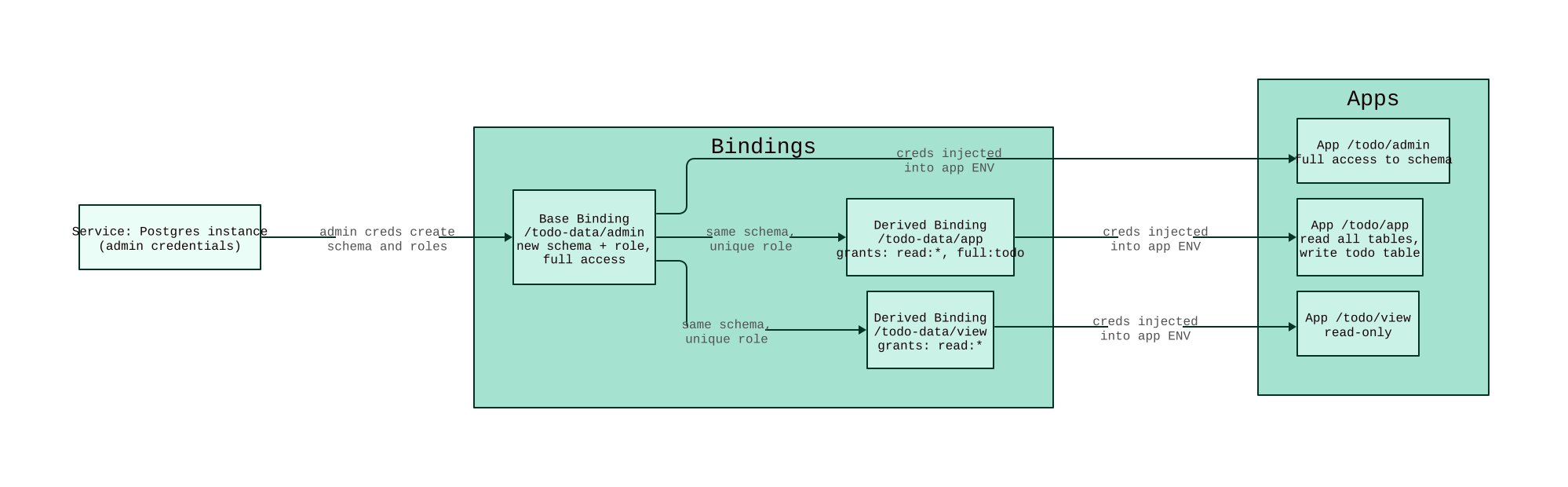
This is where service bindings move from convenience into authorization architecture. Many internal tools have asymmetric access patterns. An admin interface might need full control over a table, a reporting view might need only read access, and a public or semi-public endpoint might need a sharply constrained subset of operations. Implementing all of that only in application code is possible, but authorization code is notoriously difficult to verify because the absence of a mistake is the property being tested.
Database grants provide a second line of enforcement. If an app-level permission check fails open, the database role can still refuse the query. That does not remove the need for application authorization, but it makes the system less dependent on any single layer being perfect.
The design also has a conceptual benefit: access becomes visible in deployment configuration. Instead of permissions living only in migration files, manually issued SQL commands, or tribal memory, the relationship between app, schema, role, and grants becomes part of the app’s declared shape.
Implications
OpenRun is an open source deployment platform for code-first internal tools, and this feature clarifies the type of platform it wants to be. It is not only trying to run apps. It is trying to absorb the platform conveniences that made low-code tools attractive, while preserving the flexibility of ordinary source code.
Low-code platforms often win inside organizations because they make deployment, authentication, database access, and environment management feel integrated. Code-first tools usually win on expressiveness, maintainability, and fit with existing engineering practices. Service bindings are an attempt to close one of the gaps between those worlds. The developer still writes a normal app, but the platform supplies the operational scaffolding that internal tooling teams frequently rebuild by hand.
There is also a GitOps implication. If service dependencies, bindings, grants, and staging behavior can be represented declaratively, then database access becomes reviewable in the same workflow as app deployment. A pull request can show not just that a new tool exists, but what service it binds to and what level of access it expects. That creates a better audit trail than a chat message asking someone to create a database user.
The approach also encourages a healthier distinction between provisioning a service and consuming a service. OpenRun does not need to become a database operator to make database access better. It can assume that the database itself is already managed by RDS, a platform team, or a DBA group, then focus on the repeatable boundary where apps receive scoped access. That boundary is where many internal platform failures happen, because it is too small to receive architectural attention and too important to leave informal.
Counter-Perspectives
The model does not eliminate the hardest database problems. Shared services still require capacity planning, backup strategy, monitoring, upgrade discipline, and incident response. Service bindings make access easier and cleaner, but they do not make a shared database infinitely divisible. Teams adopting this pattern need to remain honest about contention, query behavior, storage growth, and blast radius.
There is also a governance question around administrative credentials. OpenRun needs privileged access to create schemas, roles, databases, users, and grants. That can be a reasonable trade if the platform is trusted and audited, but it concentrates power in the deployment system. The security of the binding mechanism, secret storage, logging behavior, and permission boundaries becomes central.
Compared with Postgres Row-Level Security, OpenRun’s binding approach solves a different problem. RLS is designed for fine-grained row visibility inside a shared table, often for tenant or user isolation. Service bindings are broader and simpler: they shape service access at the account, schema, and grant level. That makes them applicable to more services, including databases, queues, and other infrastructure APIs, but it does not replace row-level policy when multiple tenants must share the same tables safely.
The deeper lesson is that platform features become powerful when they turn invisible human procedure into visible system behavior. OpenRun’s service bindings are not just a credential convenience. They are a claim that internal software should be allowed to remain code-first without forcing every team to become expert in the repetitive rituals of database access management.
Comments
Please log in or register to join the discussion