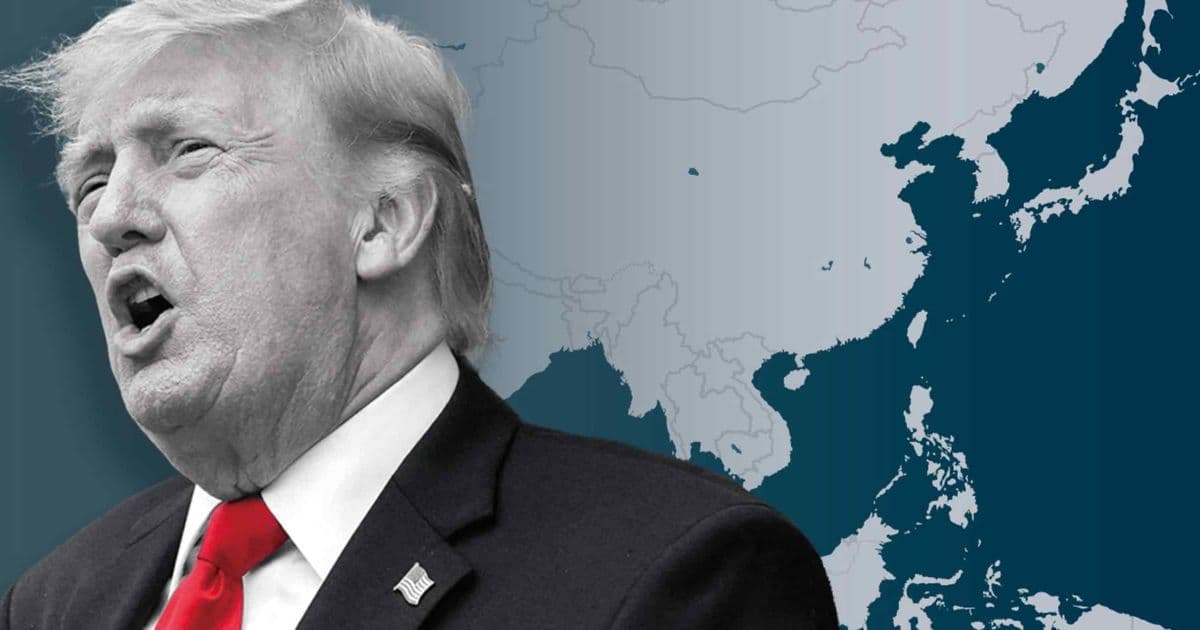
A weaker U.S. commitment to predictable regional rules would not just unsettle diplomats. It would raise the cost of building AI, chips and cloud infrastructure across Asia’s most important production corridor.
Business news
Nikkei Asia’s report from the Shangri-La Dialogue in Singapore captures a shift with direct consequences for the technology economy: Asian governments are increasingly worried that the U.S. is moving from rules-based security commitments toward a more transactional, power-based model under President Donald Trump. For the tech sector, that is not an abstract diplomatic debate. It goes straight to the cost of capital, supply-chain design and the reliability assumptions behind AI infrastructure.
The Asia-Pacific region is the physical backbone of the modern AI stack. Taiwan dominates advanced foundry manufacturing through TSMC, South Korea is central to memory and high-bandwidth memory supply through Samsung Electronics and SK Hynix, Japan controls key materials and semiconductor equipment niches, and Southeast Asia provides assembly, testing, electronics manufacturing and fast-growing data center capacity. A less predictable U.S. security posture forces companies to price political risk into decisions that previously looked like operating questions.
That matters because the numbers have become enormous. The global semiconductor market reached an estimated $791.7 billion in 2025 and is projected by industry forecasters cited by the Semiconductor Industry Association ecosystem to approach $1 trillion in 2026. TSMC’s revenue base has expanded sharply with AI and high-performance computing demand, while advanced nodes and packaging capacity have become strategic bottlenecks rather than ordinary supplier inputs. At the same time, Goldman Sachs analysts have estimated that AI-related capital expenditure could climb toward $1.1 trillion by 2027, with higher scenarios near $1.4 trillion if hyperscaler buildouts keep accelerating.
The business issue is simple: AI infrastructure assumes geopolitical continuity. A GPU cluster in Texas, a cloud region in Singapore, a model-training roadmap in California and a smartphone launch in Shenzhen all depend on chips, substrates, memory, networking gear, undersea cables, energy contracts and logistics routes that cross Asia’s contested waters and treaty systems. If regional governments no longer believe the U.S. will consistently defend the rules that keep those flows open, the private sector has to pay for redundancy.
Market context
The old globalization model optimized for unit cost. The new model optimizes for survivability, and that is more expensive. Companies are already adding supplier audits, export-control compliance teams, inventory buffers, alternative logistics routes and second-source manufacturing plans. Those costs rarely appear as a single line item, but they show up in gross margins, longer cash-conversion cycles and lower returns on invested capital.
Semiconductors are the clearest example. Advanced AI chips are not just designed by Nvidia, AMD, Broadcom, Google or Amazon. They require leading-edge wafer production, advanced packaging such as CoWoS, HBM stacks, specialized substrates, precision chemicals, lithography tools, test equipment and highly coordinated logistics. A disruption in one part of that chain can delay an entire data center buildout. The value at risk is no longer measured only in chip revenue. It includes cloud backlog, enterprise AI deployment timelines, power-purchase agreements and the depreciation schedule of facilities built around expected GPU availability.
The market has already rewarded companies sitting closest to those bottlenecks. TSMC, Nvidia, SK Hynix and advanced packaging suppliers have benefited from AI demand because they control scarce capacity. But scarcity cuts both ways. The more concentrated the supply chain, the more geopolitical risk becomes an equity-market variable. Investors may assign higher multiples to companies with pricing power, but they also demand a discount when cash flows depend on a narrow geographic corridor exposed to military escalation or policy reversals.
Japan is central to the next phase. Nikkei’s argument that Japan must step up is not only about defense policy. Japan is one of the few countries with deep semiconductor materials expertise, a large industrial base, strong capital markets and treaty credibility with the U.S. Its support for Rapidus, chip equipment suppliers and regional security partnerships reflects a broader attempt to turn economic security into industrial strategy. If Washington becomes less predictable, Tokyo’s role as an anchor for trusted manufacturing and standards coordination becomes more valuable.
Southeast Asia also gains strategic weight. Vietnam, Malaysia, Singapore, Thailand and the Philippines are not replacing Taiwan or South Korea in leading-edge chip production, but they are absorbing more electronics manufacturing, assembly, cloud infrastructure and regional operations. For companies, ASEAN diversification reduces single-country exposure. For governments, it creates bargaining power. A U.S. that behaves more transactionally may push these countries to hedge, taking American cloud and chip investment while keeping diplomatic and commercial channels open with China.
That hedging has a cost. The tech industry prefers clear standards, predictable export rules and stable cross-border data policies. A more fragmented regional order increases the chance of incompatible compliance regimes. Cloud providers may need more local data controls. AI companies may face tighter model, chip and data transfer restrictions. Hardware firms may need to redesign products for multiple regulatory blocs. Each measure can be rational on national-security grounds, but together they reduce scale efficiency.
What it means
For technology executives, the main takeaway is that geopolitical risk is moving from board-level background material into operating plans. A company building AI infrastructure in 2026 cannot treat Asia security as a separate government-relations topic. It affects procurement, treasury, product availability, customer contracts and insurance.
The first implication is higher working capital. If firms believe shipping lanes, export licenses or regional commitments could become less predictable, they will hold more inventory. That helps resilience but ties up cash. In consumer electronics, excess inventory can become a margin problem when demand shifts. In AI infrastructure, insufficient inventory can be worse, because data center capacity sits idle if GPUs, networking switches or power components arrive late.
The second implication is more capex duplication. Governments want local fabs, domestic packaging, sovereign cloud regions and national AI infrastructure. Companies will accept some of this because subsidies reduce upfront cost. The problem is utilization. Semiconductor fabs and data centers are capital-intensive assets that need high load factors. Duplicating capacity across friendly jurisdictions may reduce geopolitical exposure, but it can also create structurally higher depreciation expense across the industry.
The third implication is a premium for firms that can navigate policy complexity. The winners will not only be the companies with the fastest chips or largest cloud regions. They will be the companies that can secure export licenses, qualify multiple suppliers, finance capacity ahead of demand and satisfy governments without losing too much operating flexibility. In that environment, legal, compliance, logistics and government-affairs capabilities become part of competitive advantage.
The fourth implication is that security guarantees become market infrastructure. The rules-based order functioned like an invisible subsidy for global tech. It lowered insurance costs, supported long planning cycles and made it easier to concentrate production where technical expertise was deepest. If that order weakens, companies pay through higher redundancy, slower deployment and higher financing costs. Investors should treat that as a margin and valuation issue, not only a geopolitical headline.
The risk is not that Asia’s tech supply chain immediately breaks. The stronger point is that the cost curve changes. AI demand is still expanding, semiconductor revenue is still growing and cloud providers are still racing to add capacity. But the market is entering a phase where physical infrastructure, national-security policy and alliance credibility shape returns as much as model performance or chip benchmarks.
Nikkei’s Singapore dispatch is therefore a business story as much as a diplomatic one. If the U.S. is seen as less committed to predictable rules in Asia, Japan, South Korea, Taiwan and Southeast Asia will adapt. Tech companies will adapt too, but adaptation means capital. In a trillion-dollar semiconductor market and a trillion-dollar AI capex cycle, even a small increase in geopolitical risk pricing can redirect billions of dollars.
Comments
Please log in or register to join the discussion