Huawei is pitching HarmonyOS 7 as an AI-native, spatial, cross-device platform, but the useful signal is in the measured app outcomes, not the keynote adjectives.
What's claimed
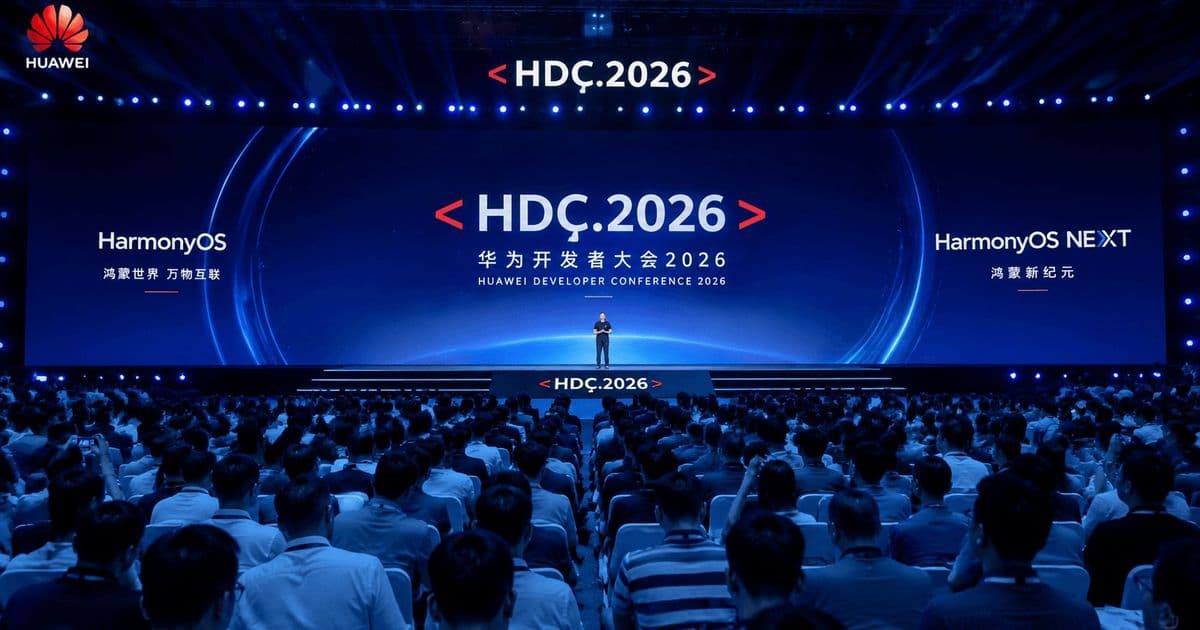
At HDC 2026, Huawei presented HarmonyOS 7 Developer Beta as a five-part upgrade across spatial computing, intelligence, security, smoothness, and device connectivity. The headline features include Remy, an on-device spatial modeling app using Neural Rendering, Xiaoyi upgraded through HMAF 2.0, Star Shield 2.0 for fraud and phishing detection, Ark Engine Predictive Scheduling, and Galaxy Connect for cross-device sharing.
The strongest numeric claims are application-level: Xiaoyi reportedly completes complex multi-step tasks with over 90% success, Dianping says its 3D restaurant browsing increased traffic by 8% and orders by 10%, JD says 3D product display reduced returns by 10% and improved conversion by 20%, and Kuaishou reports more than 80% AI-generated code in parts of its HarmonyOS workflow.
What's actually new
The interesting part is not that HarmonyOS has an AI assistant. Every platform vendor now has one. The more concrete shift is that Huawei is pushing AI features into OS-level surfaces rather than treating them as isolated apps. If HMAF 2.0 gives Xiaoyi access to app intents, user context, and multi-step execution primitives, then the assistant becomes less like a chatbot and more like a task planner wired into the operating system.
That matters because agent benchmarks inside a phone OS are harder than demo videos suggest. A real agent has to disambiguate user intent, call the right app capability, preserve permissions, recover from partial failure, and avoid destructive actions. A reported 90% task success rate is promising, but it needs detail: task set size, task difficulty, app coverage, retry policy, human evaluation criteria, and whether failures include silent wrong actions or only explicit non-completions.
Remy is also technically more interesting than the phrase spatial computing implies. Huawei says it can generate 3D spatial models on-device in about three minutes without uploading data to the cloud. If accurate, that suggests a practical implementation of Neural Rendering optimized for mobile NPUs, memory limits, and thermal constraints. The user benefit is clear: scan an object or space, get a local 3D representation, and use it in shopping, design, accessibility, or social content without waiting on server-side reconstruction.
The partner demos make the platform story more credible. Dianping using HarmonyOS 3DGS for restaurant browsing is a better test than a canned platform demo because the metric is not visual novelty, it is whether users browse and book more. JD's naked-eye 3D product display claim is similarly pragmatic. A 10% reduction in returns would be commercially meaningful if measured over enough categories and traffic volume.
Security is the other area where OS integration can beat app-level add-ons. Star Shield 2.0 combines AI phishing detection, suspicious QR warnings, and scam defense. Alipay integrating its risk-control system into Star Shield could matter because fraud detection benefits from signals across identity, device state, transaction history, and app behavior. The risk is obvious too: the same integration that improves detection can become opaque if developers and users cannot understand why an action was blocked.
Developers should watch the HarmonyOS developer portal and the broader OpenHarmony project for how much of this becomes accessible through documented APIs rather than keynote-only system apps. That difference will decide whether HarmonyOS 7 is merely better Huawei software or a platform where third-party developers can build comparable experiences.
Limitations
The missing piece is independent evaluation. The reported benchmark results are useful, but they are vendor and partner claims. We do not yet have public test suites for Xiaoyi task completion, reproducible Neural Rendering quality comparisons, latency distributions across device tiers, or failure-mode analysis for Star Shield 2.0.
There is also an ecosystem constraint. HarmonyOS has been moving toward a native app model using ArkTS, ArkUI, and Huawei's own runtime stack. That can improve integration and performance, but it raises the cost of porting for teams already maintaining Android, iOS, web, and mini-program surfaces. Kuaishou's claim that two engineers can maintain three platforms with heavy AI code generation is useful, but it may reflect a mature internal tooling setup rather than the baseline experience for smaller teams.
The AI coding claim needs especially careful reading. More than 80% AI-generated code does not automatically mean an 80% productivity gain. Generated code still has to compile, match platform conventions, pass review, avoid subtle UI regressions, and remain maintainable after the original engineer leaves. The real metric is not generation rate, it is shipped features per engineer-month with defect rate held constant.
Huawei's strongest case for HarmonyOS 7 is that the OS, AI agent, rendering stack, security layer, and device bus are being designed together. That can produce better product experiences than bolting AI features onto an older mobile architecture. The skeptical read is that integration only pays off if developers get stable APIs, clear docs, realistic tooling, and enough users to justify the platform work.
For now, HarmonyOS 7 looks like a serious platform iteration with credible technical hooks: on-device 3D reconstruction, OS-level task agents, fraud-aware system services, predictive scheduling, and cross-device app workflows. The proof will come from reproducible benchmarks, developer adoption outside Huawei's closest partners, and whether these features survive contact with ordinary apps, ordinary devices, and ordinary failure cases.
Comments
Please log in or register to join the discussion