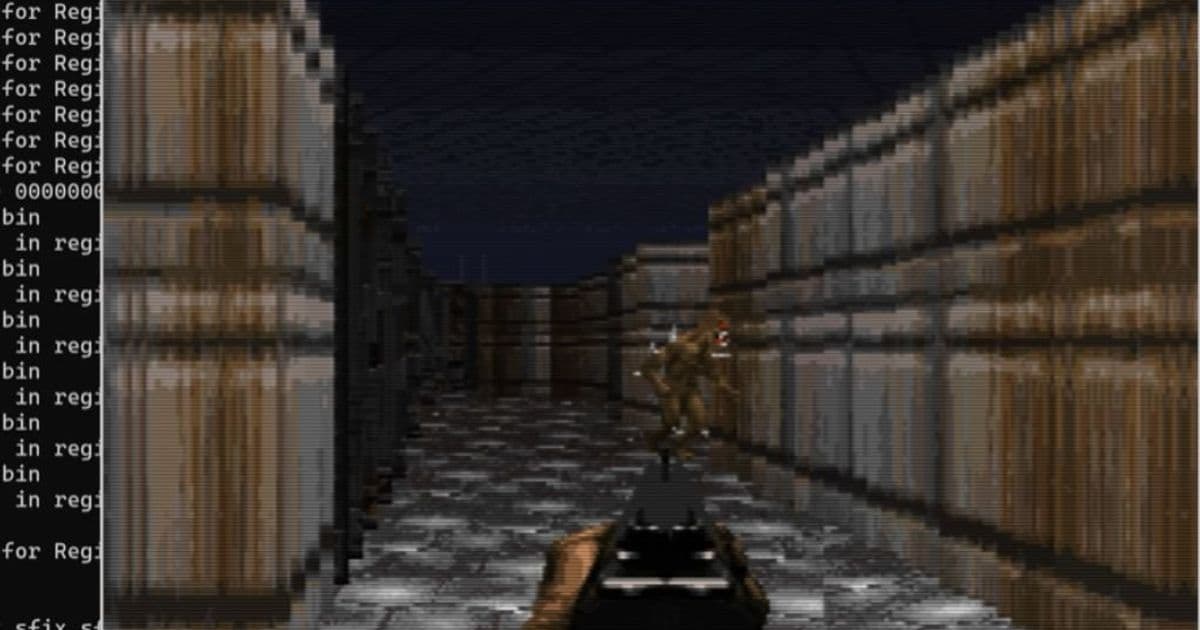
A new DoomGeo prototype shows DOOM-style play on SNK’s sprite-heavy Neo Geo AES, but the real achievement is making 1990 arcade hardware fake a job it was never designed to do.
What's new
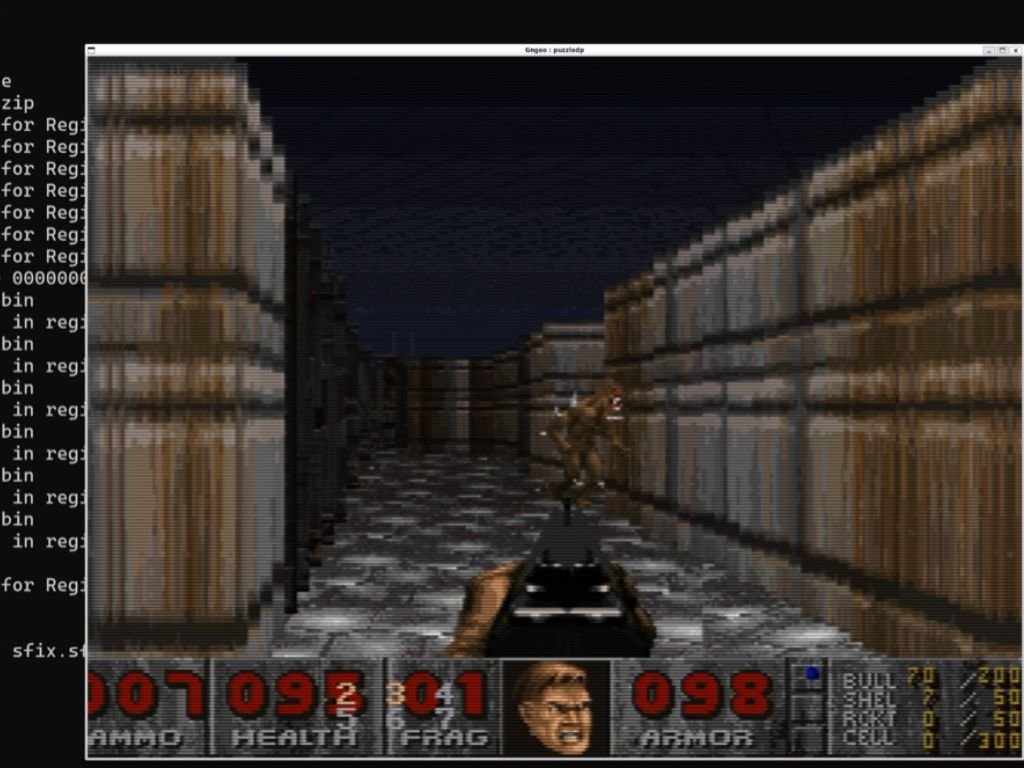
The latest Neo Geo AES DOOM effort is not a finished port of id Software’s 1993 shooter, but it is a meaningful step closer than the hardware usually allows. After Modern Vintage Gamer showed a simple raycaster running on SNK’s 1990 console, the DoomGeo project expanded the idea into something that now looks much more recognizably DOOM-like, complete with a status bar, Doomguy face, ammo readouts, weapons, enemies, and a first-person corridor view.
That matters because the Neo Geo AES is one of the strangest targets in the long-running “can it run DOOM” tradition. The console was extremely powerful for 2D arcade games, yet awkward for the kind of 3D scene construction that made DOOM famous. Its Motorola 68000 CPU, Z80 sound CPU, Yamaha audio hardware, and massive sprite throughput made it feel like an arcade cabinet in home-console form. For games like Metal Slug, Samurai Shodown, Fatal Fury, and Blazing Star, that design was exactly right. For a texture-mapped first-person shooter, it is a hostile test bench.
The technical trick in the new work is using the Neo Geo’s sprite-scaling capability to approximate a raycasted 3D view. Instead of drawing a modern framebuffer pixel by pixel, the prototype builds walls and corridors from vertical sprite strips. That is a clever fit for the AES because the hardware wants to move and scale sprites, not fill an arbitrary 3D view like a PC VGA card. MVG’s original experiment reportedly hovered around 8 frames per second with basic corridors, which is slow by commercial shooter standards but valuable as a proof of concept. The follow-up work from DoomGeo appears to prioritize recognizability and game structure, adding the HUD and combat elements that turn a renderer demo into something closer to a playable prototype.
The core tension is simple: the Neo Geo AES was expensive, powerful, and specialized. At launch, the home system was famously priced far above a Super Nintendo or Sega Genesis, with cartridges that could cost as much as full consoles from competitors. That price bought arcade-grade 2D assets, huge ROM capacity for the era, and hardware tuned for enormous sprites. It did not buy the kind of flexible chunky pixel framebuffer that DOOM liked on DOS PCs.
That is why this is more interesting than another novelty port. DOOM has already appeared on devices with far less gaming credibility, including calculators, printers, and tiny embedded displays. The Neo Geo is not weak in the usual sense. It is strong in the wrong direction. Getting DOOM-like gameplay onto it is less about raw horsepower and more about translating a 3D engine into the language of a 2D arcade board.
How it compares
Against the original 1993 PC version, the Neo Geo AES effort is clearly compromised. DOOM on DOS expected a 386 or 486-class PC, with the 486 delivering the smoother experience most players remember. The game’s renderer was not true polygonal 3D, but it still depended on drawing vertical wall spans, textured surfaces, sprites, lighting changes, and a responsive viewport into a linear framebuffer. That model makes sense on a PC graphics adapter. It does not map cleanly to the Neo Geo’s tile and sprite machinery.
The AES uses a 16-bit Motorola 68000 CPU running at roughly 12 MHz, helped by a Z80 for sound. That sounds respectable next to the Genesis, which also used a 68000, but the Neo Geo’s advantage was never general-purpose 3D math. Its advantage was feeding the screen with large, colorful, scalable sprites and arcade-quality art data from very large cartridges. In 2D, it could make SNES and Genesis software look constrained. In DOOM-style 3D, the comparison flips because the renderer needs operations the Neo Geo was not built to accelerate.
Compared with the Super Nintendo, the Neo Geo has more CPU speed and far more sprite muscle, but Nintendo’s console had enhancement-chip escape routes. The SNES version of DOOM used the Super FX 2 chip inside the cartridge, effectively adding custom silicon to push the game over the line. The Neo Geo cartridge format had room for enormous ROMs, which helped with animation and sound, but it was not commonly used as a host for a Super FX-style 3D coprocessor. A pure Neo Geo solution has to work with the machine’s existing strengths.
Compared with the Sega Genesis, the Neo Geo again wins many 2D comparisons, especially sprite size, color richness, and arcade fidelity. But Genesis homebrew and commercial oddities have shown that a simpler framebuffer-like approach can sometimes be easier to abuse for pseudo-3D than an arcade board designed around sprite composition. The Neo Geo’s strength becomes a constraint because every wall slice, enemy, weapon, and UI element has to behave like something the sprite system can tolerate.
The Atari Jaguar and Sega 32X sit in a different class. Both were marketed around 3D or 3D-adjacent capability, and both received DOOM ports with their own trade-offs. The Jaguar version had smoother performance than many earlier console attempts but lost music during gameplay. The 32X version was cropped and content-limited, but it ran on hardware built to extend the Genesis into a more 3D-capable system. The Neo Geo AES was not trying to be that machine. It was trying to put an arcade board under a television.
That distinction explains why the current DoomGeo work should be judged less like a normal game preview and more like a hardware renderer experiment. A buyer in the 1990s would not have chosen a Neo Geo AES for first-person shooters. They would have bought it for arcade-perfect fighting games, sports titles, shooters, and showpiece 2D animation. In that context, a DOOM-like prototype is a stress test of architecture, not a missed commercial opportunity.
The most interesting technical difference is how the image gets built. DOOM’s renderer casts rays through a 2D map, determines wall intersections, and draws textured vertical columns at different heights to create the illusion of depth. Floors and ceilings are handled through additional projection techniques, and enemies remain sprites placed in the scene. That pipeline still assumes the CPU can write the final image into video memory in a flexible way.
The Neo Geo does not want that job. It wants prearranged graphics data, sprite attributes, scaling values, and tile maps. A wall that would be a column of pixels on a PC has to become a stretched sprite or a group of sprite pieces on the AES. That can work for simple corridors, especially when texture variety is limited, but it becomes painful as rooms get wider, enemies increase, doors animate, projectiles move, and the player expects the frame rate to hold.
Memory and storage also cut in two directions. Neo Geo cartridges could be huge by early 1990s standards, which is why the system could throw around lavish 2D artwork. DOOM’s shareware WAD content, by contrast, was compact for what it achieved, but its data was organized around maps, textures, flats, sprites, and engine assumptions from the PC version. A convincing AES version would likely need custom assets and custom map constraints rather than a straight asset transfer. The closer the project tries to get to original DOOM behavior, the more it has to fight the machine.
Frame rate is the obvious practical limit. MVG’s early 8 fps figure is far below the fluidity most players expect, but it is not meaningless. On hardware like this, the first question is whether the scene can be drawn at all. The second question is whether it can be drawn with enough stability for control, aiming, enemy movement, and collision to feel intentional. The DoomGeo additions make the prototype more exciting, but the hard part is scaling from a corridor demo into levels with combat pressure.
The HUD is more than cosmetic. DOOM’s status bar is a constant part of how players read the game. Health, ammo, armor, keys, weapon ownership, and the face animation all give feedback without pausing the action. Seeing that structure appear on Neo Geo hardware suggests the project is moving beyond “look at this wall renderer” and toward the broader problem of game feel. That is the difference between a graphics trick and a porting effort.
Who it's for
This is for retro hardware people who care about how machines actually draw frames, not just whether a familiar logo appears on screen. If you collect or emulate Neo Geo software, the project is a useful reminder that the AES was not simply a more expensive Genesis. It was a purpose-built 2D arcade platform with very different priorities. Its strengths were visible in large sprites, animation, color, and sound. Its weaknesses show up when a developer asks it to behave like a DOS PC.
It is also for DOOM port watchers who have become numb to novelty targets. A pregnancy test display running a DOOM-themed demo is funny, but the Neo Geo challenge is technically richer because the console is both powerful and unsuitable. That contradiction makes it a better engineering story. The port is not fighting a lack of prestige. It is fighting a mismatch between engine design and graphics architecture.
For practical buyers, this does not change the value proposition of a Neo Geo AES. Original hardware remains expensive, cartridges remain collector-priced, and a prototype DOOM-like project should not be treated as a reason to buy the system. If your goal is to play DOOM, a PC, modern console, Raspberry Pi, handheld emulator, or even a low-cost retro device will give you a better experience. The Neo Geo AES is still a machine to buy for its own library, not for experimental first-person shooters.
For developers, though, DoomGeo is a useful case study in constraint-driven rendering. Modern machines hide a lot of the work behind GPUs, APIs, and abundant memory bandwidth. Old consoles force the developer to ask what the video hardware can do cheaply, what must be faked, and what has to be removed. On the Neo Geo, that means accepting sprite scaling as the main primitive and designing around it. The result may never match PC DOOM, but it can teach more than a straightforward port to a flexible framebuffer device.
The most realistic path is not a perfect DOOM conversion. A better target would be a Neo Geo-native shooter inspired by DOOM, built around narrow corridors, limited texture sets, controlled enemy counts, and predictable room shapes. That would let the hardware show its strengths in weapons, enemy sprites, HUD art, and sound while keeping the renderer inside sane limits. The AES could make the front end, status bar, and monster art look fantastic. The level design would need discipline.
That design trade-off mirrors what many commercial console ports did in the 1990s. Developers often reduced viewport size, simplified levels, cut animation frames, removed textures, lowered frame rates, or changed enemy placement to fit the target hardware. The difference here is that the Neo Geo never received an official DOOM port, so the community is effectively running the experiment decades later with better tools, documentation, and patience.
The broader lesson is that specs do not tell the whole story. A 12 MHz 68000 in an arcade-grade console sounds capable until the task shifts from sprite-heavy 2D to first-person rendering. A giant cartridge sounds liberating until the bottleneck becomes how each frame is composed. A machine that crushed rivals in fighting games can still struggle with a renderer that a cheaper PC handled more naturally. Hardware is always about fit.
For now, the DoomGeo prototype is best viewed as a promising technical milestone rather than a near-finished game. The visible additions, especially the HUD, weapons, monsters, and DOOM-style presentation, make the project feel much closer to the source material. The remaining questions are harder: sustained frame rate, map complexity, enemy logic, collision, sound, memory layout, and whether the whole thing can remain playable once real encounter design enters the picture.
That is enough to make it one of the more interesting DOOM hardware stories in years. Not because it proves the Neo Geo AES was secretly a 3D console, but because it shows how far a developer can push a very specific 2D machine when they stop asking it to be a PC and start feeding it work in its own format. Follow Modern Vintage Gamer for the renderer analysis, and keep an eye on community updates around DoomGeo if you want to see whether this prototype becomes a playable Neo Geo experiment rather than another impressive clip.
Comments
Please log in or register to join the discussion