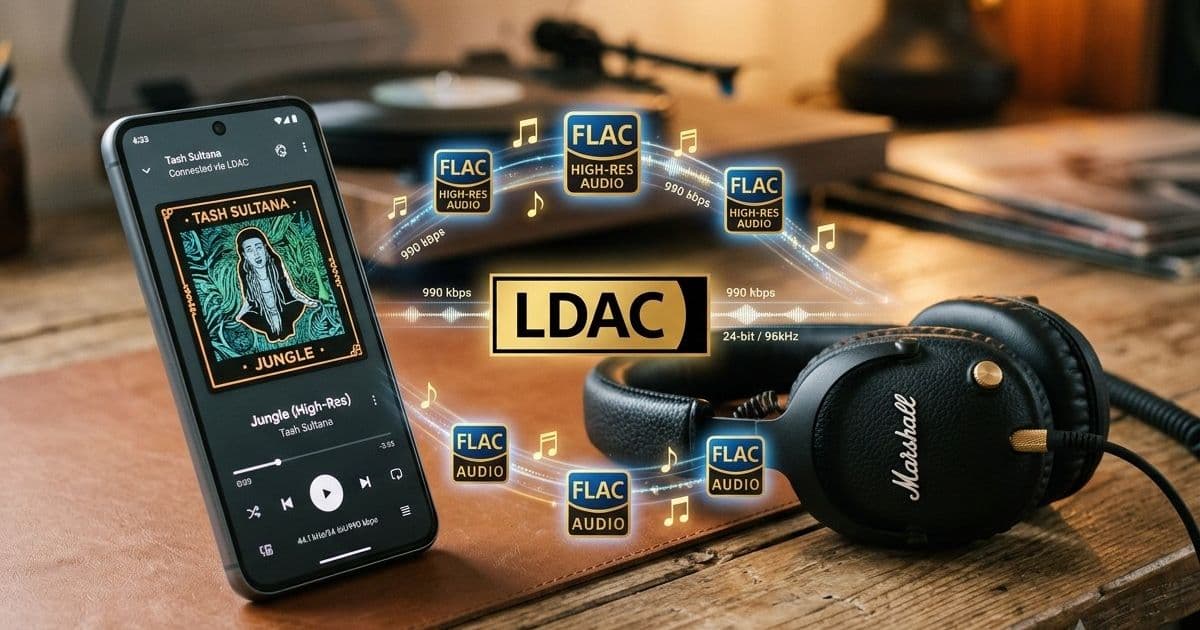
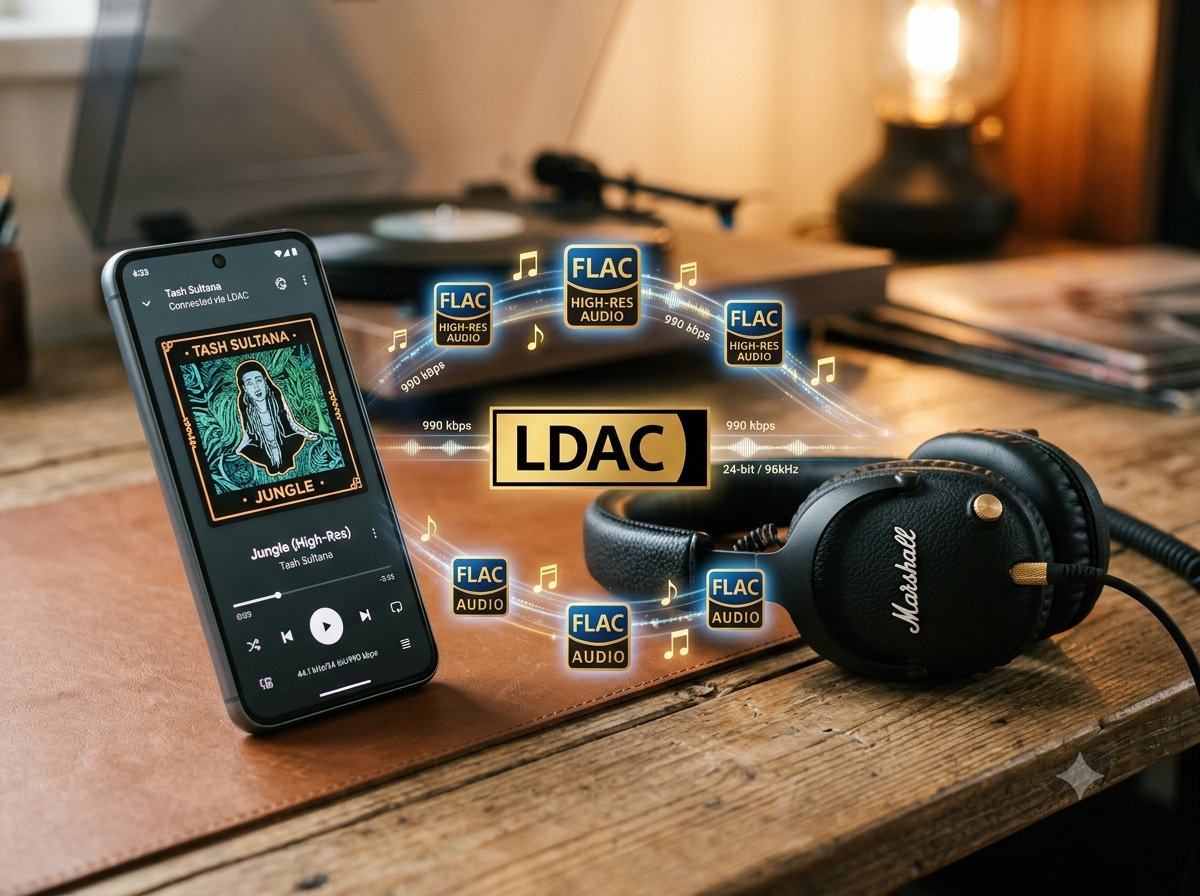
LDAC can make Bluetooth headphones sound cleaner on Android, but the codec only pays off when the headphones, phone, source files, and wireless conditions all cooperate.
What's new
The Marshall Milton A.N.C. is a useful example of where Bluetooth audio is heading in 2026: not just longer battery life and better noise cancelling, but more attention to codecs. The headline feature here is LDAC support, Sony's higher-bitrate Bluetooth codec, paired with a compact on-ear design, active noise cancelling, transparency mode, Bluetooth 6.0, USB-C audio, multipoint pairing, a replaceable battery, and a claimed battery life of more than 50 hours with ANC on or up to 80 hours with ANC off.
Pricing puts the Milton A.N.C. around the upper midrange for on-ear headphones, at about $229.99 in the US, with reported pricing around £179.99 and €199 in Europe. That matters because LDAC is often associated with more expensive over-ear models from Sony and other audio-focused brands. Marshall is bringing it into a more portable, style-driven on-ear product rather than reserving it for a flagship over-ear headphone.
LDAC itself is not new, but it is still one of the more meaningful codec upgrades Android users can actually use. Sony describes LDAC as a Bluetooth audio technology capable of transmitting up to 990 kbps, compared with the lower data rates used by standard SBC and many AAC implementations. The Android Open Source Project libldac repository also shows why LDAC has become common across Android devices rather than staying locked to Sony phones.
That does not make LDAC magic. Bluetooth remains a compressed, radio-based connection. It has to balance bandwidth, latency, battery use, and interference. But LDAC gives compatible headphones more data to work with, and that can reduce the compression penalty when the rest of the chain is good enough.
What LDAC actually changes
Standard Bluetooth audio is a compromise. Your phone takes a digital music file, encodes it into a Bluetooth codec, sends it over a short-range wireless link, and your headphones decode it before sending the signal through their amplifier and drivers. Every stage can limit quality.
SBC is the baseline codec. It works almost everywhere, but it is not designed to preserve as much detail as higher-bitrate options. AAC can sound good, especially on Apple devices where the implementation is mature, but it usually does not reach LDAC's maximum data rate. LDAC operates in three main quality tiers: 330 kbps, 660 kbps, and 990 kbps. The top mode is the one people associate with high-resolution Bluetooth audio, although in practice many phones choose 660 kbps automatically because it is more stable.
That stability trade-off is the key detail. A 990 kbps Bluetooth stream needs a cleaner connection than a 330 kbps stream. Put your phone in a back pocket, walk through a busy station, or sit near a crowded 2.4 GHz wireless environment, and the connection can fall back to a lower bitrate or stutter if you force the highest setting. When I test codecs, I treat 990 kbps as a best-case mode, not the everyday baseline.
{{IMAGE:3}}
The improvement is also limited by the source. TIDAL's sound quality page lists HiRes FLAC up to 24-bit/192 kHz and FLAC up to 16-bit/44.1 kHz, while Qobuz positions itself around lossless and hi-res streaming. Those are the kinds of sources that give LDAC something useful to carry. If you are playing heavily compressed music, podcasts, YouTube audio, or low-bitrate local files, LDAC has less room to help.
The headphones matter even more. A codec cannot fix a poor driver, a bad seal, uneven tuning, or weak amplification. The Milton A.N.C. uses 32 mm dynamic drivers and an on-ear fit, so its sound is shaped as much by pad pressure and ear positioning as by codec bandwidth. LDAC can sharpen the edges of a good presentation, but it will not turn an on-ear ANC headphone into a wired open-back studio reference.
How to enable LDAC on Android
The practical setup is simple once the requirements are clear. You need LDAC-compatible headphones, an Android phone that supports LDAC, and a source worth listening to in higher quality. The Marshall Milton A.N.C. checks the headphone box. Most modern Android phones check the device box. iPhones do not support LDAC, and MacBooks do not support it natively either.
{{IMAGE:4}}
On Android, pair the Milton A.N.C. through Bluetooth as usual. In many cases, LDAC will activate automatically when the phone detects a compatible headset. To confirm it, open the Bluetooth device settings for the headphones and look for an HD audio or LDAC toggle. If that option appears, turn it on.
For more control, enable Developer Options. Open Settings, go to About phone, then tap Build number seven times. After Developer Options appear, go to the Bluetooth audio section and find Bluetooth Audio Codec. Select LDAC if it is not already selected. If the Milton A.N.C. is disconnected, the LDAC option may be unavailable or grayed out.
{{IMAGE:5}}
Android also lets you choose LDAC playback quality on many phones. The useful mental model is this:
| LDAC mode | Best use | Trade-off |
|---|---|---|
| 330 kbps | Walking, commuting, crowded wireless areas | Most stable, least codec advantage |
| 660 kbps | Daily listening | Strong balance of quality and reliability |
| 990 kbps | Quiet room, phone close to headphones | Best theoretical quality, most sensitive to dropouts |
For most buyers, 660 kbps is the setting I would start with. It usually gives LDAC a real advantage over SBC without making the connection fragile. I only force 990 kbps when testing in a controlled environment or listening at home with the phone nearby.
How the Milton compares
The Milton A.N.C. sits between Marshall's simpler on-ear models and its larger premium over-ear headphones. Compared with the Major V, the Milton adds active noise cancelling, LDAC, USB-C audio, larger cushioned pads, and a more feature-heavy app experience. The trade-off is price and battery life. The Major V is the better endurance pick if you mostly want a compact Marshall on-ear for casual listening. The Milton is the one that makes sense if ANC and higher-quality Android playback are part of the brief.
Compared with Marshall's Monitor III A.N.C., the Milton is smaller and lighter, but it gives up the physical advantages of an over-ear design. Over-ear pads create a better passive seal, which usually helps ANC, bass consistency, and long-session comfort. The Milton's on-ear format is easier to carry and less bulky, but it depends more on how well the pads sit on your ears. That means the fit can change the bass response more noticeably from person to person.
Against Sony's premium noise-cancelling headphones, the codec story gets more interesting. Sony's WH-1000X line has long been one of the more Android-friendly choices because LDAC support is part of the package. A current Sony flagship over-ear will generally beat the Milton on ANC strength and likely on refinement, but it costs far more and is less compact. The Milton's argument is not that it beats a Sony flagship. Its argument is that it brings LDAC, ANC, and serious battery life into a smaller on-ear frame at roughly half the price of many premium over-ear competitors.
Bose takes a different path. The QuietComfort Ultra Headphones focus on ANC, comfort, and spatial processing rather than LDAC. They are excellent travel headphones, but Android listeners who specifically want LDAC will not find it there. Apple AirPods Max are even more ecosystem-specific. They can sound very good with Apple devices, but LDAC is not part of the Apple Bluetooth audio stack.
Beyerdynamic's Aventho 100 is probably the closer category rival because it is also an ANC on-ear around the same price class. That comparison comes down less to codec checklists and more to tuning, comfort, and app control. Marshall is aiming for a punchy, energetic sound with brand-heavy design. Beyerdynamic tends to appeal to listeners who want a more traditional hi-fi angle.
The buyer guidance
LDAC is most valuable for Android users who already care about source quality. If your phone is a recent Pixel, Galaxy, Xperia, OnePlus, Xiaomi, or similar Android handset, and you listen through TIDAL, Qobuz, Amazon Music Unlimited, Apple Music lossless downloads played locally on Android, or your own FLAC library, LDAC is worth enabling. On the Milton A.N.C., I would treat it as a free quality upgrade that should be switched on unless it causes dropouts.
It is less valuable for iPhone users. The Milton will still work over Bluetooth with an iPhone, but it will fall back to AAC or another supported codec. That does not make the headphones pointless, but it changes the buying logic. If you are fully inside Apple's ecosystem, buy the Milton for design, battery life, ANC, comfort, and Marshall's tuning, not for LDAC.
It is also less valuable if Spotify is your main source. Spotify's compressed streams can still sound good, and headphone tuning matters more than file format for most casual listening. But LDAC has less to reveal when the original stream is already heavily compressed. In that setup, the difference between LDAC and AAC or SBC may be hard to pick out in blind listening.
For buyers comparing specs, the Milton A.N.C. has a strong checklist: 32 mm dynamic drivers, ANC, transparency mode, Bluetooth 6.0, SBC, AAC, LC3, LDAC, USB-C audio, multipoint, replaceable battery, and up to 80 hours of playback without ANC. The weak points are inherent to the format. On-ear ANC rarely matches over-ear ANC, the seal is more fit-sensitive, and LDAC's best mode is vulnerable to interference.
Who it's for
The Marshall Milton A.N.C. is for the Android listener who wants better-than-basic Bluetooth audio without carrying large over-ear headphones. It makes sense for commuters who prefer on-ear portability, office listeners who want ANC without a bulky travel headset, and buyers who like Marshall's design but previously found the Major line too limited on features.
It is also a good fit for people who test their own settings. LDAC rewards a little setup work. Turn it on, try 660 kbps, listen to familiar lossless tracks, then test 990 kbps in the places you actually use your headphones. If the top mode stays stable, keep it. If it breaks up, drop back to 660 kbps and enjoy the more reliable connection.
The Milton A.N.C. is not the right choice if maximum ANC is the priority. For flights, subway noise, and long-haul travel, a premium over-ear Bose or Sony model will usually isolate better. It is also not the best choice for iPhone owners buying purely for codec quality, since Apple does not transmit LDAC.
The practical verdict is straightforward: LDAC is a worthwhile upgrade, not a miracle. On the Marshall Milton A.N.C., it gives Android users a cleaner path to higher-quality Bluetooth playback, especially with FLAC or hi-res streaming sources. The improvement is most noticeable when the headphones already fit well, the source is high quality, and the wireless link is stable. Buy the Milton for the whole package, compact on-ear design, ANC, long battery life, USB-C audio, and Android-friendly codec support. Treat LDAC as the extra bit of polish that helps good headphones sound a little closer to their wired potential.
Comments
Please log in or register to join the discussion