
A public Windows error on a railway display is a practical reminder that unsupported software must be inventoried, risk-assessed, isolated, and retired under modern data security and cyber resilience duties.
Regulatory Action
A Windows application error on a Docklands Light Railway information screen at Limehouse station may look like a minor operational failure, but for compliance teams it raises a familiar control question: is unsupported software still present in public-facing or network-connected infrastructure, and has the organization documented why it remains there?
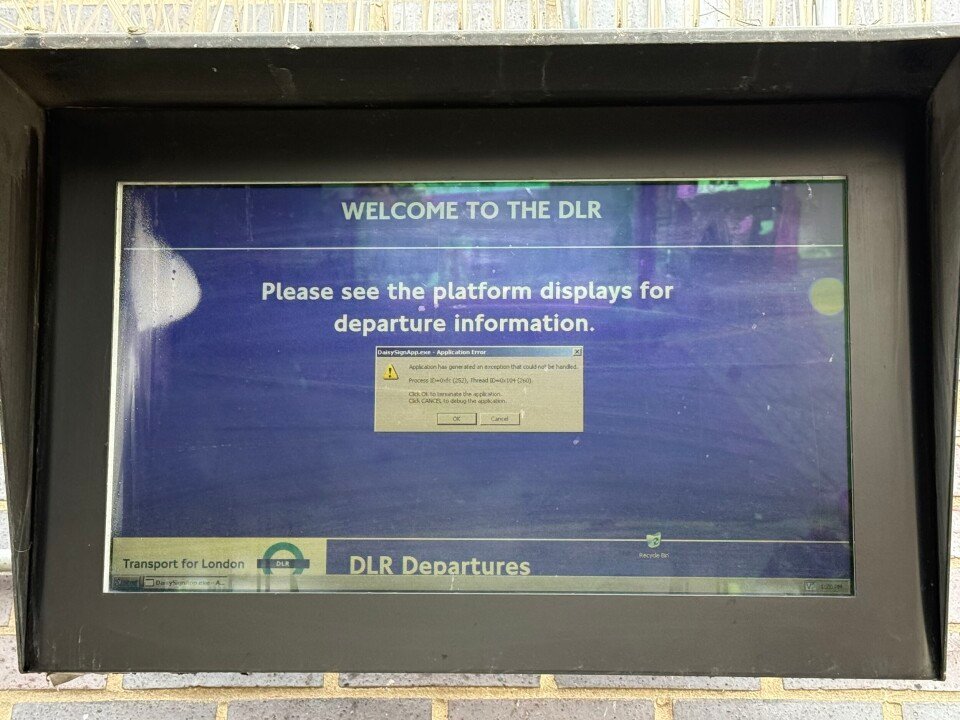
The visible error reportedly came from DaisySignApp.exe, with desktop clues suggesting Windows XP or possibly Windows Server 2003. Microsoft lists Windows XP as out of extended support since April 8, 2014. Windows Server 2003 reached the end of extended support in July 2015. A railway display screen is not the same thing as a signaling system, and the image alone does not prove exposure of personal data or safety-critical systems. It does, however, create a governance issue: a regulated operator should be able to explain asset ownership, support status, network segmentation, patching exceptions, monitoring, and replacement dates.
The main UK regulatory frame is the UK GDPR security principle and Article 32 guidance from the ICO. The Data Protection Act 2018 received Royal Assent on May 23, 2018, and the GDPR regime applied from May 25, 2018, later becoming the UK GDPR after Brexit. The ICO guidance requires appropriate technical and organisational measures based on risk, including confidentiality, integrity, availability, restoration capability, and regular testing of controls.
For transport and other essential services, the Network and Information Systems Regulations 2018 came into force on May 10, 2018. They apply to operators of essential services and digital service providers, with transport expressly identified as an essential service sector. The UK government has also introduced the Cyber Security and Resilience Bill, first read in Parliament on November 12, 2025, to reform the NIS framework and strengthen duties around critical and digital services.
For organizations with US-facing financial services activities, the Federal Trade Commission has a parallel expectation under the FTC Safeguards Rule. The rule took effect in 2003, was amended in 2021, and breach notification requirements took effect in May 2024. Covered non-bank financial institutions must maintain a written information security program and notify the FTC no later than 30 days after discovering a qualifying breach involving at least 500 consumers' unencrypted customer information.
What It Requires
A compliance officer should treat the DLR screen as a case study in unsupported technology governance. The first requirement is not immediate blame. The first requirement is evidence. If a legacy endpoint is present, the operator should know whether it is standalone, vendor-managed, connected to a management network, remotely administered, protected by application allow-listing, monitored for compromise, and covered by an approved exception.
Under UK GDPR Article 32, unsupported software is not automatically unlawful. The legal standard is risk-based. That means the organization must show that the technical and organisational measures are appropriate to the nature of the processing and the likely impact on individuals. If the display processes no personal data, the UK GDPR exposure may be limited. If the same platform family is used for systems that process CCTV feeds, staff credentials, passenger assistance records, customer communications, payment data, or operational logs tied to identifiable people, the compliance burden becomes much higher.
The practical control set is straightforward. Maintain an accurate asset inventory that records operating system version, application owner, vendor support status, business function, network zone, data handled, remote access route, and replacement owner. Unsupported systems should be flagged as exceptions, not allowed to disappear into general operations. Each exception should have a documented risk acceptance signed by an accountable executive, a compensating-control plan, and an expiry date.
For NIS-regulated operators, the question broadens from personal data to service continuity. A public display failure may be low impact, but the same maintenance pattern can signal weak lifecycle control across operational technology. NIS compliance expects security and physical resilience for network and information systems supporting essential services. That includes preventing incidents, minimizing impact, and maintaining continuity. A transport operator should be able to separate passenger information displays from safety-critical railway systems, prove that administrative access is controlled, and demonstrate that a display fault cannot become a route into more sensitive networks.
Vendor management is equally important. Public transport estates often contain long-lived embedded systems supplied under contracts that predate current cyber rules. The compliance team should review whether contracts require supported software, vulnerability disclosure, patch availability, incident cooperation, secure remote access, logging, and end-of-life notices. A vendor's statement that a system still functions is not enough. Functionality is not support, and support is not the same as security.
For FTC-covered organizations, the lesson is similar but framed through customer information. The Safeguards Rule requires a written program, a qualified individual, risk assessments, access controls, encryption where feasible, multi-factor authentication, secure disposal, change management, activity logging, monitoring, staff training, service provider oversight, and periodic reporting to the board or equivalent governing body. A legacy display screen may not trigger the rule, but the control failure it represents would be relevant if the same organization handles nonpublic personal information in older systems.
The compliance position should be practical: isolate first, replace on a governed schedule, and document every deviation. If the system must remain temporarily, disable unnecessary services, remove internet exposure, restrict administrative access, place it in a tightly controlled network segment, monitor it, back up required configuration, and test recovery. If the system cannot meet those controls, it should be treated as a priority replacement rather than a tolerated oddity.
Compliance Timeline
Immediate action, within 72 hours, should focus on facts. Identify the asset, owner, operating system, application version, network connections, remote access methods, data handled, and vendor. Confirm whether the failure is confined to a passenger information endpoint or linked to broader management infrastructure. Preserve relevant logs if there is any indication of unauthorized access, but do not overclassify a visible application crash as a breach without evidence.
Within 30 days, complete a documented risk assessment. For UK GDPR, record whether personal data is processed and whether confidentiality, integrity, availability, and restoration controls are appropriate. For NIS, map the endpoint to the essential service dependency chain and confirm segmentation from higher-risk systems. For FTC-regulated entities, decide whether the system touches customer information or supports a system that does. If a qualifying FTC notification event is discovered, the 30-day clock runs from discovery.
Within 60 to 90 days, close the governance gap. Either remove the unsupported platform or approve a time-limited exception with compensating controls. The exception should include named ownership, business justification, technical restrictions, monitoring requirements, backup and recovery steps, vendor commitments, and a retirement date. Unsupported systems should not remain in production on informal assurances.
By the next annual audit cycle, legacy technology should appear in board-level risk reporting. The report should list unsupported operating systems, unsupported applications, externally reachable services, exceptions past expiry, and replacement funding. Compliance teams should also track the Cyber Security and Resilience Bill during 2026 because it is designed to reform the NIS Regulations and may expand expectations for service providers and incident reporting.
The operational message is clear. A public Windows error is not, by itself, a regulatory breach. It is a prompt to prove lifecycle control. If the organization can show inventory, risk assessment, isolation, monitoring, vendor oversight, and a funded replacement plan, the incident remains an embarrassing service defect. If it cannot, the screen is evidence of a deeper compliance problem that regulators, auditors, and customers will understand immediately.
Comments
Please log in or register to join the discussion