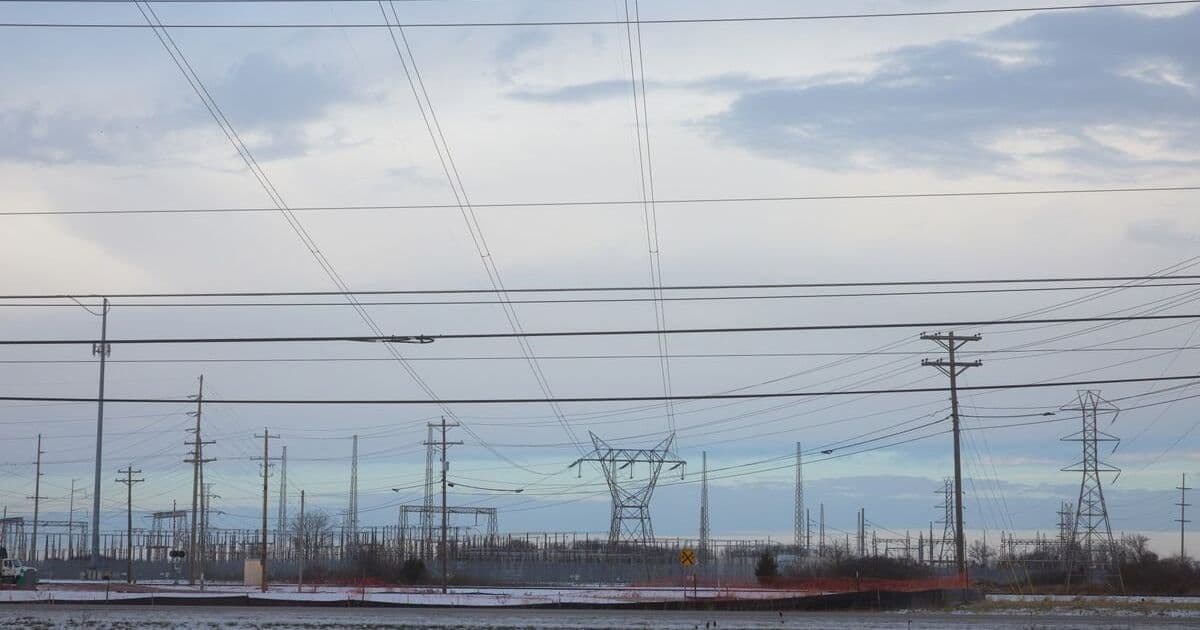
The largest U.S. grid operator has reduced its peak electricity demand forecast for summer 2027, tempering expectations for the power consumption surge driven by the AI boom. The revision reflects a significant number of proposed projects, particularly data centers, that lack firm commitments for construction or grid service.
The PJM Interconnection, the regional transmission organization that manages the electric grid for 13 states and the District of Columbia, has lowered its forecast for peak summer electricity demand in 2027. The new projection of approximately 160 gigawatts (GW) is down from a previous estimate of 164 GW. This 4 GW reduction, while seemingly modest, signals a more cautious outlook on the near-term power consumption growth that has been largely attributed to the rapid expansion of energy-intensive AI data centers.
What's Claimed vs. What's Actually New
The prevailing narrative over the past two years has been one of insatiable, exponential growth in electricity demand. Projections from data center developers, utility executives, and industry analysts have painted a picture of a grid under immense strain, with forecasts for power consumption doubling or even tripling by the end of the decade. This has fueled a massive rally in utility stocks and spurred plans for building new power plants and upgrading transmission infrastructure.
The PJM's revised forecast acts as a reality check on this narrative. It's not a declaration that the AI-driven power boom is over. Instead, it's a more granular, data-driven adjustment based on the difference between proposed projects and projects with guaranteed financial and construction backing. The core of the update is the distinction between a project being announced and a project being committed. Many data center developers have announced plans for massive facilities, but they have not yet secured the final power purchase agreements or construction financing that would lock in their energy demand with PJM. The grid operator is simply removing the uncommitted portion from its near-term forecast.
The Practical Reality: Uncertainty in the Build-Out
For grid operators like PJM, forecasting is a critical input for planning. They need to ensure there is enough generation capacity to meet peak demand, which typically occurs during hot summer afternoons when air conditioning use is high. An inaccurate forecast can lead to either overbuilding (and passing unnecessary costs to consumers) or underbuilding (and risking reliability issues).
The key takeaway from PJM's action is the acknowledgment of significant uncertainty in the data center pipeline. While the demand for AI compute is real, the physical build-out of the infrastructure to support it is not a foregone conclusion. Developers face numerous hurdles:
- Grid Connection Queues: PJM, like other grid operators, has a massive backlog of generation and storage projects waiting for interconnection. The wait time can be several years, delaying when a new data center can actually get power.
- Supply Chain Constraints: Securing critical equipment, from high-voltage transformers to the chips themselves, remains a challenge.
- Financing Hurdles: The immense capital required for these projects means developers need to secure firm commitments from customers (cloud providers or AI companies) and financiers. In a high-interest-rate environment, this is more difficult.
Limitations and Broader Implications
This forecast revision is specific to PJM and the 2027 timeframe. It does not negate the long-term structural increase in electricity demand from AI. The underlying trend of growing power needs for computing remains intact. However, it does suggest that the most aggressive growth scenarios may not materialize as quickly as some investors and industry watchers have assumed.
For the broader energy market, this has several implications:
For Utilities: It provides a moment of relief. While they still need to plan for significant growth, the immediate pressure to bring massive amounts of new generation online by 2027 may be slightly less acute. Their long-term capital expenditure plans remain valid, but the timeline may be more flexible than previously thought.
For Data Center Developers: The onus is now on them to convert announced plans into firm commitments. This means navigating complex interconnection processes and securing long-term power contracts. The era of simply announcing a 1 GW data center campus without a clear path to power is likely ending.
For the AI Industry: This highlights a critical physical constraint on the AI boom. The computational capacity needed to train and run models like GPT-5 and beyond is not just a matter of buying more GPUs; it's about having the physical infrastructure—power plants, substations, and transmission lines—to run them. The PJM forecast is a tangible data point showing that the build-out of this infrastructure will be a staggered, complex process, not a single, explosive event.
In essence, the PJM update is a crucial piece of grounding the AI hype cycle in physical reality. The demand is coming, but the grid's ability to deliver it will depend on firm commitments, not just ambitious announcements.
Comments
Please log in or register to join the discussion