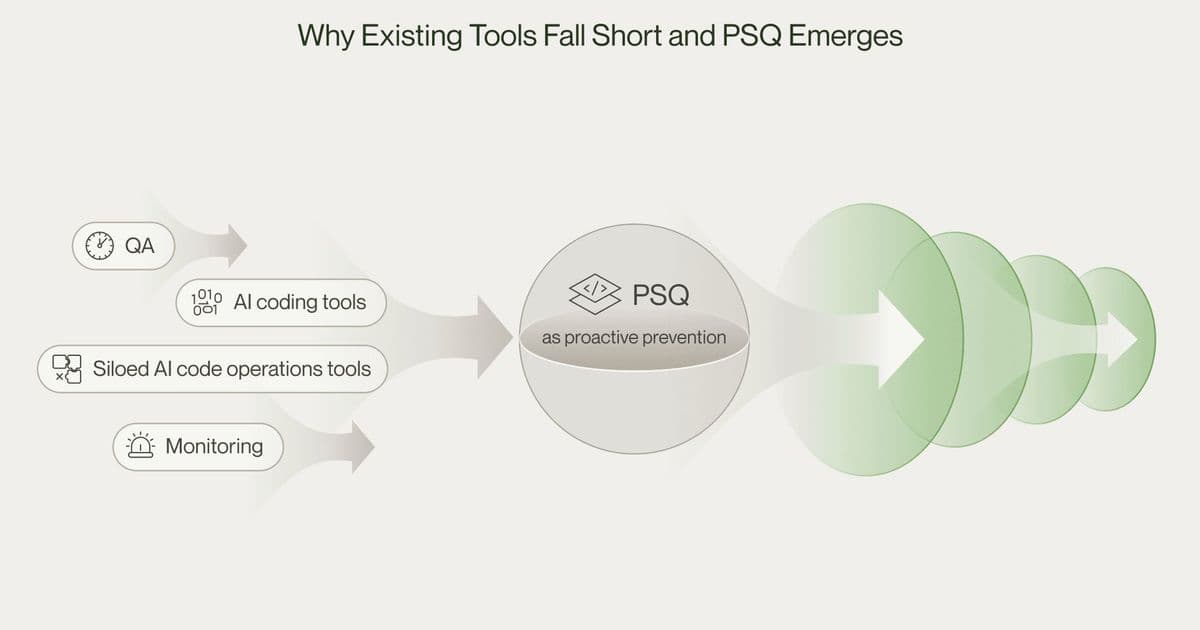
Enterprises are drowning in code, alerts, and post‑release bugs. Predictive Software Quality (PSQ) uses AI‑driven simulation, risk ranking, and continuous knowledge capture to forecast defects before they ship, cutting firefighting time and speeding releases. PlayerZero, backed by Foundation Capital and Green Bay Ventures, is commercialising the first platform built for this approach.
 )
)
The problem enterprise engineers face today
Large product teams are releasing new features every week, yet the codebase they manage is expanding faster than any manual testing effort can keep up with. Recent internal surveys show that more than 25 % of new code at leading cloud providers is now generated by AI, and the number is climbing. At the same time, alert streams have swelled to over 4,000 notifications per day per team, with two‑thirds of those ignored because engineers are burnt out. The result is a steady flow of production defects – roughly one in four releases still ships a bug that reaches customers.
Traditional quality tools are built for a reactive world: static linters, scripted test suites, and post‑mortem monitoring. They catch what they are told to look for, but they cannot anticipate the hidden interactions that emerge when a new module touches legacy code written years ago. The industry’s current “add‑more‑tests” mindset is hitting a wall – test maintenance costs are rising, and coverage gaps remain.
Why existing AI‑assisted tools don’t close the gap
A wave of AI helpers has arrived for code review, bug triage, and even automated test generation. Each of these tools tackles a single step in the software development lifecycle. When used in isolation they provide modest speed gains, but they do not change the overall workflow. Engineers still have to merge the AI suggestion, run a full CI pipeline, watch the alerts, and then react to any failures. The biggest opportunity lies in re‑thinking the entire quality process, moving from “catch‑after‑the‑fact” to “predict‑before‑the‑fact”.
Predictive Software Quality (PSQ) explained
Predictive Software Quality is a methodology that blends four core capabilities:
- Code simulation – an AI model, called Sim‑1, ingests the whole repository graph and runs lightweight, scenario‑driven simulations of a proposed change. It does not require a full test environment, which keeps the feedback loop under a minute for most changes.
- Automated risk detection – the simulation output is scored against business‑impact heuristics (e.g., revenue‑critical checkout flow, authentication path). The highest‑risk regressions are surfaced directly in the pull request.
- Scenario generation – real‑world telemetry, past incident tickets, and product specifications are transformed into concrete test cases. For example, a login flow that previously failed on email addresses containing a hyphen is turned into a synthetic test automatically.
- Knowledge capture – every defect that is prevented or fixed is logged, tagged, and fed back into Sim‑1, making the model smarter over time.
Together these steps create a continuous loop: data → simulation → risk ranking → developer feedback → knowledge update. The loop runs on every commit, giving teams foresight that traditional QA simply cannot provide.
A concrete example
A fintech company added a new two‑factor authentication option. The feature passed all unit and integration tests, but a handful of users reported being unable to enroll when their phone number started with a leading zero. The root cause was a legacy parsing routine that stripped leading zeros before validation – a path that had not been exercised by the new tests.
With PSQ in place, the platform generated a scenario from the recent support tickets, simulated the change against the legacy routine, and flagged the regression before the code was merged. The developer received an inline comment with the exact line of code and a suggested fix. The bug never reached production, preserving the onboarding funnel and avoiding a potential revenue dip.
What happens when a defect does escape?
Even with a 80 %+ prevention rate, some issues will slip through. The PSQ platform performs three actions automatically:
- Validation – confirms the signal is a genuine defect and estimates user impact.
- Root‑cause mapping – links the symptom to the responsible code segment using the same Sim‑1 model.
- Remediation workflow – proposes a code change, updates relevant documentation, and notifies the appropriate stakeholder groups (engineers, support, product).
Because the knowledge capture step records the incident, the next similar change will be caught early.
Measurable impact for early adopters
| Company | Defect escape reduction | Ticket‑resolution time | Engineering‑hours saved |
|---|---|---|---|
| Cayuse (cloud research platform) | 90 % | 80 % | 30 % |
| Cyrano Video | 80 % | 70 % | 25 % |
| Key Data (data‑pipeline SaaS) | 85 % | 75 % | 28 % |
These numbers come from internal case studies published by the customers themselves. In each case, the engineering organization reported that the freed capacity was redirected toward feature work rather than incident response.
PlayerZero’s role in defining the category
PlayerZero built the first end‑to‑end PSQ platform. Its flagship innovations include:
- Sim‑1 model – a purpose‑built transformer that reasons over multi‑repo architectures, unlike generic LLMs that only understand snippets.
- CodeSim engine – a lightweight simulation runtime that can evaluate a change across the entire dependency graph in seconds.
- Agentic debugging – an autonomous agent that takes a support ticket, finds the offending line, and suggests a patch.
- Continuous knowledge capture – a structured repository that turns every resolved bug into a reusable artifact.
The company is backed by Foundation Capital, Green Bay Ventures, and several angels who previously funded Databricks, Dropbox, Figma, and Vercel. Their latest Series A round raised $45 million (see the announcement on the official blog).
How PSQ reshapes team roles
- Developers – see AI‑generated risk warnings directly in pull requests, allowing them to fix issues before they become blockers.
- QA engineers – shift from maintaining brittle test suites to curating high‑impact scenario feeds for the simulation engine.
- Customer‑success – receive automatically generated hypotheses for recurring issues, reducing escalations.
- Engineering leadership – gains a dashboard that shows defect‑escape trends, risk heat‑maps, and ROI on quality investments.
Looking ahead
Predictive Software Quality is still in its early adoption phase, but the momentum is clear. As AI‑generated code becomes the norm, the gap between speed and reliability will only widen unless teams adopt a forward‑looking approach. PSQ offers a concrete path to bridge that gap without adding headcount.
If you want to see the technology in action, PlayerZero provides a live demo and a free trial for qualified enterprises. More technical details are available in their launch announcement and the open‑source reference implementation of the CodeSim engine on GitHub (playerzero/codesim).
Author’s note: The analysis above reflects publicly available information as of May 2026. All monetary figures are taken from the company’s disclosed financing rounds.
Comments
Please log in or register to join the discussion