
Prusa Research announces ColorMix engine for PrusaSlicer and EasyPrint, joining competitors in implementing Full Spectrum color printing technology with significant performance improvements over current methods.
Prusa Research has entered the competitive race for advanced color printing technology with the announcement of a new open-source ColorMix engine for both PrusaSlicer and its web-based EasyPrint slicer. The move places Prusa alongside Snapmaker and Bambu Lab in implementing "Full Spectrum" color printing capabilities, a method that visually blends FDM filaments to create an extensive color palette.
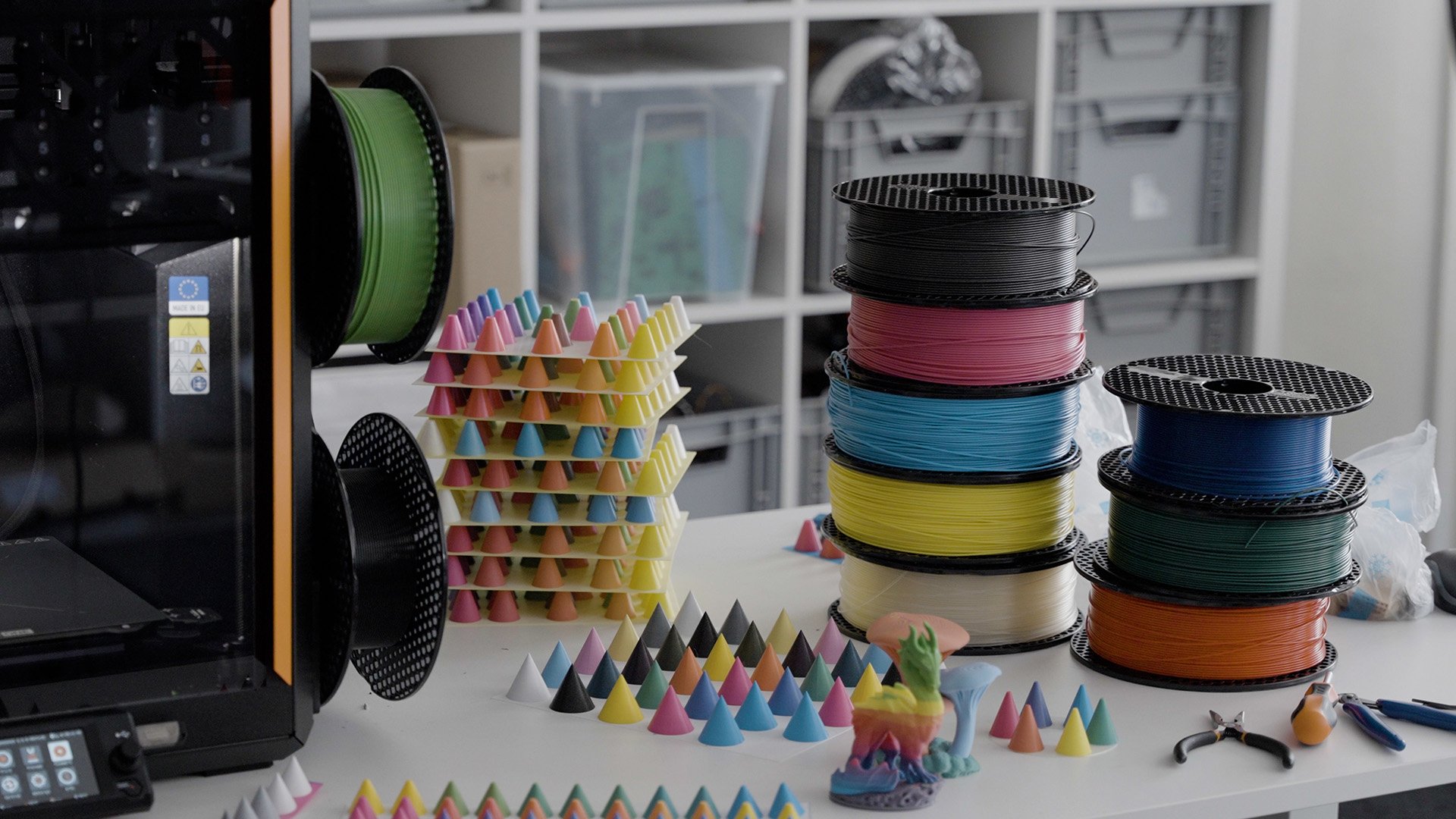
Full Spectrum color printing represents a significant advancement in multimaterial 3D printing, leveraging the growing capabilities of toolchangers and similar multimaterial printers. The technique works optimally when printing at ultra-thin layer heights, which modern toolchangers can achieve with relative speed and minimal material waste. According to Prusa's recent development details shared in a video and blog post, this method can produce subtle shades and hues that would otherwise require purchasing numerous individual spools of specific colors.
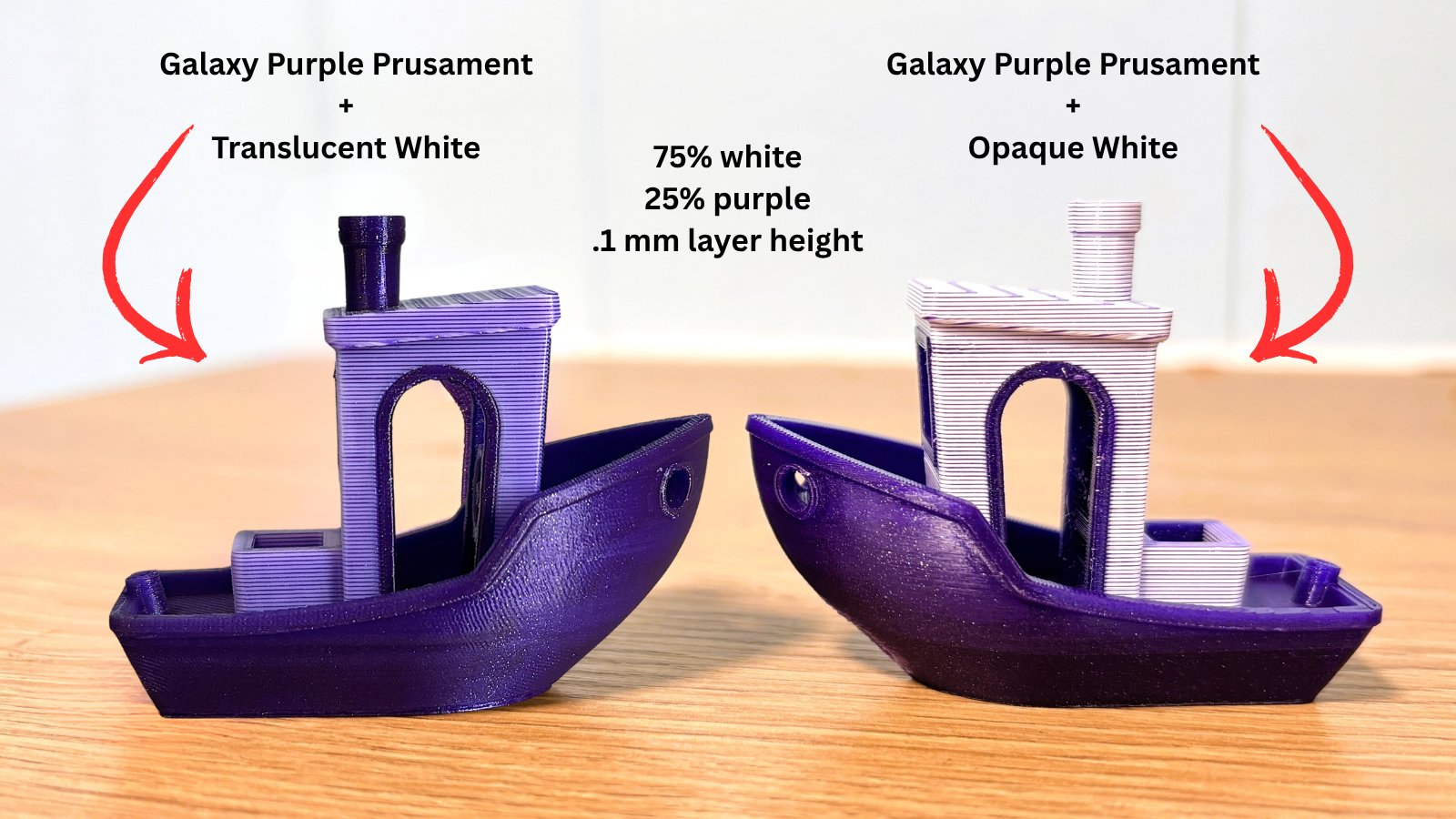
However, the technology comes with trade-offs. Prusa engineers acknowledge that color mixing will likely not replace having individual spools of precise colors in the near future. Besides requiring significantly more print time, Full Spectrum colors can exhibit noticeable banding, particularly when using opaque materials. Testing revealed that translucent "high speed" white filaments blend much better than standard opaque white options when creating mixed colors like a 75% white with 25% purple combination.
Performance testing demonstrated the current limitations of the technology. When printing a 3D Benchy using a Prusa MK4 with an MMU3, the process took over 7 hours to create a 66-gram purge tower. On a Prusa XL toolchanger, the time was reduced to 2 hours and 46 minutes, with waste material decreased to only 22 grams. These figures highlight the efficiency gains provided by dedicated toolchanging systems compared to single-extruder machines with material switching capabilities.
Prusa's upcoming INDX printer promises to further improve these metrics, potentially increasing print speeds while reducing waste to nearly negligible levels. This advancement could make Full Spectrum printing more practical for commercial applications and serious hobbyists.
The technology builds upon concepts developed by others in the open-source 3D printing community, including Radu's (Ratdoux) OrcaSlicer-FullS implementation, Justin H. Rahb's filament mixer, and the PeggyPalette model for comparing results. Prusa Research has also leveraged its Open Tag project—a comprehensive library of thousands of filaments from dozens of brands—and created the Prusa FDM Mixer to virtually create new colors from existing filaments.
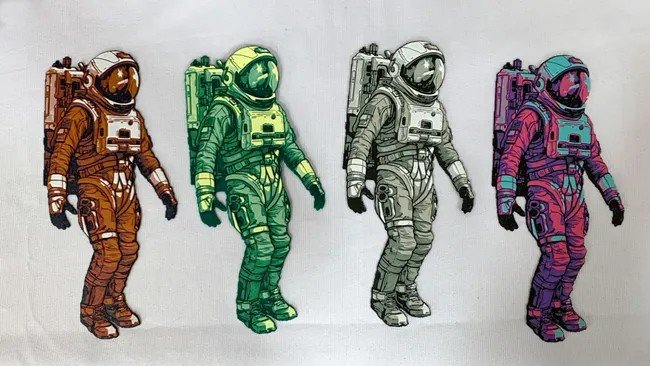
At its core, Full Spectrum printing addresses a fundamental challenge: plastic filaments cannot mix together like paint or ink. Instead, the technique creates the illusion of color through optical tricks. The Prusa team identified similarities between Ratdoux's method and halftoning—the process used in traditional printing that creates color images by spacing small dots of ink. Much like how paper printing presses use CMYK (cyan, magenta, yellow, and black) with white provided by the underlying paper, ColorMix utilizes five filament colors.
Prusa Polymers is currently working to standardize these five colors as part of the method. For immediate experimentation, Prusa recommends using Prusament Azure Blue, Ms. Pink, and Pineapple Yellow. The company expects its upcoming CMYKW filament set to feature translucent properties that will further enhance color blending capabilities.
Currently, ColorMix can be accessed through PrusaSlicer beta version 2.9.6, with users needing to employ the Prusa FDM Mixer separately to estimate color values. This two-step process highlights the current limitations of the implementation. PrusaSlicer, originally developed for single-color MK printers, has always been somewhat cumbersome for multicolor machines. While it allows color selection using a standard RGB and HSL color picker, it doesn't enable filament color selection by spool name, requiring manual transfer of RGB values between tools.
The company has indicated that PrusaSlicer 3.0 will include dedicated tools to simplify the ColorMix workflow, potentially making this advanced color printing technique more accessible to the broader 3D printing community. This development aligns with Prusa's commitment to open-source innovation and its position at the forefront of desktop 3D printing technology.
As the 3D printing industry continues to evolve, Full Spectrum color printing represents an important step toward more visually complex and aesthetically pleasing printed objects. While challenges remain in print speed and material waste, the rapid improvements in both hardware and software suggest that color mixing capabilities will become increasingly practical and widespread in the coming years.
Comments
Please log in or register to join the discussion