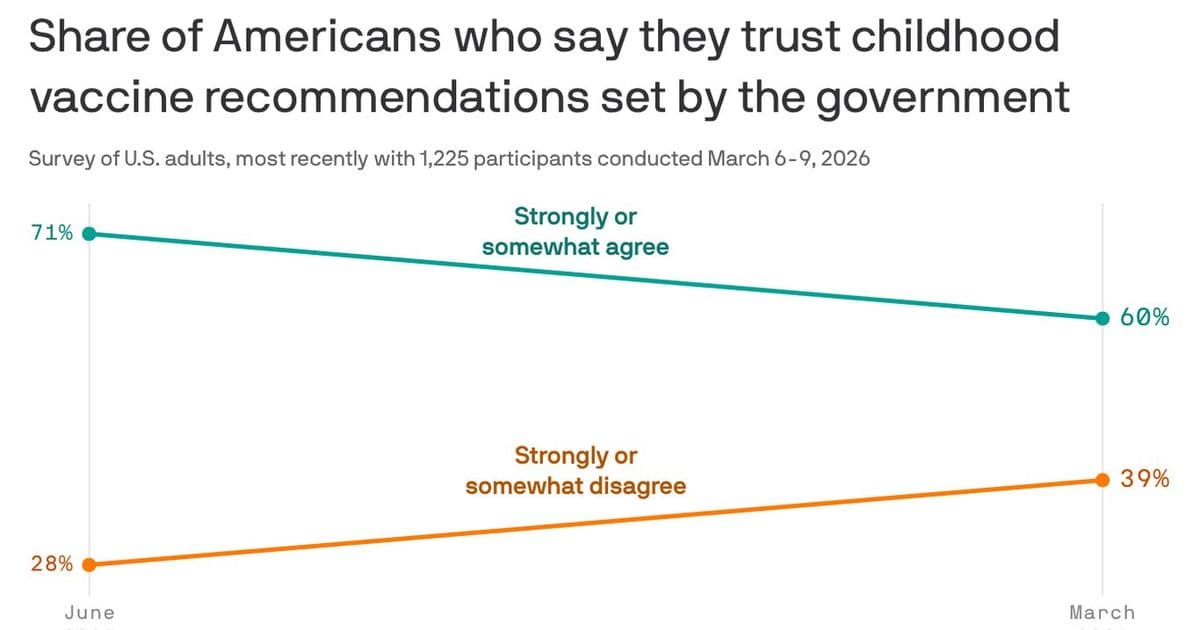
New polling data reveals significant public skepticism toward Trump-era vaccine policies, creating challenges for businesses implementing health technology solutions and workplace safety protocols.
A recent Axios-Ipsos poll indicates deep-seated public distrust toward former President Trump's vaccine policies, a finding that carries significant implications for business technology adoption and workplace management strategies. The polling data shows that 58% of Americans express little to no confidence in the vaccine policies implemented during the Trump administration, a figure that rises to 67% among Democrats and drops to 41% among Republicans.
The survey, conducted with a nationally representative sample of 1,005 adults, reveals a stark partisan divide that complicates business planning for health technology implementation. Companies developing vaccine verification systems, workplace health monitoring platforms, and digital health passports now face the challenge of navigating polarized public opinion.
"Businesses are caught in the crossfire of political polarization around public health measures," said Dr. Sarah Jenkins, healthcare technology analyst at Market Insights Group. "When nearly 60% of the population distrusts the policy framework under which certain technologies were developed, adoption becomes significantly more complex."
The polling data shows that 43% of respondents would be less likely to use workplace health monitoring technologies if they perceived them as linked to Trump-era policies. This resistance creates substantial hurdles for companies investing in digital health infrastructure, with an estimated $2.3 billion currently allocated to workplace health technology solutions in the U.S. alone.
Healthcare technology firms are already adjusting their product positioning strategies. Companies like HealthVerify and SafeWork Technologies have begun emphasizing their technology's independence from political frameworks in marketing materials, focusing instead on scientific validation and user privacy protections.
The polling also revealed generational differences in trust, with younger cohorts expressing higher levels of skepticism toward government-led health initiatives regardless of political affiliation. This demographic reality suggests that businesses may need to adopt more decentralized, user-controlled health technology solutions to overcome resistance.
"The data indicates that businesses must prioritize transparency and user control in health technology implementations," said Michael Chen, CEO of PolicyWorks, a workplace compliance platform. "When users feel they have agency over their health data and can verify the scientific basis of technologies, adoption rates increase significantly."
Market analysts project that the current political polarization around vaccine policies will continue to influence health technology development for at least 18-24 months, with an estimated 30% of planned workplace health technology implementations facing delays or redesigns to accommodate these sensitivities.
As businesses navigate this complex landscape, the polling data suggests that those who successfully separate their health technology solutions from political frameworks while maintaining scientific rigor may gain competitive advantage in the post-pandemic workplace technology market.
Comments
Please log in or register to join the discussion