A deep dive into Python's fundamental distinction between object identity and value equality, explaining why confusing 'is' and '==' leads to subtle bugs and performance pitfalls. Learn when to use each operator through practical examples and immutable type quirks that every Python developer must master.
In Python's elegant yet nuanced landscape, few distinctions cause as much initial confusion—and subsequent enlightenment—as the difference between the is and == operators. At first glance, both seem to answer "Are these the same?" But as seasoned developers discover, one examines essence while the other evaluates appearance—a philosophical divide with profound technical consequences.
The Core Dichotomy
==(Equality): Compares values or contents. Asks: "Do these objects hold identical data?"a = [1, 2, 3] b = [1, 2, 3] print(a == b) # True – same contentsis(Identity): Checks memory references. Asks: "Are these the exact same object?"print(a is b) # False – distinct objects in memory
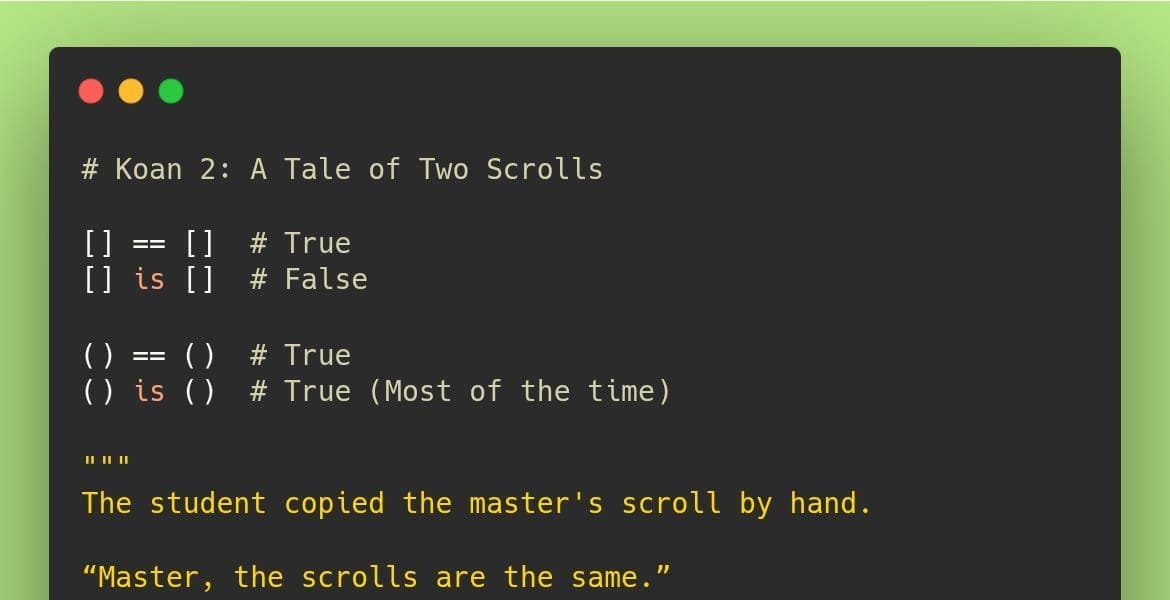
This mirrors two identical scrolls: though their text matches, altering one leaves the other unchanged. Identity (is) confirms they're the same physical artifact, while equality (==) verifies the message aligns.
Why Identity Matters: Singletons and Sentinels
is shines when handling unique objects like None, True, or custom sentinels:
if user_input is None:  # Not '== None'
    handle_missing_value()
Here, is explicitly checks for the singleton None object—safer and faster than value comparison. Relying on == risks subtle bugs if values emulate None.
The Immutable Illusion
With small integers or tuples, CPython's optimization caches objects, creating illusions:
x = 256; y = 256
print(x is y)  # True (cached integers)

a = 1000; b = 1000
print(a is b)  # False (larger values aren't cached)
Warning: This behavior is an implementation detail, not a language guarantee. Using is with immutable types invites unpredictability.
Containers: Empty Doesn’t Mean Identical
- Lists:
[] == []isTrue(same content), but[] is []isFalse—each[]creates a new object. - Tuples:
() is ()often returnsTruedue to empty tuple reuse, but don’t rely on it. Python 3.8+ flags such comparisons withSyntaxWarning.
Best Practices for Clarity
- Default to
==for value checks (contents, strings, numbers). - Reserve
isfor singletons (None,True,False) or custom sentinels. - Avoid
iswith literals—implementation quirks aren’t substitutes for design.
The Deeper Lesson
Understanding is versus == transcends syntax—it’s about recognizing Python’s object model. When two variables look identical, ask: are they shared entities or distinct vessels? This distinction prevents elusive bugs in caching, concurrency, and memory-sensitive applications. Like the master’s scrolls, identical words don’t imply identical origins. Python rewards those who see beyond the surface.
Source: Vivis Dev, Python Koans
Comments
Please log in or register to join the discussion