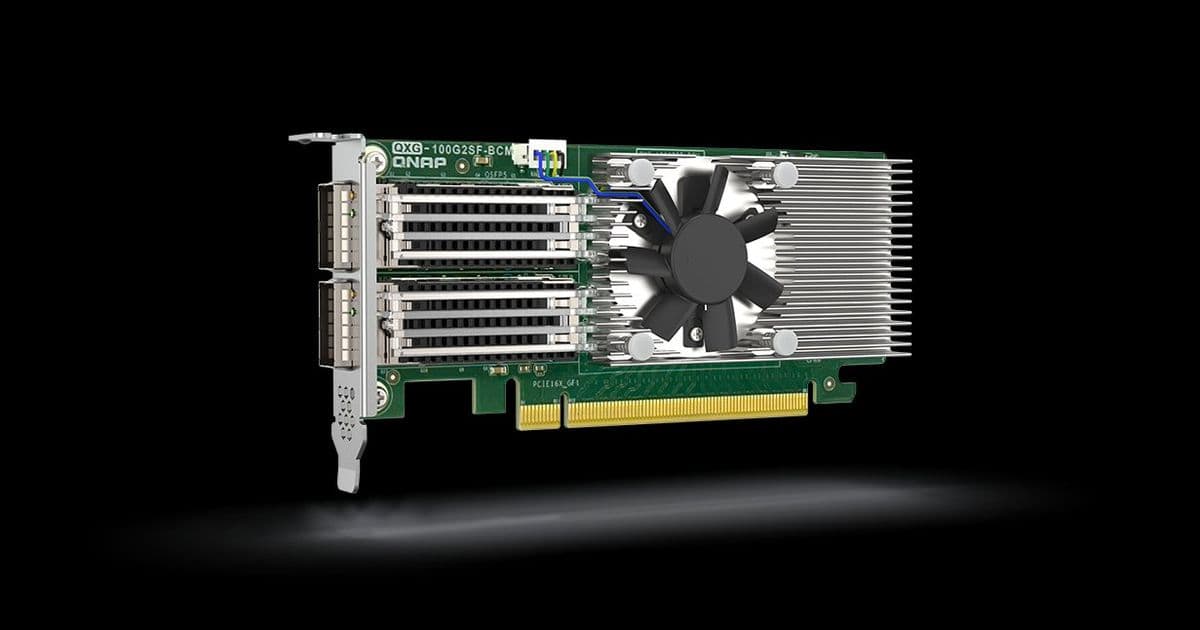
QNAP's new QXG-100G2SF-BCM expansion card delivers dual 100GbE connectivity with Broadcom silicon and RDMA support, targeting demanding NAS and server environments.
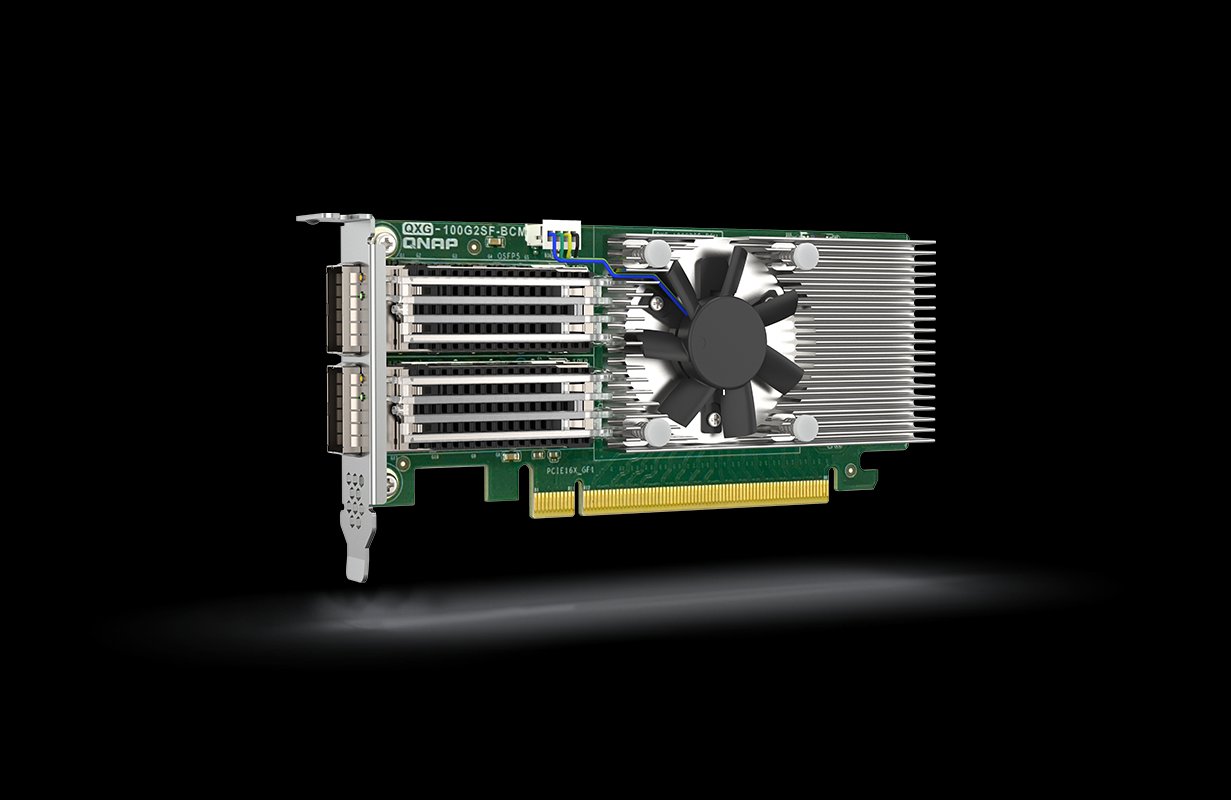
QNAP has introduced the QXG-100G2SF-BCM network expansion card, positioning it as a solution for high-bandwidth networking in NAS systems and workstations. Featuring two QSFP28 ports capable of 100 Gbps each, this PCIe 4.0 x16 card leverages Broadcom's 57508 controller to handle massive data transfers.
The card's active cooling system ensures thermal stability during sustained operations, while Remote Direct Memory Access (RDMA) technology significantly reduces CPU overhead by enabling direct data transfers between network hardware and system memory. This approach cuts latency by up to 40% compared to standard TCP/IP implementations, particularly beneficial for virtualization and storage clustering scenarios.
Compatibility spans QNAP's QuTS hero/TVS-hx74 series NAS devices and Windows 11 workstations. The card ships with both standard and low-profile brackets for flexible installation in rack servers or compact NAS enclosures. Unlike some competitors, QNAP includes specialized mounting hardware for their NAS products, simplifying integration.
Users must supply compatible optical transceivers or opt for QNAP's CAB-DAC15M-Q28 Direct Attached Cable solution. While requiring PCIe 4.0 for full throughput, backward compatibility with PCIe 3.0 systems maintains functionality at reduced speeds.
Priced at $999 MSRP, the QXG-100G2SF-BCM enters a competitive segment dominated by Intel and Mellanox solutions. Its value proposition lies in QNAP-specific optimizations and RDMA implementation tailored for storage workloads. Early adopters should note limited retail availability initially, with broader distribution expected in coming weeks.
For NAS administrators managing video production pipelines or large-scale virtualization, this card potentially doubles available bandwidth compared to dual 40GbE configurations while maintaining similar power consumption profiles. Workstation users dealing with massive datasets will appreciate the direct memory access capabilities when paired with compatible storage arrays.
Comments
Please log in or register to join the discussion