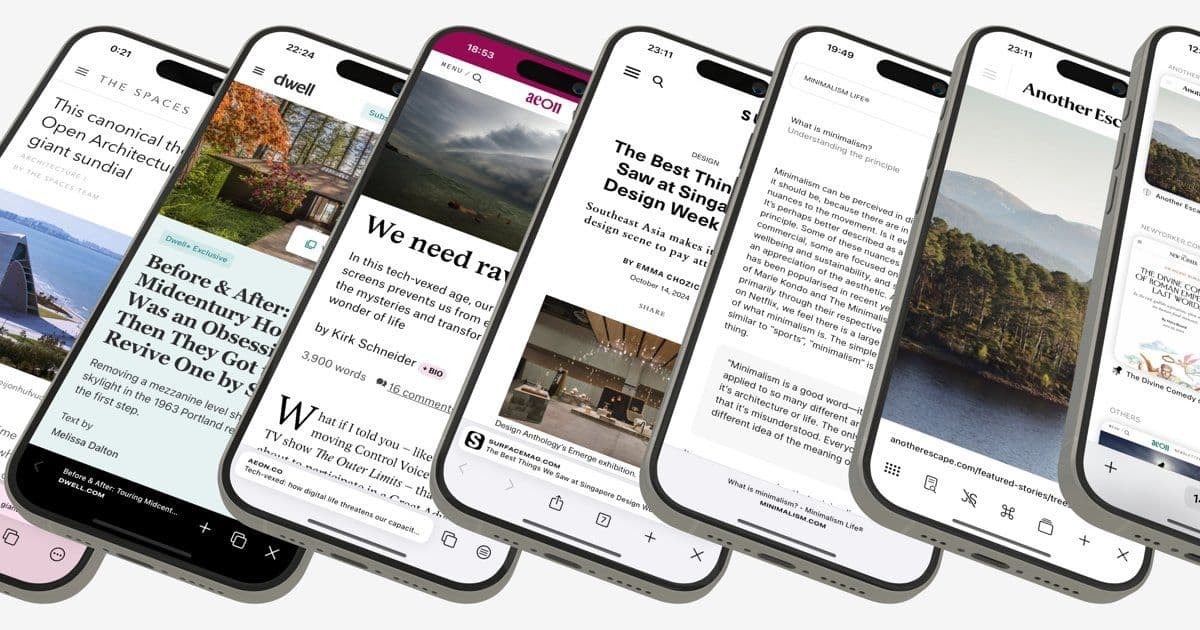
Quiche Browser emerges as a refreshing alternative in a crowded browser market, offering unprecedented customization options while maintaining a steadfast commitment to privacy, transparency, and user experience. Developed by a passionate solo developer, this iOS browser has gained significant traction with its unique approach to web browsing.
Quiche Browser: The Art of Personalized Web Navigation
In an era dominated by tech giants and their one-size-fits-all solutions, Quiche Browser stands as a testament to the power of independent development and user-centric design. This iOS browser has quietly amassed 50,000+ downloads with a remarkable 4.9★ average rating, demonstrating that there remains a significant appetite for browsers that prioritize user control and privacy over corporate interests.
A Philosophy of Radical Customization
At its core, Quiche Browser challenges the assumption that browsers must be rigid, standardized experiences. The developer's frustration with "the rigidity and conservatism of most web browsers" has resulted in a product that turns conventional browser design on its head. Unlike the bloated clones that dominate the App Store, Quiche Browser was "built entirely from scratch," creating a lean foundation that promises better performance, lower memory usage, and faster updates.
The browser's customization capabilities are nothing short of extraordinary. Users can:
- Control toolbar elements: Place every button exactly where needed, eliminating the one-size-fits-all approach that forces users to adapt to browser design rather than the reverse.
- Customize the menu: Less-used buttons can be placed in a popover menu, accessible through a dedicated button, a tap on the address bar, or a long press.
- Master tab management: Choose between list or grid layouts, adjust snapshot sizes, sort by recency or read time, and group tabs by website.
- Personalize the address bar: Select from various visual styles and choose which page information to display.
- Color the experience: Select background colors or set the browser to automatically match the site's color scheme, with different options for light and dark modes.
- Achieve extreme minimalism: Buttons can be moved to a popover menu or even removed entirely, allowing websites to take center stage.
These features collectively represent a fundamental rethinking of how browsers should interact with users. As one reviewer noted, "It's somehow both incredibly simple and one of the most customizable browsers I've ever tried, which is a really hard balance to pull off."
Privacy by Design
In an age of pervasive tracking and data exploitation, Quiche Browser takes a refreshingly different approach. The developer explicitly states: "No sign-up, obviously. Since when did it become normal to require an account to use a web browser?" This simple statement reflects a commitment to user privacy that many mainstream browsers have abandoned.
The privacy features extend beyond the absence of an account requirement:
- Zero usage monitoring: "No usage monitoring or telemetry. I prefer talking directly with users rather than spying on numbers."
- No backend infrastructure: "Quiche Browser doesn't own any backend server or connect to third-party services, with the exception of RevenueCat to manage purchases and prevent fraud."
- Optional search suggestions: Users can turn off search engine suggestions in private tabs or everywhere.
- Built-in blocker: Ads, trackers, cookie banners, and other nuisances are blocked by default.
The transparency extends to an invitation for users to "verify this yourself by inspecting network traffic through a proxy." Such openness is rare in the software world and demonstrates a level of confidence in the privacy claims that few developers would dare to make.
The Independent Developer Advantage
Quiche Browser's development philosophy is perhaps its most distinctive feature. The developer emphasizes their independence as a significant advantage: "As an independent app, all product decisions come directly from me, a full-time user. This freedom is a huge advantage over browsers tied to unsustainable financial deals or startups controlled by investors pushing for unrealistic growth and billion-dollar returns, almost always leading to enshittification."
This perspective reflects a growing awareness among users that corporate priorities often conflict with user experience. The developer's commitment to staying "niche, laser-focused, and financially sustainable" suggests a long-term vision that avoids the pitfalls of growth-at-all-costs mentality that has plagued many tech products.
The development approach also promises faster iteration and more responsive user feedback. "Greg develops and supports it, you get quick answers to all your requests. Where else can you find this?" noted one user, highlighting the direct connection between developer and users that larger organizations struggle to maintain.
Market Reception and User Love
The browser's reception offers valuable insights into what users truly value. The 1,500+ App Store ratings with an average of 4.9★ speak volumes about user satisfaction. Comments reveal a pattern of appreciation for the balance between customization and usability:
- "A very robust, exquisitely designed, stunningly handsome web browser. It's just so thoughtful. So utterly modern in its appearance and features, but old-school in its hyperfocus on serving you, the user through craftsmanship."
- "My favorite iOS browser these days is Quiche Browser. It's somehow both incredibly simple and one of the most customizable browsers I've ever tried, which is a really hard balance to pull off."
- "If you want a lightweight, private, minimalistic, yet customizable web browsing experience on your iPhone – Quiche Browser might be the perfect answer for you. It also offers a number of unique features to make it more tailored for power users than Safari."
The praise extends beyond the product itself to the developer's approach. "Love at first sight, excellent dev support, great roadmap, friendly monetization," wrote one user, while another noted: "I believe a solo developer made it, and they are the embodiment of a thousand loving grandmother energy."
Business Model and Sustainability
The developer has chosen a user-funded approach rather than traditional venture capital or advertising models. "My goal for Quiche Browser is to grow it enough to cover my living expenses so I can focus on it full-time and step away from side jobs," they explain.
This approach is facilitated through Quiche PLUS, a completely optional subscription that unlocks website darkening, all app icons, button customizations, and the developer's "eternal gratitude." The optional nature of this monetization strategy stands in stark contrast to the forced premium features or aggressive advertising that characterize many freemium applications.
The developer emphasizes financial sustainability through minimal expenses: "By keeping expenses minimal, it's designed to never go bankrupt." This pragmatic approach suggests a realistic understanding of the challenges of independent development while maintaining a commitment to the product's core values.
Implications for the Browser Landscape
Quiche Browser's emergence comes at an interesting time in the browser market. While mainstream browsers continue to add features that often serve corporate interests rather than user needs, there appears to be growing demand for alternatives that prioritize user control, privacy, and customization.
The browser's success demonstrates that there remains a market for products developed with clear principles and consistent vision. Its approach challenges the assumption that browsers must follow a particular design pattern or business model to succeed.
The developer's commitment to staying independent and avoiding "enshittification" resonates with users who have witnessed beloved products deteriorate after acquisition by larger companies. This suggests that there may be opportunities for similar independent browsers to gain traction if they maintain their focus on user experience rather than growth metrics.
Looking Forward
With the iPad version currently in beta and potential plans for a Mac port, Quiche Browser appears poised for continued growth. The developer's transparent roadmap and direct communication with users suggest a thoughtful approach to expansion that maintains the product's core values.
The browser's existence raises important questions about the future of web browsing. Will we see more independent browsers that challenge the dominance of major tech companies? Can user-funded models prove sustainable for complex applications like browsers? And will users increasingly demand greater control over their browsing experience?
Quiche Browser offers compelling answers to these questions. By demonstrating that browsers can be both highly customizable and easy to use, both private and feature-rich, and both independent and financially sustainable, it provides a blueprint for a different approach to web navigation—one that puts users first.
As one user eloquently put it: "It's become my default browser. So much love and care from the dev." In an industry often criticized for its lack of human connection, Quiche Browser stands as a reminder that technology, at its best, is built with people in mind.
For more information or to download Quiche Browser, visit the official website. The developer can be followed on Twitter for updates and insights into the development process.
Comments
Please log in or register to join the discussion