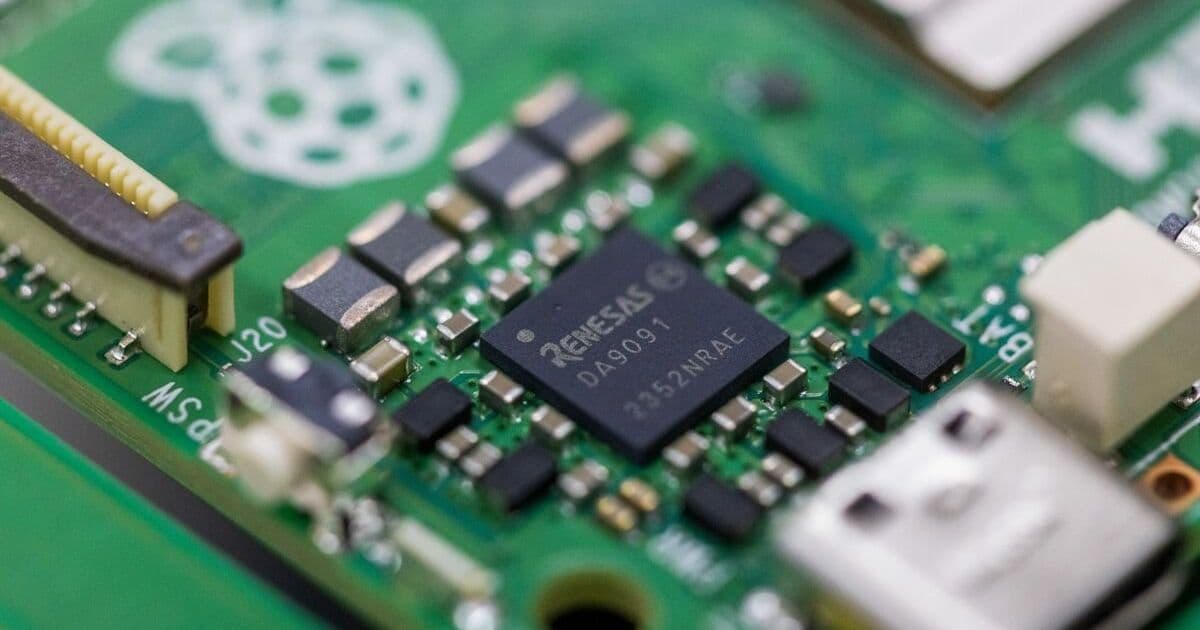
Raspberry Pi reports 25% revenue growth to $323.2M in 2025, driven by US and China demand, while selling more chips than computers for the first time - marking a strategic pivot in the company's business model.
Raspberry Pi Holdings Plc has reported a 25% year-over-year revenue increase to $323.2 million for 2025, with the British maker of low-cost computers seeing particularly strong demand in the United States and China. The company's financial results reveal a significant strategic shift: for the first time, Raspberry Pi sold more chips than complete computers, signaling a fundamental change in its business model.
This chip-first approach represents a departure from Raspberry Pi's traditional identity as a computer manufacturer. The company has historically been known for its affordable single-board computers that have become staples in education, hobbyist projects, and industrial applications. By selling more chips than finished products, Raspberry Pi is positioning itself as a semiconductor supplier while maintaining its ecosystem of development boards and software.
The geographic distribution of demand provides insight into Raspberry Pi's market dynamics. The United States and China emerging as primary growth drivers suggests the company has successfully expanded beyond its European roots. This diversification is particularly noteworthy given ongoing geopolitical tensions and supply chain concerns that have affected technology companies globally.
Raspberry Pi's pivot to chip sales reflects broader trends in the semiconductor industry. As computing becomes increasingly embedded in everyday devices, the demand for specialized chips has grown exponentially. By supplying chips directly to manufacturers, Raspberry Pi can leverage its expertise in low-power, cost-effective computing while potentially achieving higher margins than selling complete systems.
The financial performance comes amid a challenging period for many hardware companies. Memory chip makers like Micron Technology have seen significant stock declines, with shares dropping 10% following earnings reports and falling 30% since mid-March. This contrast highlights Raspberry Pi's resilience and the strength of its business model adaptation.
Industry analysts note that Raspberry Pi's strategy mirrors approaches taken by other successful hardware companies. Apple, for instance, has increasingly focused on designing its own chips while outsourcing manufacturing. Similarly, companies like NVIDIA have built empires on chip design and intellectual property rather than manufacturing.
The implications extend beyond Raspberry Pi's balance sheet. As a company that has played a crucial role in making computing accessible to students and hobbyists worldwide, its shift toward chip sales could affect the availability and pricing of its popular development boards. However, the company's continued growth suggests it has found a way to balance its educational mission with commercial opportunities.
Looking ahead, Raspberry Pi's chip-first strategy positions it well in an era of AI acceleration and edge computing. The company's expertise in low-power, efficient computing aligns perfectly with the growing demand for AI-capable devices that don't require constant cloud connectivity. This could open new markets in industrial IoT, smart home devices, and other applications where Raspberry Pi's technology offers unique advantages.
The financial results also come at a time when the broader tech industry is grappling with AI's impact on various sectors. While companies like OpenAI face massive projected losses despite significant revenue growth, Raspberry Pi's steady expansion demonstrates the continued value of practical, accessible computing solutions.
As the company continues to evolve, its ability to maintain its community-focused ethos while pursuing commercial opportunities will be crucial. Raspberry Pi's success has always been built on a foundation of accessibility and education, and any strategic shift must preserve these core values to maintain its unique position in the technology landscape.
For now, Raspberry Pi's 25% revenue growth and chip-first strategy suggest a company that has successfully navigated the challenges of scaling while staying true to its mission of making computing accessible to everyone. The question remains whether this new direction will enable Raspberry Pi to maintain its cultural significance while achieving the commercial success its technology deserves.
Comments
Please log in or register to join the discussion