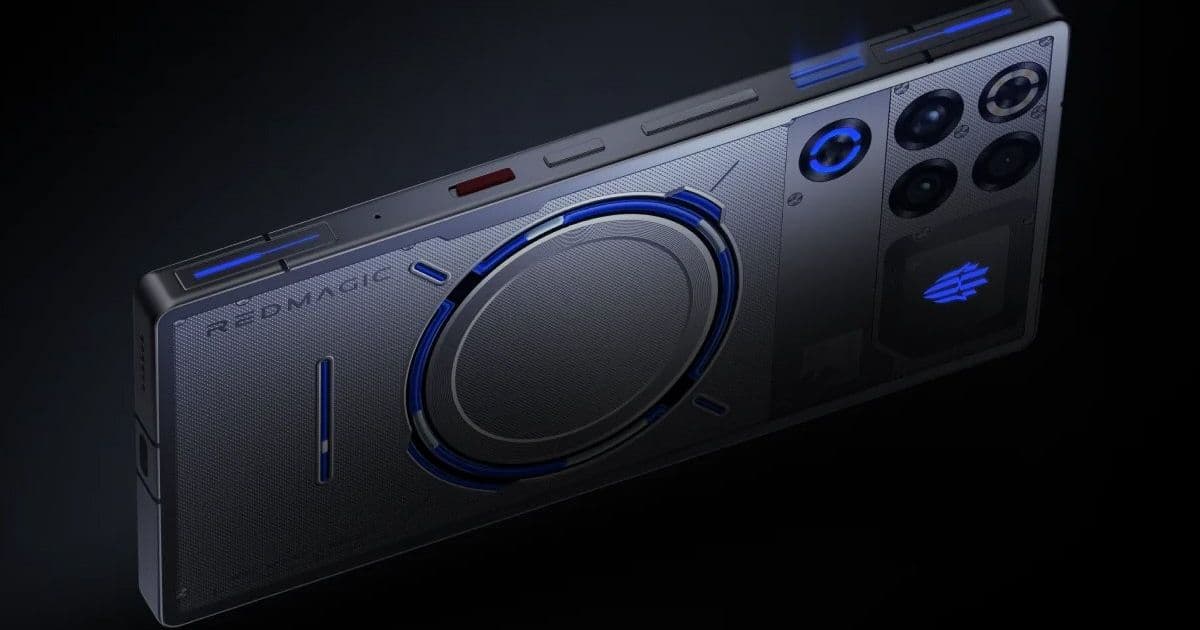
The RedMagic 11 Pro+ continues its reign at the top of AnTuTu's flagship performance charts for December 2025, posting a commanding lead over rival Snapdragon 8 Elite Gen 5 devices while MediaTek's Dimensity 9500 makes its debut in the rankings.
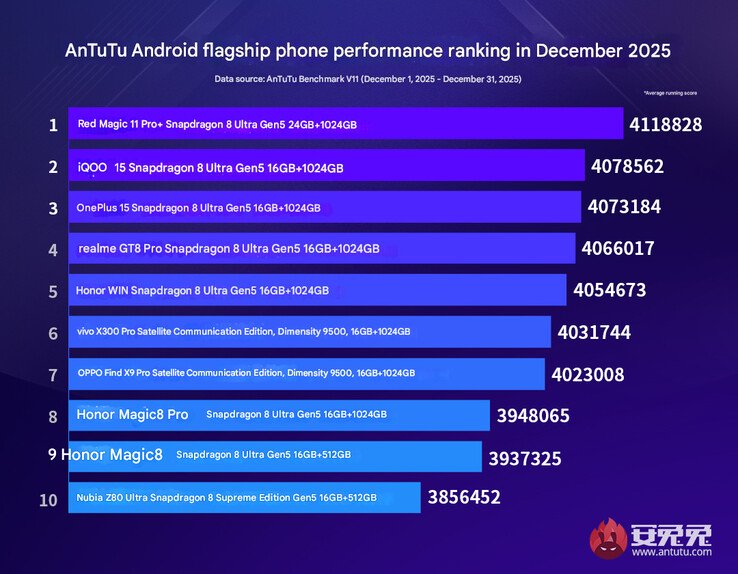
The latest AnTuTu flagship performance rankings for December 2025 reveal little change at the very top, but a subtle shift in the competitive landscape beneath it. The RedMagic 11 Pro+, equipped with Qualcomm's Snapdragon 8 Elite Gen 5, secured the number one position for the second consecutive month, maintaining a noticeable lead over its closest competitors.
This consistency at the summit underscores a key trend: raw performance leadership in Android flagships is increasingly tied to specialized gaming-focused hardware and aggressive thermal management, areas where RedMagic has consistently invested. The device's average score of 4,118,828 points isn't just a number; it represents a tangible gap of roughly 40,000 points over the next closest phone, a margin that becomes significant during sustained gaming sessions or demanding computational tasks.
The Snapdragon 8 Elite Gen 5 Sweep
What's particularly striking about this latest list is the overwhelming dominance of Qualcomm's newest silicon. Eight of the top ten positions are held by devices powered by the Snapdragon 8 Elite Gen 5, creating a clear performance tier.
Right behind the RedMagic 11 Pro+ is the iQOO 15, which claimed second place with an average score of 4,078,562. The iQOO 15 is currently available on TradingShenzhen for approximately $672.62 (256GB variant), positioning it as a more accessible alternative to the gaming-centric RedMagic while delivering nearly identical peak performance.
The OnePlus 15 followed closely in third with 4,073,184 points, continuing the brand's tradition of packing flagship hardware into a refined package. Realme's GT8 Pro took fourth place with 4,066,017 points, and Honor's Win model secured fifth with 4,054,673. The Honor Magic 8 Pro and its non-Pro sibling also appeared in eighth and ninth positions, respectively.
Rounding out the Snapdragon contingent was the Nubia Z80 Ultra, which entered the rankings for the first time in tenth place with an average score of 3,856,452. Its inclusion marks the only newcomer to the list, displacing the Redmi K90 Pro Max, which failed to secure a spot this time around.
MediaTek Dimensity 9500 Makes Its Mark
While Qualcomm's chips dominate the rankings, the real story for industry watchers is the arrival of MediaTek's Dimensity 9500. This new flagship SoC made its debut in the December charts, claiming the sixth and seventh positions.
The Vivo X300 Pro, powered by the Dimensity 9500, achieved an average score of 4,031,744 points, while the Oppo Find X9 Pro with the same chip posted 4,023,008 points. These results place the Dimensity 9500 squarely within striking distance of the Snapdragon 8 Elite Gen 5, trailing by roughly 40,000 to 90,000 points depending on the specific device implementation.
This is a significant development. Historically, MediaTek's flagship chips have competed well on paper but often lagged behind Qualcomm in sustained performance due to differences in thermal management and OEM optimization. The Dimensity 9500's strong showing suggests MediaTek has closed that gap, at least in terms of peak benchmark scores. For consumers, this means more choice and potentially better pricing, as manufacturers may be more willing to adopt MediaTek's chip if performance parity is achievable.
What These Scores Actually Mean
AnTuTu's overall score is a composite metric that combines CPU, GPU, memory, and UX performance. While benchmark numbers can be gamed or skewed by aggressive cooling solutions, they remain a useful indicator of a device's raw hardware capability.
The scores here are averages, meaning they reflect performance across multiple test runs under controlled conditions. The gap between first and tenth place is roughly 262,000 points, which translates to a noticeable difference in real-world tasks like video rendering, 3D gaming, and multitasking.
For example, a sustained 10% performance lead (the RedMagic holds about a 3.2% lead over the iQOO 15) could mean the difference between maintaining 60fps in a demanding game versus dipping into the mid-50s during intense scenes. Similarly, the Dimensity 9500 devices, while slightly behind the top Snapdragon phones, are still delivering performance that far exceeds what was possible just a year ago.
The Gaming Phone Advantage
Why does the RedMagic 11 Pro+ consistently lead? The answer lies in its specialized design. Gaming phones like the RedMagic typically feature:
- Active cooling systems: Built-in fans or advanced vapor chambers that prevent thermal throttling during extended loads.
- Higher power limits: The ability to draw more power from the battery and deliver it to the SoC, enabling higher clock speeds.
- Optimized software: Gaming modes that prioritize performance over battery life and background processes.
These features give gaming phones an edge in benchmark scenarios, but they also translate to better real-world performance for users who push their devices hard. The trade-off is often a thicker chassis, louder fan noise, and shorter battery life when not plugged in.
The Competitive Landscape
The December rankings paint a picture of a highly competitive flagship market. Qualcomm's Snapdragon 8 Elite Gen 5 is the clear performance leader, but MediaTek's Dimensity 9500 has entered the conversation as a legitimate alternative. The displacement of the Redmi K90 Pro Max by the Nubia Z80 Ultra suggests that even within the same chip family, implementation matters greatly.
For buyers, the choice is clearer than ever. If you want the absolute best performance regardless of other factors, the RedMagic 11 Pro+ is the phone to beat. If you prefer a more balanced device with near-top performance, the iQOO 15, OnePlus 15, or Realme GT8 Pro offer compelling packages. And if you're curious about MediaTek's latest offering, the Vivo X300 Pro and Oppo Find X9 Pro are worth watching as they mature.
The full rankings, including additional devices and detailed breakdowns, are available in AnTuTu's official release. You can follow the source link at AnTuTu for the complete dataset and methodology.
Source: AnTuTu (machine translated from Chinese)
About the Author: Abid Ahsan Shanto is a Senior Tech Writer at Notebookcheck with over 2,400 articles published since 2023. His journey as a technophile began when he first assembled his PC, and his insatiable curiosity has driven him to explore every aspect of this rapidly evolving technological landscape.
Published: 2026-01-11
Comments
Please log in or register to join the discussion