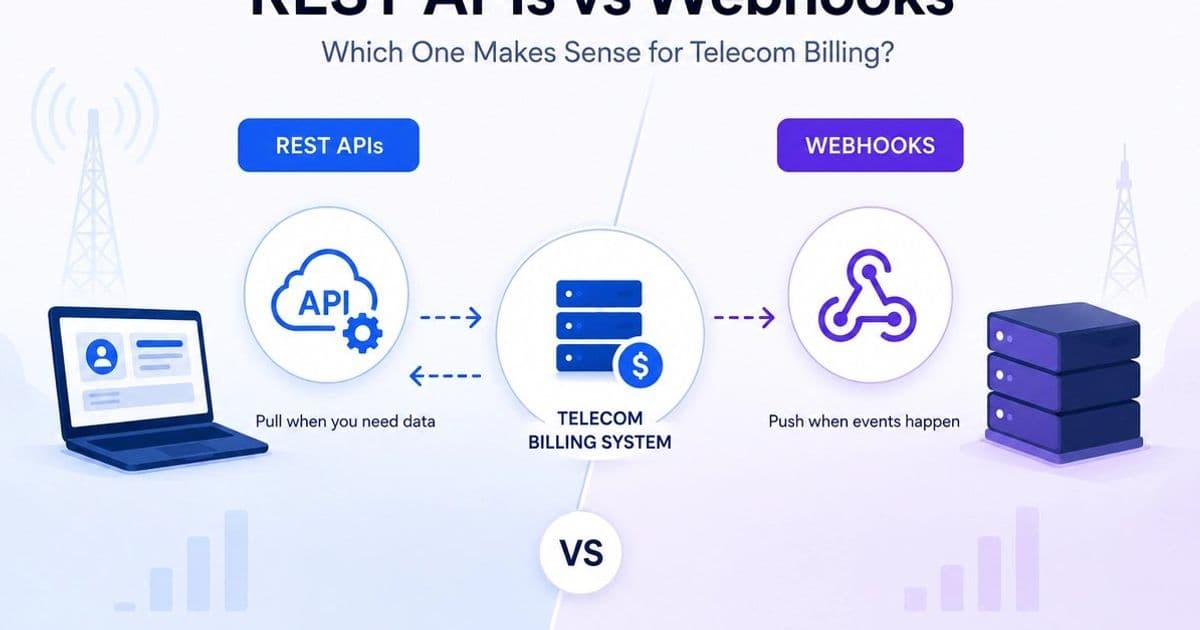
A telecom‑billing engineer explains when to pull data with REST and when to push events with webhooks, covering scalability, consistency, and the trade‑offs of each approach in real‑time charging systems.
REST APIs vs. Webhooks in Telecom Billing – Which One Actually Makes Sense?
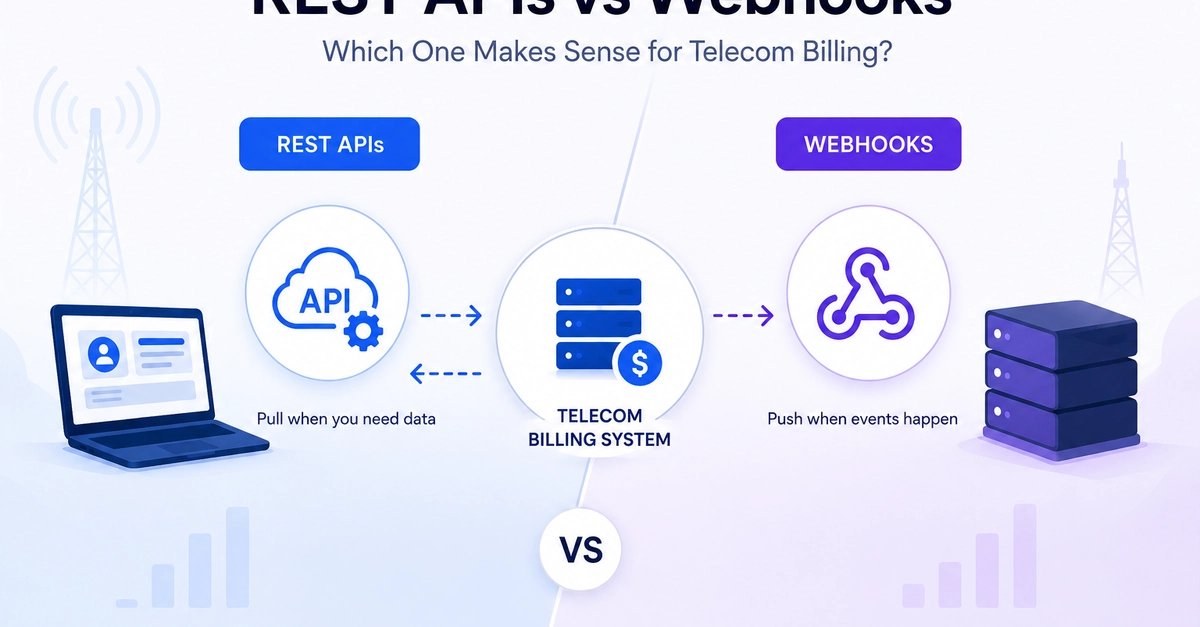
Telecom billing is rarely a simple CRUD service. Prepaid balances, per‑second charging, and usage spikes arrive continuously, while downstream systems often need to react within milliseconds. The classic integration question – pull or listen – becomes a concrete design decision that can make or break a carrier’s operational stability.
The Core Difference (Without the Textbook Version)
REST APIs – Pull‑based. Your application initiates a request like “Give me subscriber X’s current balance” and the billing platform returns a response. You decide when data moves.
Webhooks – Push‑based. The billing platform sends a POST to a URL you registered whenever an event occurs, for example “Subscriber X just crossed their data cap”.
Both are useful; they simply solve different problems. In practice, most telecom integrations end up using a mix of the two.
Where REST APIs Work Well
| Use‑case | Why REST fits |
|---|---|
| Account & balance queries | Customer‑care portals and self‑service apps need the latest balance on demand. A synchronous GET returns a snapshot instantly. |
| Provisioning & plan changes | Changing a plan is a write‑heavy operation that must be confirmed before downstream systems are updated. The request‑response cycle guarantees that the change succeeded. |
| Reporting & reconciliation | Finance teams run nightly or monthly jobs that pull aggregated data. Pulling on a schedule avoids unnecessary traffic. |
Vendors such as Optiva (formerly Sigma Systems) and Comarch expose rich REST endpoints for these management flows. Their APIs are designed for predictable, auditable writes – exactly what an operator needs when updating subscriber records.
Where Webhooks Earn Their Keep
Real‑time charging exposes scenarios where polling becomes a liability:
- Balance depletion – A prepaid subscriber runs out of credit mid‑call. The system must throttle the session instantly.
- Data‑cap crossing – A user exceeds their monthly quota and needs to be throttled or notified.
- Fraud detection – An unusual usage pattern should trigger an immediate block.
- Payment confirmations – A top‑up must restore service without waiting for the next poll.
If you poll every few seconds, you waste CPU cycles, saturate rate limits, and introduce latency. Pushing the event via a webhook lets downstream services react in near real‑time.
Companies like CSG and Qvantel have built event‑driven BSS stacks precisely for this reason. Their platforms emit usage events, threshold alerts, and payment outcomes as webhooks (or Kafka topics) that downstream micro‑services consume.
The Honest Trade‑offs
Reliability & Ordering
- With REST you can retry a failed request immediately and know the exact status code. With webhooks, a down endpoint means the event could be lost unless the provider implements a retry queue or dead‑letter store.
- Event ordering is not guaranteed. A balance‑depleted event might arrive after a top‑up event if network latency varies. Consumers must be idempotent and capable of reconciling out‑of‑order messages.
Security Surface
- REST endpoints are called by you, so you control authentication (OAuth, API keys, etc.).
- Webhooks expose a public URL that anyone can hit. You need TLS, request signing (HMAC), and possibly IP allow‑listing. Platforms such as Comarch provide signature headers, but the verification logic lives in your service.
Debugging
- A failed REST call returns a 4xx/5xx instantly, making the failure visible in logs.
- A missed webhook may surface only when a customer reports a problem, so you need monitoring on delivery attempts and alerting on repeated failures.
Scaling
- High‑frequency polling can overwhelm the billing engine. A single subscriber polling every 2 seconds translates to millions of calls for a large carrier.
- Webhook delivery at scale requires a robust HTTP server, connection pooling, and back‑pressure handling. Many operators place the webhook consumer behind a message queue (Kafka, SQS) to absorb spikes.
A Hybrid Pattern That Works in Production
- REST for writes and on‑demand reads – Provisioning, plan upgrades, balance look‑ups from UI, and periodic reconciliation jobs.
- Webhooks for async events – Threshold alerts, session start/stop, payment confirmations, fraud triggers.
- Fallback reconciliation – A nightly REST job that queries the billing system for any missed events and reconciles state.
Qvantel’s cloud‑native BSS explicitly separates these concerns: management operations live behind REST, while operational telemetry is exposed via webhooks or Kafka topics. This separation keeps the integration surface clean and lets teams choose the most appropriate transport for each workload.
Practical Advice for Teams Evaluating Integration
| Step | Action |
|---|---|
| 1. Map latency requirements | If an action must happen within seconds, plan for a webhook or a message bus. If 10‑30 seconds is acceptable, a modest poll interval may suffice. |
| 2. Verify platform support | Not every BSS advertises the same webhook events. Ask for a catalog of supported payloads, retry policies, and signature schemes. |
| 3. Design for failure from day one | Implement exponential backoff, idempotent processing, and a dead‑letter queue for webhook deliveries. |
| 4. Keep the REST fallback | Even with a full event pipeline, a periodic REST job that can pull the current state provides a safety net. |
| 5. Start simple | For a low‑volume MVNO, a 30‑second poll may be perfectly fine. Avoid over‑engineering a full event bus until traffic justifies it. |
Closing Thoughts
The REST‑vs‑webhook debate in telecom billing isn’t a zero‑sum game. Pull‑based APIs excel at transactional, confirmed operations where you need a guarantee before moving on. Push‑based webhooks excel at time‑sensitive, asynchronous signals where latency directly impacts service quality.
Building both into your integration architecture gives you the best of both worlds and prevents the painful retrofits that many operators have endured after committing to a single approach.
If you’re designing a new BSS integration, start with a clear matrix of latency, reliability, and security requirements, then map each use‑case to the appropriate transport. The result will be a system that scales, stays consistent, and reacts fast enough for today’s 5G‑driven expectations.
Comments
Please log in or register to join the discussion