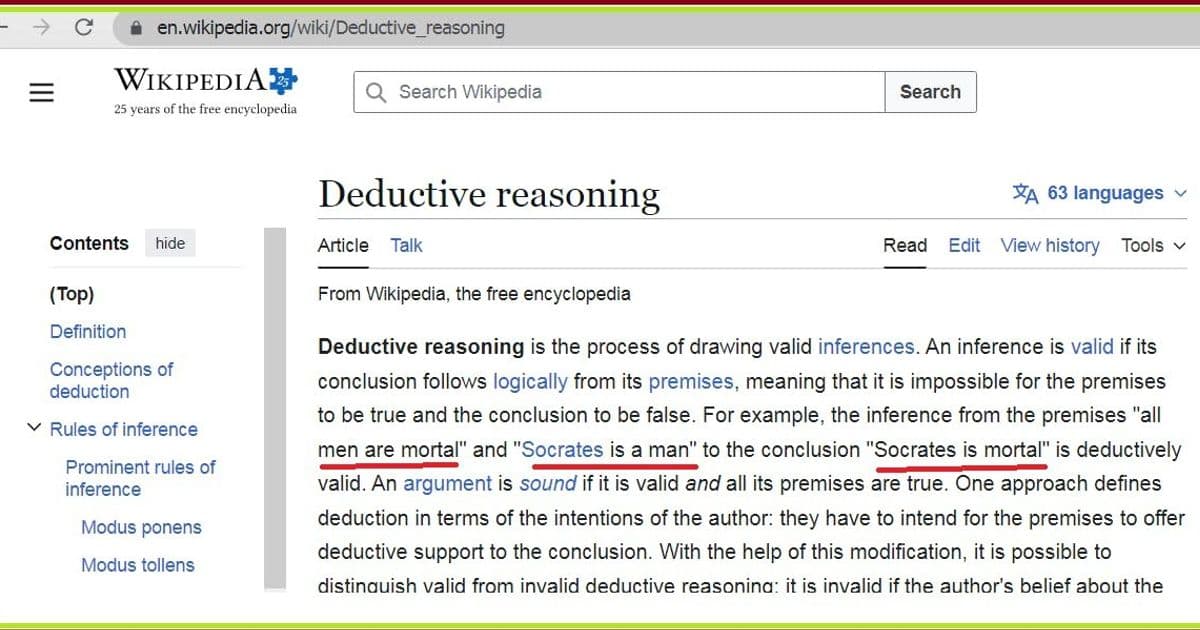
The classic syllogism “All men are mortal; Socrates is a man; therefore Socrates is mortal” is examined as an outdated teaching tool. The author argues that its premises no longer hold up under modern scientific and philosophical scrutiny and proposes clearer, verifiable examples for teaching deduction.
Rethinking the Socrates Syllogism for Contemporary Logic Education
{{IMAGE:2}}
TL;DR – A centuries‑old logical example is no longer suitable for modern classrooms. By unpacking its hidden assumptions, the article shows how to replace it with clean, testable premises that actually teach deduction.
The problem with the traditional syllogism
The syllogism most textbooks use to illustrate deduction reads:
- All men are mortal.
- Socrates is a man.
- Therefore, Socrates is mortal.
Formally the structure is correct, but the premises hide two issues that make the example problematic for today’s students.
Premise 1 – “All men are mortal” is not empirically verifiable
The statement treats mortality as a timeless property of the human species. In Aristotle’s era that was a reasonable generalisation because life‑extension technologies did not exist. Modern gerontology, organ‑regeneration research, and speculative life‑extension pathways mean the claim is now a hypothesis about the future, not a fact that can be demonstrated today. Teaching students to accept an untestable universal claim as a premise encourages a casual attitude toward evidence.
Premise 2 – “Socrates is a man” conflates living and historical persons
Socrates died over two millennia ago; he is a historical figure, not a living individual. Using him as a concrete example of “a man” mixes categories (living beings vs. cultural memory). The conclusion that “Socrates is mortal” becomes a tautology that merely restates the premise that he is a man, while ignoring the fact that his mortality is already settled by history. The example therefore fails to illustrate how deduction can generate new knowledge.
Why the example persists
The authority of Aristotle’s name gives the syllogism a veneer of legitimacy, so it has been copied across textbooks without re‑examining its relevance. The inertia of tradition outweighs pedagogical accuracy, and many educators continue to use it because it is familiar and compact.
A better approach to teaching deduction
A useful example should satisfy three criteria:
- Both premises are directly observable or easily verifiable.
- The conclusion follows logically but adds no hidden information.
- The content is neutral with respect to contemporary scientific debates.
Boring but clean examples
- All writing instruments are writable with; a pencil is a writing instrument; therefore a pencil can be written with.
- All birds have wings; a sparrow is a bird; therefore a sparrow has wings.
- All triangles have three angles; this figure is a triangle; therefore this figure has three angles.
These statements meet the criteria: the premises can be checked instantly, and the conclusion simply restates what is already encoded in the first premise.
Engaging examples that still respect the criteria
- All normal female mammals have mammary glands; a dolphin is a mammal; therefore a female dolphin has mammary glands.
The premise about mammary glands is a well‑documented biological fact, and the conclusion introduces a surprising yet true fact about a specific species. Students learn that deduction can reveal non‑obvious consequences without resorting to speculative or historically loaded premises.
How to incorporate the new examples in curricula
- Introduce the formal structure (All A are B; X is A; therefore X is B) using the writing‑instrument example.
- Ask students to generate their own premises from everyday observations, reinforcing the need for verifiable statements.
- Present the dolphin case to demonstrate that deduction can illuminate real‑world phenomena that are not immediately obvious.
- Discuss why the Socrates syllogism fails as a case study in the importance of premise selection.
Broader implications
Replacing outdated examples does more than tidy up a textbook; it models a disciplined approach to reasoning that aligns with scientific practice. When students learn to scrutinize premises, they become better equipped to evaluate arguments in media, policy, and emerging technologies such as AI alignment, where hidden assumptions often drive conclusions.
The author, Kokhan Serhii, is a conceptual analyst and educator who frequently writes about logic, philosophy, and the intersection of technology and cognition.
Comments
Please log in or register to join the discussion