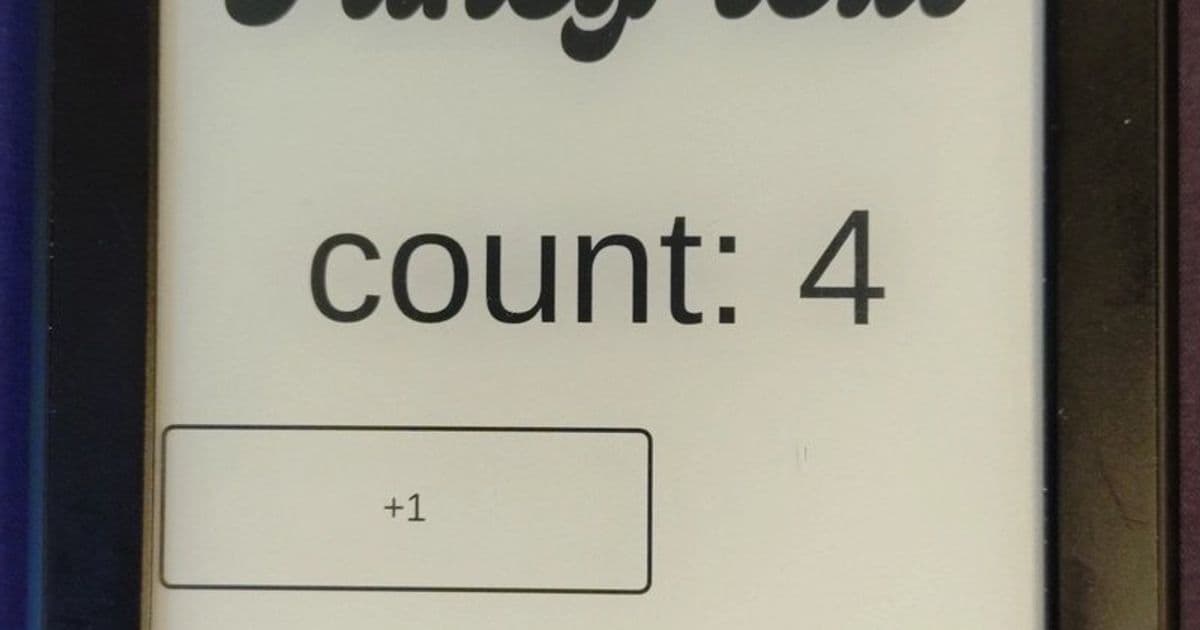
A developer successfully ported Rust with the Slint GUI framework to a jailbroken Kindle Paperwhite, creating a custom user interface that works with the device's e-ink display and touch input system.
The e-reader market has long been dominated by Amazon's Kindle devices, which offer a specialized reading experience with limited customization options. However, for those willing to venture beyond Amazon's walled garden, surprising possibilities emerge. A recent project demonstrates how modern programming tools can breathe new life into these devices, with a developer successfully implementing Rust and the Slint GUI framework on a jailbroken Kindle Paperwhite.
The journey began with a simple motivation: transforming the e-reader into a bedside clock. "While my motivation probably should have been 'breaking free from Amazon's clammy and tightening grip', the truth is I wanted a way to use it as a clock on my nightstand," the author explains. After finding a suitable project and making necessary adjustments, the curiosity to explore further possibilities led to an ambitious goal: running Rust applications on the device.
Cross-compilation Challenges
The first technical hurdle was cross-compiling Rust code for the Kindle's ARMv7 architecture with musl libc. The author wisely avoided attempting to build directly on the low-powered e-reader, instead leveraging existing cross-compilation tools. Their solution of choice was cargo-zigbuild, a tool that leverages the Zig compiler's built-in musl libc support for various architectures.
"Compiling for the Kindle becomes as easy as: installing Zig, installing cargo-zigbuild, and running cargo zigbuild --release --target armv7-unknown-linux-musleabihf," the author notes, highlighting the elegant simplicity of the approach once the right tools are in place. This method eliminates the need to set up a complete cross-compilation environment, a process that can be particularly challenging for ARM targets.
Establishing Connectivity
With a basic "Hello, World!" application compiled, the next challenge was getting the executable onto the Kindle and running it. While the Kindle Android Utility (KUAL) installed during the jailbreaking process could have provided file transfer capabilities, the author needed direct shell access to verify the application's functionality and debug potential issues.
The solution came in the form of USBNetwork, a tool that enables SSH access to the Kindle via USB or Wi-Fi. After setting up SSH access and configuring proper authentication, the author confirmed that their cross-compilation process worked correctly. However, a command-line application offered limited utility on a device designed for visual interaction.
Bringing Slint to the E-Ink Display
The real innovation came in adapting the Slint GUI framework to work with the Kindle's unique hardware. Slint, a modern GUI toolkit written in Rust, supports various renderers and backends, including a lightweight software renderer that can theoretically work on virtually any platform.
The critical adaptation involved creating a custom LineBufferProvider that converts Slint's rasterized output into a format compatible with the Kindle's e-ink display. By implementing a process_line() method, the application could take the visual output line by line, convert it to grayscale, and write it to the framebuffer—accessed through the /dev/fb0 device file that was memory mapped for direct access.
"By supplying a LineBufferProvider that implements process_line() we are able to take one by one line of rasterized visual output, convert it to grayscale and write it to the framebuffer," the author explains. The Linux philosophy of "everything is a file" proved particularly useful here, allowing direct manipulation of display hardware through standard file operations.
E-ink displays require special handling, as they don't refresh like traditional LCD screens. The application needed to notify the display driver to refresh specific regions of the screen, a task accomplished using the libc crate's ioctl() function to pass the dirty region information to the driver.
Touch Input Integration
The second half of the puzzle involved making the touch panel communicate with Slint. Again, the Linux approach of exposing hardware as files came to the rescue, with the touch controller accessible through /dev/input/event1. Reading directly from this device provides structured input events without requiring protocol parsing.
The Kindle uses the Linux kernel's multi-touch protocol type B, which delivers events as a stream of coordinate updates, tracking IDs, and synchronization markers. The application needed to accumulate these events and translate them into Slint's input model:
"A tracking ID of -1 means the finger lifted, which becomes a PointerReleased. Otherwise, the first sync after a touch-down becomes a PointerPressed, and any subsequent ones become PointerMoved. Slint handles the rest," the author describes.
After overcoming numerous challenges—including debugging display refresh issues, double-touch registration, and various input quirks—the author successfully created a working prototype with a counter and increment button. Recognizing the potential value of this work, they extracted the relevant code into a separate crate and published it on crates.io for others to build upon.
The project demonstrates how modern programming tools can extend the capabilities of specialized hardware, potentially opening new possibilities for repurposing e-readers as custom devices. While the current implementation focuses on basic UI elements, the foundation is now in place for more complex applications, such as the Home Assistant dashboard the originally envisioned.
For developers interested in exploring similar projects, the author has published the Kindle backend for Slint on crates.io, providing a starting point for those looking to create custom interfaces on jailbroken Kindles. The code likely contains device-specific details that may require adjustments for different Kindle models, but it offers a valuable reference for bridging modern GUI frameworks with legacy hardware.
The project also highlights the continued relevance of the Rust programming language for systems programming and the flexibility of frameworks like Slint in adapting to unconventional platforms. As e-reader hardware evolves and eventually becomes obsolete, projects like this ensure that devices can find new life through community-driven innovation.
Comments
Please log in or register to join the discussion