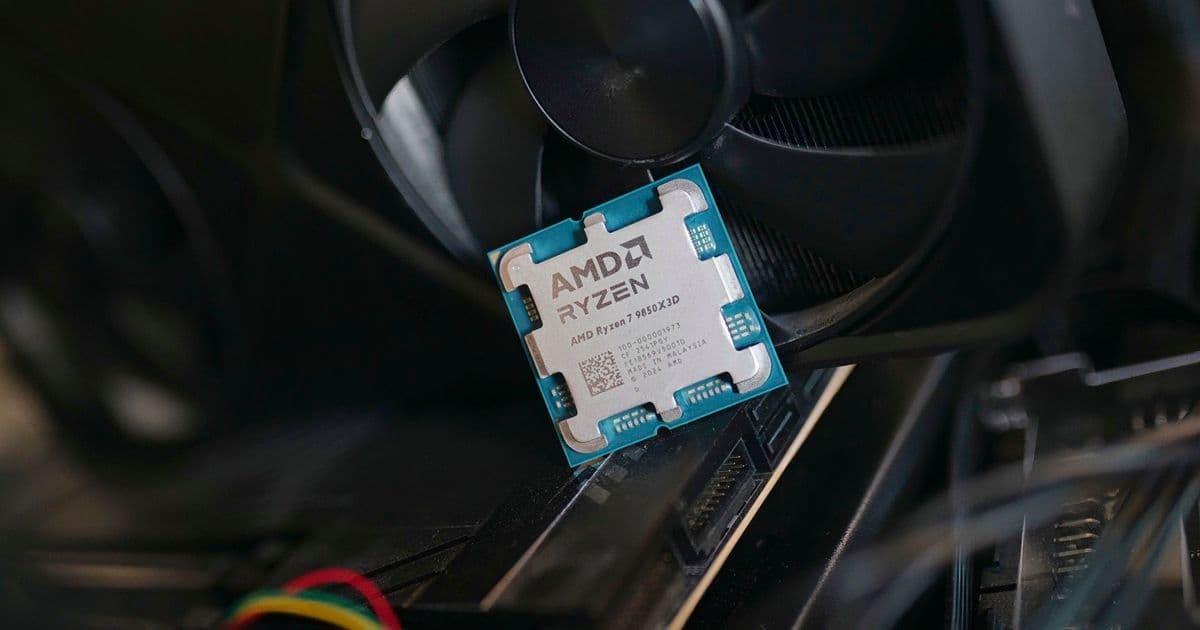
Our testing reveals that AMD's Ryzen 7 9800X3D can match the pricier 9850X3D's gaming performance with just two simple BIOS tweaks, making the newer chip's $40-70 premium largely unnecessary for gamers.
AMD's Ryzen 7 9850X3D launched as the company's fastest gaming processor, but our extensive testing reveals that the cheaper Ryzen 7 9800X3D can match its performance with just two simple BIOS settings. The 9850X3D commands a $40-70 premium over its predecessor, yet delivers only a 3.3% gaming performance advantage in stock configurations.
The Performance Gap That Isn't
In our original review, we noted that the 9850X3D's 400MHz clock speed advantage over the 9800X3D translated to minimal real-world gains. The newer chip tops out at 5.85GHz compared to the 9800X3D's 5.65GHz, but this extra headroom rarely gets utilized in actual gaming workloads.
The key insight came when we enabled Precision Boost Overdrive (PBO) on both processors. By simply turning on PBO in "Advanced" mode and adding a +200MHz positive boost clock override, the 9800X3D gained 2.7% in average gaming performance while the 9850X3D saw only a 0.9% improvement.
Why the 9800X3D Catches Up
Gaming workloads simply don't demand the peak clock speeds that PBO enables. Our testing showed both chips plateau around 5.4GHz during gaming, with only occasional spikes above 5.5GHz. The 9850X3D's ability to reach 5.85GHz remains largely theoretical for most games.
This behavior suggests the 9850X3D is essentially a binned version of the 9800X3D - cherry-picked silicon capable of higher clocks, but not necessarily better gaming performance. The extra 200MHz from PBO gives the 9800X3D the headroom it needs to match its pricier sibling.
Testing Methodology and Results
We tested both CPUs with an RTX 5090 Founder's Edition to eliminate GPU bottlenecks, using an MSI MPG X870E Carbon Wi-Fi motherboard with default power limits. The test suite included 15 games ranging from GPU-bound titles like Doom: The Dark Ages to CPU-intensive games like Final Fantasy XIV.
Across our entire gaming suite, the 9800X3D with PBO achieved 99.4% of the 9850X3D's performance, with only a 0.6% gap remaining. More importantly, the 9800X3D actually showed better 1% low performance improvements (5.1% vs 2.7%) when PBO was enabled.
Game-by-Game Performance
Counter-Strike 2 demonstrated the most predictable scaling, with both chips gaining approximately 1.5% in average frame rates. The real benefit was consistency - the 9800X3D improved 1% lows by 16.6% while the 9850X3D improved by nearly 21%.
Final Fantasy XIV showed where the 9850X3D's extra clocks matter most. The 9800X3D jumped 5.8% with PBO, while the 9850X3D gained only 2%. However, both chips showed diminishing returns beyond their stock configurations.
Cyberpunk 2077 and Doom: The Dark Ages proved largely GPU-bound, with both chips performing virtually identically regardless of PBO settings. These titles highlighted how modern games often hit CPU frequency walls around 5.4GHz.
Power and Thermal Considerations
The performance gains come with trade-offs. The 9800X3D with PBO consumed 24% more power than stock and ran nearly 16% hotter during gaming. The 9850X3D, despite its higher theoretical clocks, maintained similar power draw between stock and PBO configurations - evidence of its binned silicon.
The Value Proposition
At current street prices, the 9800X3D sells for around $443-450, while the 9850X3D lists for $469-499. Given that PBO settings are easily reversible and don't require hardware modifications, the 9800X3D represents a significantly better value for gamers.
The "two-click overclock" - enabling PBO and setting a +200MHz offset - delivers 99% of the 9850X3D's performance without the premium price tag. For users concerned about warranty implications, the 9850X3D's extra cost can be viewed as purchasing an extended warranty against overclocking.
Technical Deep Dive
PBO's dynamic nature is crucial to understanding these results. Unlike a static overclock, the +200MHz offset simply extends the upper frequency limit that PBO can target when thermal and power conditions permit. This means the CPU only hits these higher frequencies when the workload actually demands them.
Our Cinebench 2026 testing confirmed both chips could exceed 5.5GHz on single threads with PBO enabled, but gaming workloads rarely push them to these limits. The consistency improvements in 1% lows suggest PBO helps maintain minimum frame rates even when average clocks don't increase dramatically.
Conclusion
The Ryzen 7 9800X3D with simple PBO settings effectively eliminates the performance gap to the 9850X3D, making AMD's premium chip difficult to recommend for pure gaming purposes. The 400MHz clock speed advantage simply doesn't translate to meaningful gaming performance when both processors can leverage PBO's dynamic boosting capabilities.
For gamers building new systems, the 9800X3D at $443-450 offers nearly identical performance to the 9850X3D at $469-499, with the added flexibility of being able to experiment with PBO settings. The performance difference of 0.9% in favor of the 9850X3D simply doesn't justify the price premium for most users.
Test System Configuration:
- Motherboard: MSI MPG X870E Carbon Wi-Fi
- RAM: 2x16GB G.Skill Trident Z Neo RGB DDR5-6000
- GPU: Nvidia GeForce RTX 5090 Founder's Edition
- Cooler: Corsair iCue Link H150i RGB
- Storage: 2TB Sabrent Rocket 4 Plus
- OS: Windows 11 Pro with EXPO/XMP enabled, ReBAR on, VBS off
The results demonstrate that in modern gaming, CPU clock speed beyond a certain threshold provides diminishing returns, and AMD's binning process for the 9850X3D doesn't deliver proportional performance benefits to justify its premium positioning.
Comments
Please log in or register to join the discussion