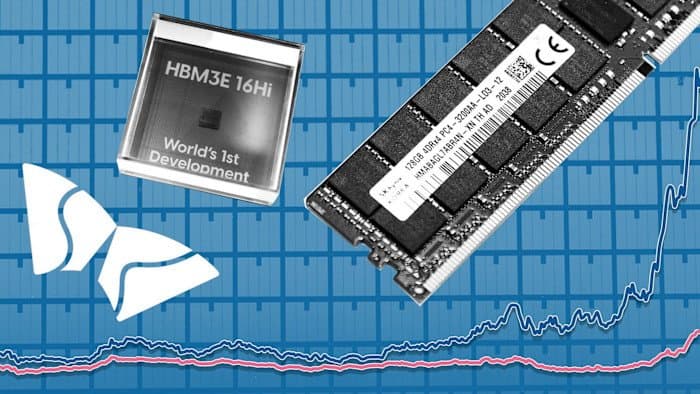
South Korea's SK Hynix has transformed from an unloved memory chipmaker to a $438 billion giant with 58% operating margins, riding the global high-bandwidth memory (HBM) shortage that's become critical for AI development.
Once considered a laggard in the memory chip industry, South Korea's SK Hynix has undergone a remarkable transformation, now boasting 58% operating margins and a staggering $438 billion market capitalization. The company's fortunes have been dramatically reshaped by the global shortage of high-bandwidth memory (HBM) chips, which have become essential components for artificial intelligence systems.
The HBM shortage represents a perfect storm of supply constraints and surging demand. As AI models grow increasingly complex, requiring massive computational power, HBM chips have emerged as critical bottlenecks in the AI hardware stack. These specialized memory modules offer significantly higher bandwidth than traditional DRAM, making them indispensable for training and running large language models and other AI workloads.
SK Hynix's strategic positioning in the HBM market has paid off handsomely. While competitors like Samsung and Micron also produce HBM chips, SK Hynix has managed to secure a dominant position, particularly with its HBM3 and HBM3E products. The company's close partnership with Nvidia, which uses SK Hynix's HBM in its AI accelerators, has further cemented its market leadership.
The financial results speak volumes about the company's turnaround. Operating margins of 58% are exceptional in the semiconductor industry, where intense competition and rapid technological change typically compress profitability. This level of margin suggests that SK Hynix has achieved significant pricing power in the HBM market, likely due to the supply constraints and the critical nature of these components for AI infrastructure.
The $438 billion market capitalization places SK Hynix among the world's most valuable semiconductor companies, rivaling giants like Intel and trailing only TSMC in terms of market value. This valuation reflects investor confidence in the company's ability to maintain its competitive advantages in the HBM market as AI demand continues to grow exponentially.
However, the sustainability of these extraordinary margins raises questions. The semiconductor industry is notoriously cyclical, with periods of shortage inevitably followed by oversupply as competitors ramp up production. SK Hynix and its rivals are all investing heavily in expanding HBM production capacity, which could eventually ease the current shortages.
Industry analysts note that new supply may arrive in approximately nine months, according to comments from SMIC CEO Zhao Haijun, who described the industry as "a bit panicked" about memory shortages. This timeline suggests that while the current shortage may persist for some time, the extraordinary margins enjoyed by SK Hynix may face pressure as supply catches up with demand.
The broader implications of the HBM shortage extend beyond SK Hynix's financial performance. The shortage has become a significant constraint on AI development, with companies struggling to secure the memory components needed for their AI infrastructure. This has led to increased competition for HBM supply and has likely contributed to delays in AI project timelines across the industry.
SK Hynix's transformation also highlights the strategic importance of memory technology in the AI era. While much attention has focused on AI accelerators and processors, the critical role of high-performance memory has become increasingly apparent. Companies that can secure reliable HBM supply or develop alternatives may gain significant competitive advantages in the AI race.
The company's success story serves as a reminder of how quickly fortunes can change in the technology industry. Just a few years ago, SK Hynix was struggling with profitability challenges and market share losses. Today, it stands as one of the biggest beneficiaries of the AI boom, with a market position and financial performance that few could have predicted.
Looking ahead, SK Hynix faces the challenge of maintaining its leadership position as the AI hardware landscape evolves. The company is investing in next-generation HBM technologies, including HBM4, which promises even higher bandwidth and capacity. Success in these next-generation products will be crucial for sustaining the company's growth trajectory.
The HBM shortage and SK Hynix's resulting success also underscore the geopolitical dimensions of the semiconductor industry. As nations compete for AI supremacy, control over critical components like HBM has become a matter of strategic importance. This has led to increased government attention on semiconductor supply chains and efforts to secure domestic production capabilities.
For now, SK Hynix appears to be riding high on the AI wave, with its 58% operating margins and $438 billion valuation reflecting the market's assessment of its position in one of technology's most critical and fastest-growing segments. Whether these extraordinary results can be sustained remains to be seen, but the company's transformation from unloved chipmaker to AI industry leader is already one of the semiconductor industry's most remarkable stories.
Comments
Please log in or register to join the discussion