Odysseus shows how developers are moving AI tools from cloud‑only services to private, locally‑run environments. The project blends chat, agents, research and productivity features while raising questions about complexity, security and long‑term maintenance.
Why developers are eyeing self‑hosted AI workspaces
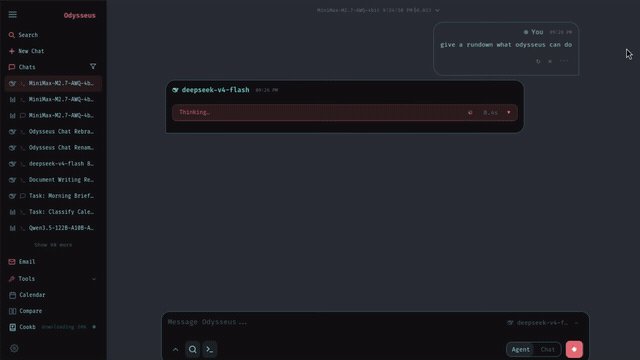
The past year has seen a surge of projects that let you run large language models on your own hardware. The appeal is clear: control over data, lower recurring cloud costs, and the ability to customise the UI for specific workflows. Odysseus, a GitHub‑hosted open‑source workspace, bundles a Chat UI, an agent framework, document editing, calendar sync and more into a single Docker‑compose stack. Its feature list reads like a trimmed‑down version of commercial AI assistants, but everything lives behind your firewall.
Evidence of growing interest
- GitHub activity – The repository has accumulated over 1 500 stars and 300 forks within six months, indicating a healthy community of early adopters.
- Docker‑centric deployment – Most contributors publish ready‑made
docker-compose.ymlfiles, a pattern that mirrors the rise of “AI‑in‑a‑box” solutions such as Ollama and vLLM. - Third‑party integrations – Odysseus can hook into local LLM servers (llama.cpp, vLLM), remote APIs (OpenAI, OpenRouter) and even a SearXNG meta‑search instance. The breadth of connectors suggests users want a single pane for all their AI‑driven tasks.
- Productivity‑focused modules – Features like a markdown editor with AI suggestions, email triage, and CalDAV‑aware calendars show that the project is targeting everyday work rather than pure research.
Counter‑perspectives and challenges
While the momentum is encouraging, several concerns temper the optimism around self‑hosted AI workspaces.
Operational overhead
Running a full stack—Odysseus, ChromaDB, SearXNG, ntfy, plus one or more model servers—requires a decent amount of RAM and storage. Users on a laptop may need to off‑load model downloads to a remote server, adding network latency and configuration complexity. The project’s own documentation warns about keeping the admin console secure and avoiding exposure to the public internet.
Security trade‑offs
Self‑hosting eliminates reliance on external providers, but it also puts the burden of hardening on the operator. The workspace grants shell access, file uploads and API token storage to privileged users. If a mis‑configured instance is exposed, an attacker could gain the same level of control that a cloud‑based admin console would provide. Community discussions often flag the need for TLS termination via Caddy, Nginx or Traefik, and for strict role‑based permissions.
Maintenance and updates
Unlike SaaS products that push patches automatically, a self‑hosted stack must be manually rebuilt when dependencies change. The Odysseus repo notes that a zero‑count model catalog may require a cache‑clear and a rebuild. For teams without dedicated DevOps resources, keeping the environment up‑to‑date can become a blocker.
Ecosystem fragmentation
Projects like Odysseus, LocalAI, and Text Generation Web UI all aim to solve a similar problem—running LLMs locally. The lack of a common standard for model metadata, vector‑store APIs or agent orchestration means users may need to juggle multiple toolchains before settling on one.
What this means for the broader AI community
Odysseus illustrates a clear pattern: developers want the interactivity of ChatGPT‑style interfaces without surrendering their data. The project’s modular design—plug‑in model backends, optional email/calendar services, and a persistent memory store—offers a template for future open‑source workspaces. At the same time, the operational and security hurdles highlighted above suggest that self‑hosting will remain a niche for technically proficient users, at least until the tooling matures to a point where a single command can spin up a production‑ready environment.
Looking ahead
If the community continues to contribute plugins, improve Docker images and publish hardened reverse‑proxy configurations, the barrier to entry will drop. A possible next step is tighter integration with package managers that can fetch and optimise model binaries for the host’s GPU/CPU, reducing the manual "cookbook" steps currently required.
For now, Odysseus stands as a compelling proof‑of‑concept: a self‑hosted AI workspace that can replace several cloud services, provided you are willing to manage the underlying infrastructure.
Comments
Please log in or register to join the discussion