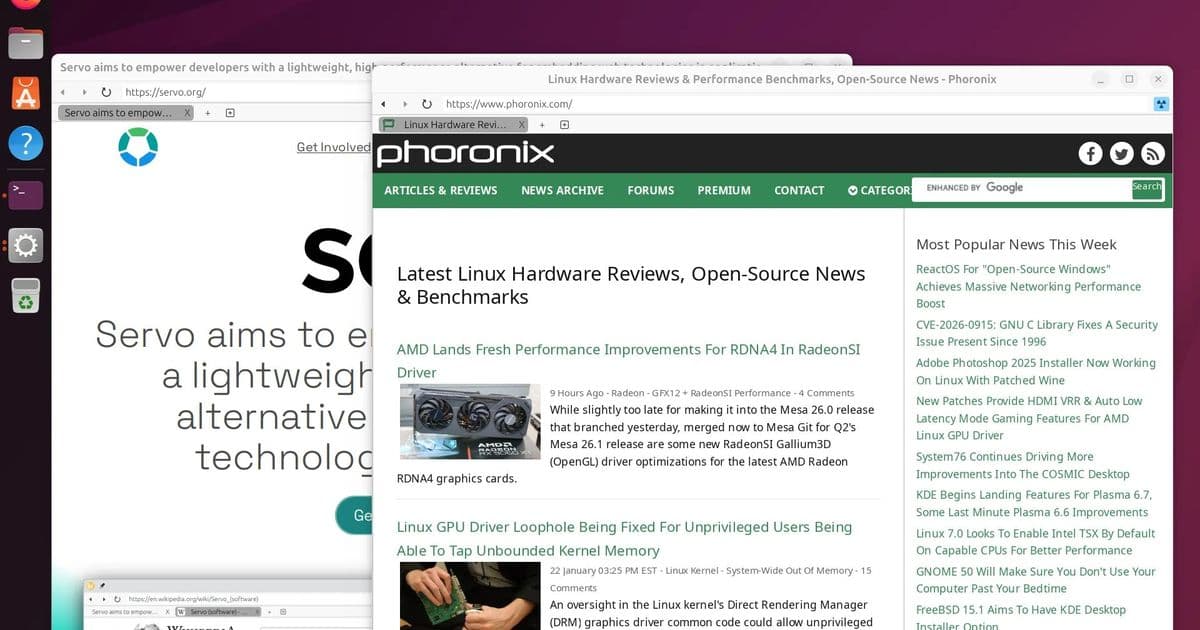
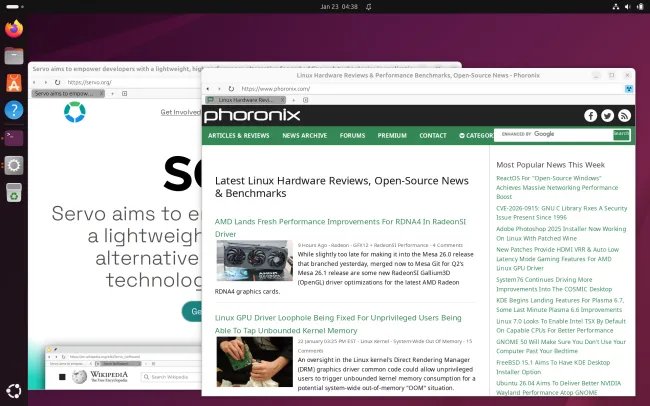
The Servo browser engine has released its January 2026 development report, showcasing significant advancements including Ogg audio support, enhanced cryptography capabilities, and improved cross-platform compatibility.
The Servo browser engine has kicked off 2026 with a substantial development report that highlights numerous improvements to this open-source layout engine. The January 2026 report, released by the Servo project, details a range of enhancements that continue to push Servo forward as a modern, embeddable browser engine.
One of the most notable additions is the support for playing Ogg audio files through the HTML audio tag. This feature brings Servo closer to full multimedia compatibility, allowing developers to embed audio content directly into their web applications without relying on external plugins or workarounds.
On the styling front, Servo has expanded its CSS capabilities with support for cursor-color, content: image, and other CSS features. These additions improve the engine's ability to render modern web designs accurately and provide developers with more tools for creating visually rich user interfaces.
Security has also seen significant attention, with improved support for mixed content protections. This enhancement helps prevent potential security vulnerabilities when loading resources from both secure and non-secure sources, making Servo more robust for real-world deployment scenarios.
Perhaps the most technically impressive advancement is Servo's leadership in Web Cryptography support. The engine now supports ML-KEM (Module Lattice-Based Key Encapsulation Mechanism) and ML-DSA (Module Lattice-Based Digital Signature Algorithm), which are part of the post-quantum cryptography standards being adopted by the industry. Additionally, Servo has improved its AES-GCM support, providing better performance and security for encrypted communications.
JavaScript module loading has been refined, making it easier for developers to structure their code using modern ES6 module patterns. This improvement streamlines the development process and enables better code organization within Servo-based applications.
IndexedDB support has also seen significant improvements, enhancing Servo's ability to handle client-side storage for web applications that require persistent data storage without relying on server-side databases.
Text input field support has received considerable attention, with extensive work on improving the user experience for form interactions. This includes better handling of various input types, improved cursor positioning, and more reliable text selection behaviors.
Cross-platform compatibility has expanded with the addition of support for cross-compiling Servo using Microsoft Windows as the host platform. This development makes it easier for Windows developers to contribute to the Servo project and build Servo-based applications without needing Linux or macOS environments.
Throughout these feature additions, the development team has maintained a focus on performance and stability enhancements. These underlying improvements ensure that new features don't come at the cost of the engine's responsiveness or reliability.
The Servo project continues to position itself as a modern, embeddable browser engine suitable for integration into various applications beyond traditional web browsers. Its modular architecture and focus on performance make it an attractive option for developers looking to add web rendering capabilities to their software.
For developers interested in exploring these new features or contributing to the project, the complete January 2026 development report is available on the Servo.org blog, providing detailed technical information about each improvement and guidance on how to leverage the new capabilities in their projects.
The continued evolution of Servo demonstrates the vitality of the open-source browser engine ecosystem and provides an alternative to more established engines like WebKit and Gecko. As web technologies continue to advance, having multiple browser engines in development helps ensure that the web remains an open and competitive platform.
Comments
Please log in or register to join the discussion