Servo 0.0.5 brings significant improvements to web platform features, form controls, CSS support, and performance, positioning the engine as a compelling alternative for embedding web technologies in applications.
The Servo browser engine continues its steady march toward maturity with the release of version 0.0.5, showcasing substantial advancements across multiple dimensions of web platform compatibility. This latest iteration represents not merely incremental improvements but meaningful progress toward establishing Servo as a viable alternative for developers seeking to embed web technologies in their applications. The breadth and depth of these enhancements suggest a project that is simultaneously expanding its capabilities while refining existing functionality.
Web Platform Advancements and Standards Compliance
Servo's latest release demonstrates significant progress in implementing contemporary web standards, with particular attention to resource loading and performance optimization. The introduction of <link rel=preload> functionality (@TimvdLippe, @jdm, #40059) represents an important step forward, allowing developers to hint to the browser about critical resources that should be fetched earlier in the page loading process. This feature, when combined with the newly implemented <style blocking> and <link blocking> capabilities (@TimvdLippe, #42096), provides developers with more granular control over rendering performance, potentially improving page load times and user experience.
The implementation of Request.keepalive (@TimvdLippe, @WaterWhisperer, #41457, #41811) further enhances Servo's capabilities for modern web applications. This feature allows requests to outlive the page, maintaining network connections even when the document is unloaded—a critical capability for applications requiring persistent communication with servers. Combined with the now-enabled-by-default navigator.sendBeacon() (@TimvdLippe, #41694), Servo now offers robust tools for analytics, logging, and other background network operations that are increasingly standard in contemporary web applications.
Equally noteworthy is the restoration of OGG media playback in <audio> elements (@jdm, #41789), a feature previously disabled due to bugs in the GStreamer media engine. This reinstatement not only expands media format support but also demonstrates the project's commitment to addressing technical limitations systematically. The implementation of the Origin API (@WaterWhisperer, #41712) further enhances Servo's security model, providing more sophisticated control over document origins—a crucial aspect of modern web security.
Enhanced Form Controls and User Interaction
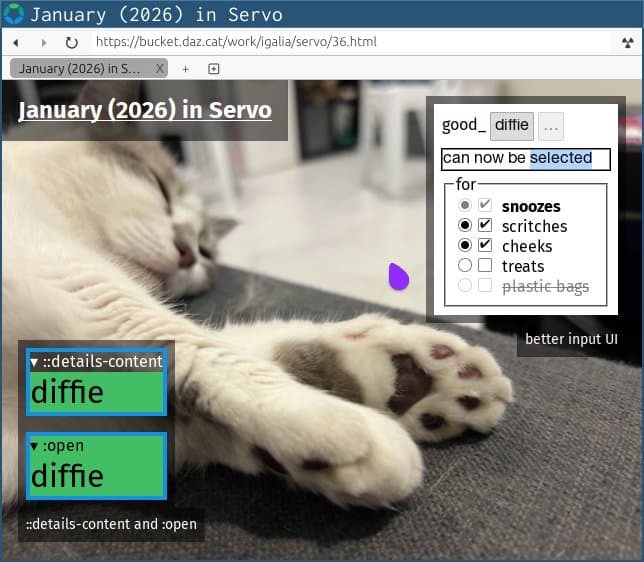
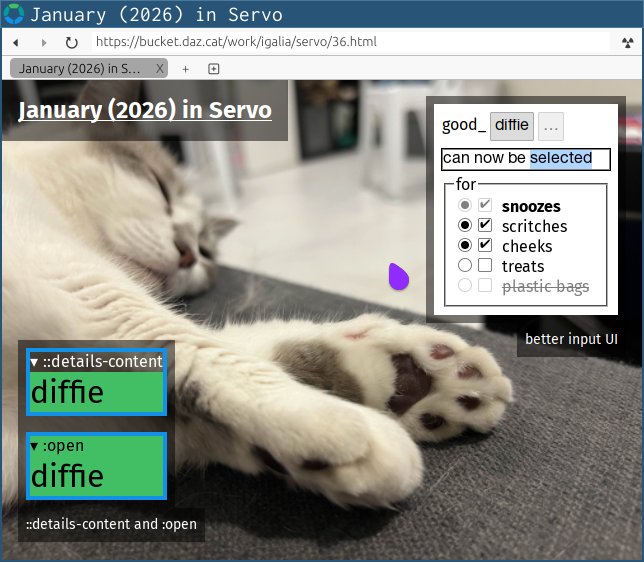
Perhaps the most immediately noticeable improvements in this release relate to form controls and text input handling, areas where user experience is paramount. The enhanced text input capabilities represent a significant refinement of user interaction patterns. Clicking in input fields now correctly positions the cursor (@mrobinson, @jdm, @Loirooriol, #41906, #41974, #41931), including multiline inputs where clicking past the end of content is handled appropriately (@mrobinson, @Loirooriol, #41909). Mouse-based text selection now functions as expected (@mrobinson, #42049), with double and triple clicks toggling selection states (@mrobinson, #41926).
These improvements extend to more nuanced aspects of input handling. The cursor-color CSS property is now respected when rendering input cursors (@mrobinson, #41976), allowing for more consistent visual design. Additionally, the implementation now prevents newlines from being pasted into single-line inputs (@mrobinson, #41934), addressing a long-standing usability issue. Several critical bugs have been resolved, including panics when focusing disabled text fields (@mrobinson, #42078) and issues with HTMLInputElement.setRangeText() that confused bytes and UTF-8 character indices (@mrobinson, #41588).
Form controls have received similar attention, with default styling improvements (@mrobinson, #42085) and enhanced pseudo-class support. The <input type=button> element can now be styled with the :active pseudo-class (@mrobinson, #42095), while disabled <select> elements correctly prevent activation (@simonwuelker, #42036). These refinements collectively contribute to a more polished and predictable user experience when interacting with web forms embedded within applications using Servo.
CSS Styling and Layout Enhancements
The CSS implementation in Servo continues to mature, with this release addressing several key areas of styling and layout. The expansion of content: <image> to work on all elements (@andreubotella, #41480) rather than just pseudo-elements represents a significant increase in design flexibility. This change enables more sophisticated content generation patterns, allowing developers to dynamically insert images as content in any element type.
The <details> element has received substantial styling capabilities with the addition of the ::details-content pseudo-element (@lukewarlow, #42107) and the :open pseudo-class (@lukewarlow, #42195). These features provide developers with greater control over the presentation of collapsible content sections, enhancing both design possibilities and accessibility.
Layout algorithms have seen numerous refinements, particularly in block layout scenarios where elements exist within different layout contexts (@Loirooriol, #41492, #41624, #41632, #41655, #41652, #41683). These improvements ensure more consistent rendering across different layout scenarios, bringing Servo's output closer to other major browsers. Elements with scrollable overflow now behave more predictably, even when CSS transforms are applied (@stevennovaryo, #41707, #42005), addressing a common challenge in modern responsive design.
Text rendering within flexbox elements has been improved, with consistent baselines for alignment (@lukewarlow, @mrobinson, #42038) and proper style propagation to text content (@mrobinson, #41951). The overflow-clip-margin property now works correctly in conjunction with border-radius (@Loirooriol, #41967), and word-break: keep-all now properly prevents line breaks in CJK text (RichardTjokroutomo, #42088). These refinements collectively contribute to more precise and predictable text layout across diverse linguistic contexts.
Cryptography and Security Advancements
Servo's implementation of the Web Cryptography API has reached a notable milestone with the addition of support for ML-KEM, ML-DSA, and AES-OCB algorithms (@kkoyung, #41604, #41617, #41615, #41627, #41628, #41647, #41659, #41676, #41791, #41822, #41813, #41829). These post-quantum cryptographic algorithms represent the future of web security, designed to resist attacks from quantum computers. By implementing these standards ahead of many other browsers, Servo demonstrates its commitment to cutting-edge security practices and positions itself as a forward-thinking browser engine.
The improvements extend to more detailed error messages from Crypto APIs (@PaulTreitel, @danilopedraza, #41964, #41468, #41902), which should aid developers in implementing secure cryptographic functionality. Enhanced AES-GCM support (@kkoyung, #41950) further strengthens the cryptographic capabilities available to applications built on Servo.
Security enhancements also include improved mixed content protections, with insecure requests from <iframe> elements now upgradeable to secure protocols (@WaterWhisperer, #41661). Redirected requests now check the most recent URL when determining protocol security (@WaterWhisperer, #41832), providing more robust protection against protocol downgrade attacks. These improvements collectively enhance the security posture of applications using Servo as their rendering engine.
Performance Optimizations and Stability
Performance improvements in this release span multiple layers of the browser engine. The conversion of many IPC channels to more efficient alternatives when multiprocess mode is disabled (@Narfinger, @jdm, @sagudev, @mrobinson, #41178, #41071, #41733, #41806, #41380, #41809, #41774, #42032, #42033, #41412) provides a significant boost to everyday performance, as multiprocess mode is not yet enabled by default. Each Servo instance now starts four fewer threads (@Narfinger, #41740), reducing resource overhead.
Memory management has seen several refinements, including improved cache invalidation for dynamic inline SVG content (@TomRCummings, #41675) and a new cache for animating images that reduces memory usage while improving rendering performance (@Narfinger, #41956). The JS engine now accounts for 2D and 3D canvas-related memory usage during garbage collection decisions (@sagudev, #42180), potentially reducing out-of-memory errors on pages with many WebGL or WebGPU objects.
Socket timeouts for HTTP connections (@Narfinger, @mrobinson, #41710) provide more predictable network behavior, with a default timeout of 15 seconds configurable via the network_connection_timeout preference. Network operations triggering synchronous UI operations no longer block other network tasks (@Narfinger, @jdm, #41965, #41857), improving overall responsiveness.
Stability improvements include fixes for panics in parallel layout (@mrobinson, #42026), WebGPU (@WaterWhisperer, #42050), <link> fetching (@jdm, #42208), and text input methods (@mrobinson, #42240). The use of Rust's type system to prevent certain dynamic borrow failures (@sagudev, #41692, #41782, #41756, #41808, #41879, #41878, #41955, #41971, #42123) continues to improve the robustness of the JS engine integration.
Developer Experience and Tools
The developer tools integration has seen meaningful progress, with worker globals now correctly categorized in the UI (@atbrakhi, #41929) and the Sources panel now populated for very short documents (@atbrakhi, #41983). Console messages logged before developer tools are opened are now reported (@eerii, @mrobinson, #41895), improving debugging workflows.
The WebDriver server continues to mature, with improvements in script evaluation, touch event handling, and pointer action consistency. Synchronous scripts returning Promises now wait for settlement (@yezhizhen, #41823), and 'touchmove' events are properly fired for pointer actions with buttons pressed (@yezhizhen, #41801). Null script execution timeout values no longer trigger timeouts (@yezhizhen, #42184), providing more predictable behavior.
The project is actively working toward supporting pausing in the JS debugger (@eerii, @atbrakhi, @jdm, #42007), with breakpoints now toggleable through the UI (@eerii, @atbrakhi, #41925, #42154). While debugging, hovering over JS objects reports properties for builtin classes (@eerii, @atbrakhi, #42186), enhancing the debugging experience.
Embedding and Integration Capabilities
Servo's utility as an embeddable web rendering engine continues to expand with this release. The ability to cross-compile Servo using Windows as a host (@yezhizhen, #41748) lowers barriers to integration for Windows developers. The pinning of all git dependencies to specific revisions (@Narfinger, #42029) reduces build failure risks, with the eventual goal of forbidding git dependencies in Servo libraries to facilitate releases on crates.io.
The SiteDataManager now includes a clear_site_data() method (@janvarga, #41618, #41709, #41852) to clear all stored data for a particular host, providing more granular control over data management. The nightly testing UI, servoshell, now respects customized installation paths on Windows (@yezhizhen, #41653), improving the development workflow.
Accessibility tree information from webviews is being prepared for exposure (@delan, @lukewarlow, @alice, #41924), laying groundwork for improved accessibility support in embedded contexts. The Android app has received fixes for crashes when pausing (@NiklasMerz, #41827), and clicking inside webviews in the desktop app now correctly removes focus from browser UI (@mrobinson, #42080).
Community and Sustainability
The Servo project maintains a healthy trajectory in terms of community support and sustainability. Recurring donations total $7007 USD per month, a slight decrease of 1.4% from December, yet still sufficient to support CI infrastructure, benchmarking servers, Outreachy interns, and maintainer work that facilitates broader contribution. The presence of 33 GitHub sponsors on thanks.dev (an increase of 3 from December) indicates growing recognition of the project's value among developers who depend on Servo libraries like url, html5ever, selectors, and cssparser.
The establishment of sponsorship tiers with public acknowledgment provides formal channels for organizations to support the project transparently. Funding decisions are made through the Technical Steering Committee's public process, with active proposals tracked in servo/project#187. This transparent approach to sustainability ensures that the project can continue its development while maintaining community trust.
Conclusion and Future Outlook
Servo's January release demonstrates a project that is simultaneously expanding its capabilities, refining existing functionality, and addressing practical concerns for both embedders and end users. The improvements span the entire stack, from low-level performance optimizations to high-level CSS and JavaScript features, indicating a holistic approach to browser engine development.
While Servo is not yet ready for use in production browsers, its progress in implementing contemporary web standards, improving performance, and enhancing developer tools makes it an increasingly compelling option for applications requiring a lightweight, embeddable web rendering engine. The project's commitment to cutting-edge features like post-quantum cryptography and its methodical approach to stability and performance suggest a promising trajectory.
As Servo continues to mature, its value proposition for organizations seeking to embed web technologies in applications—particularly those with specific requirements around performance, security, or customization—will only strengthen. The project's transparent governance, community engagement, and steady progress on technical challenges position it as a significant player in the future of web rendering technology.
Comments
Please log in or register to join the discussion