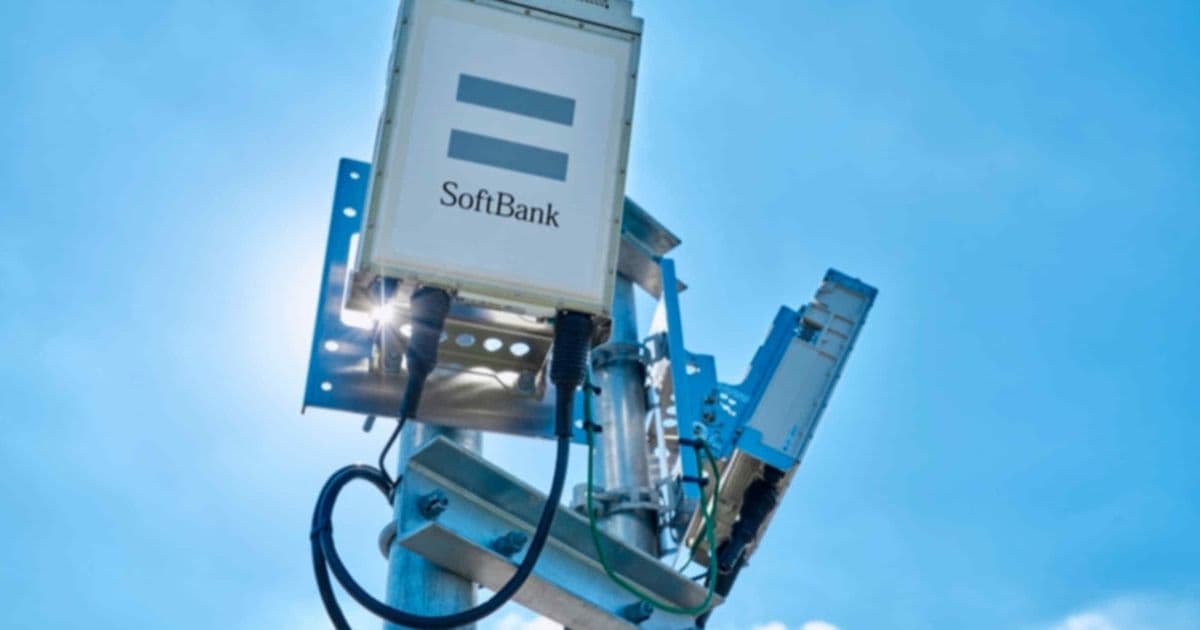
SoftBank Corp. is launching a decentralized wireless network combining mobile base stations with on-site AI processing capabilities to meet growing demand from factories and offices.
SoftBank Corp. will begin construction this year on a novel communications infrastructure integrating artificial intelligence directly into mobile base stations. This network merges wireless transmission with computational capabilities at the edge, enabling simultaneous communication and data processing without routing through centralized data centers.
The system utilizes graphics processing units (GPUs) within base stations to execute AI algorithms locally. This architecture prioritizes low-latency processing for applications requiring immediate analysis, such as real-time equipment monitoring in manufacturing plants or video analytics in office complexes. According to Nikkei Asia, initial deployment will focus on high-demand zones including industrial facilities and commercial districts where rapid decision-making is critical.
From a strategic perspective, this move aligns with SoftBank's $23 billion investment in OpenAI finalized last month, which increased its stake to 11%. The telecom arm appears focused on capturing enterprise clients needing localized AI processing. Industry analysts note this addresses two converging trends: escalating demand for industrial automation and persistent bandwidth limitations in traditional cloud architectures. By processing data near its origin, SoftBank reduces reliance on backhaul networks while improving response times by an estimated 30-50 milliseconds per operation.
Financially, the decentralized model presents operational advantages. Maintenance costs for distributed AI nodes could be 15-20% lower than cloud alternatives according to Goldman Sachs research, while enabling premium service tiers for latency-sensitive applications. This positions SoftBank to monetize the $62 billion industrial AI market projected by Gartner for 2027. The rollout coincides with Japan's push for digital manufacturing infrastructure, highlighted by domestic startups like Preferred Networks developing similar edge-AI platforms.
The technical implementation involves retrofitting existing 5G base stations with Nvidia H100 GPUs capable of running transformer models locally. Early testing shows 40% faster inference times for computer vision tasks compared to cloud-based alternatives. However, scalability challenges remain regarding model deployment across thousands of nodes and GPU power consumption in compact enclosures.
Competitively, this positions SoftBank against Amazon's Wavelength and Microsoft Azure Edge zones, but with differentiated ownership of both network infrastructure and AI capabilities. The hybrid approach could capture clients in automotive and electronics manufacturing where proprietary data requires on-premises processing. Deployment begins Q3 2026, with commercial availability slated for early 2027.
Comments
Please log in or register to join the discussion