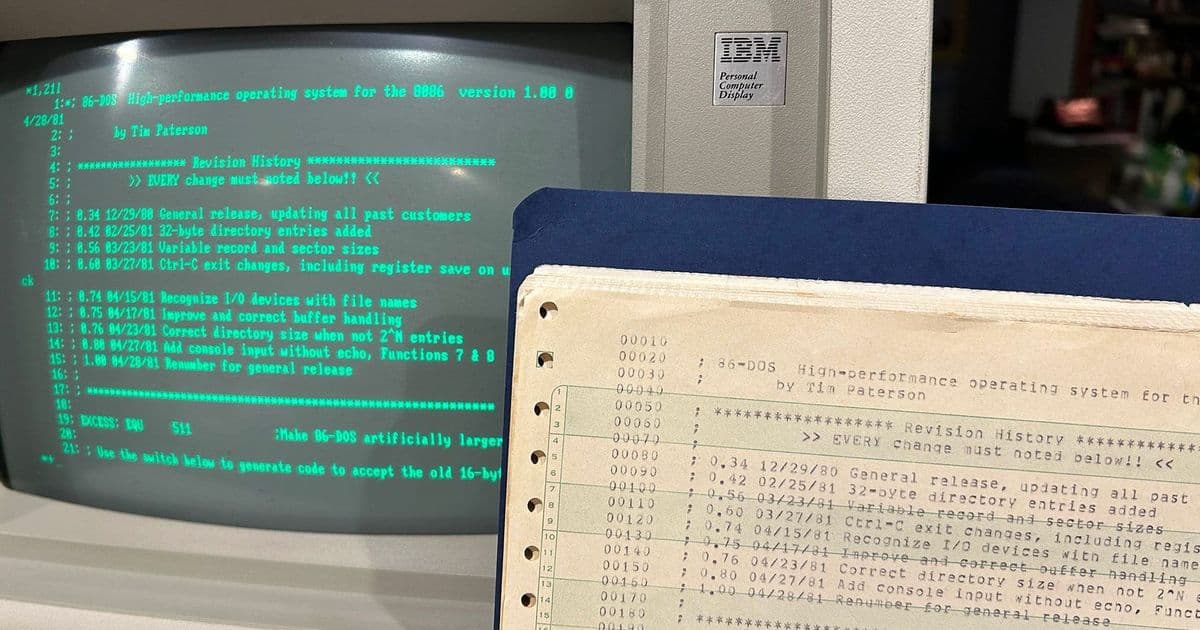
Microsoft has released the original source code for 86-DOS 1.00, transcribed from decades-old printouts found in creator Tim Paterson's garage, offering unprecedented insight into early operating system development.
Microsoft continues its initiative to preserve computing history by open-sourcing the earliest DOS source code, marking a significant milestone in software archaeology. The company has made available Tim Paterson's DOS listings, containing the source code of the 86-DOS 1.00 kernel, various PC-DOS 1.00 pre-release kernels and utilities, and the Microsoft BASIC-86 Compiler runtime library, all transcribed from physical printouts discovered in Paterson's garage.
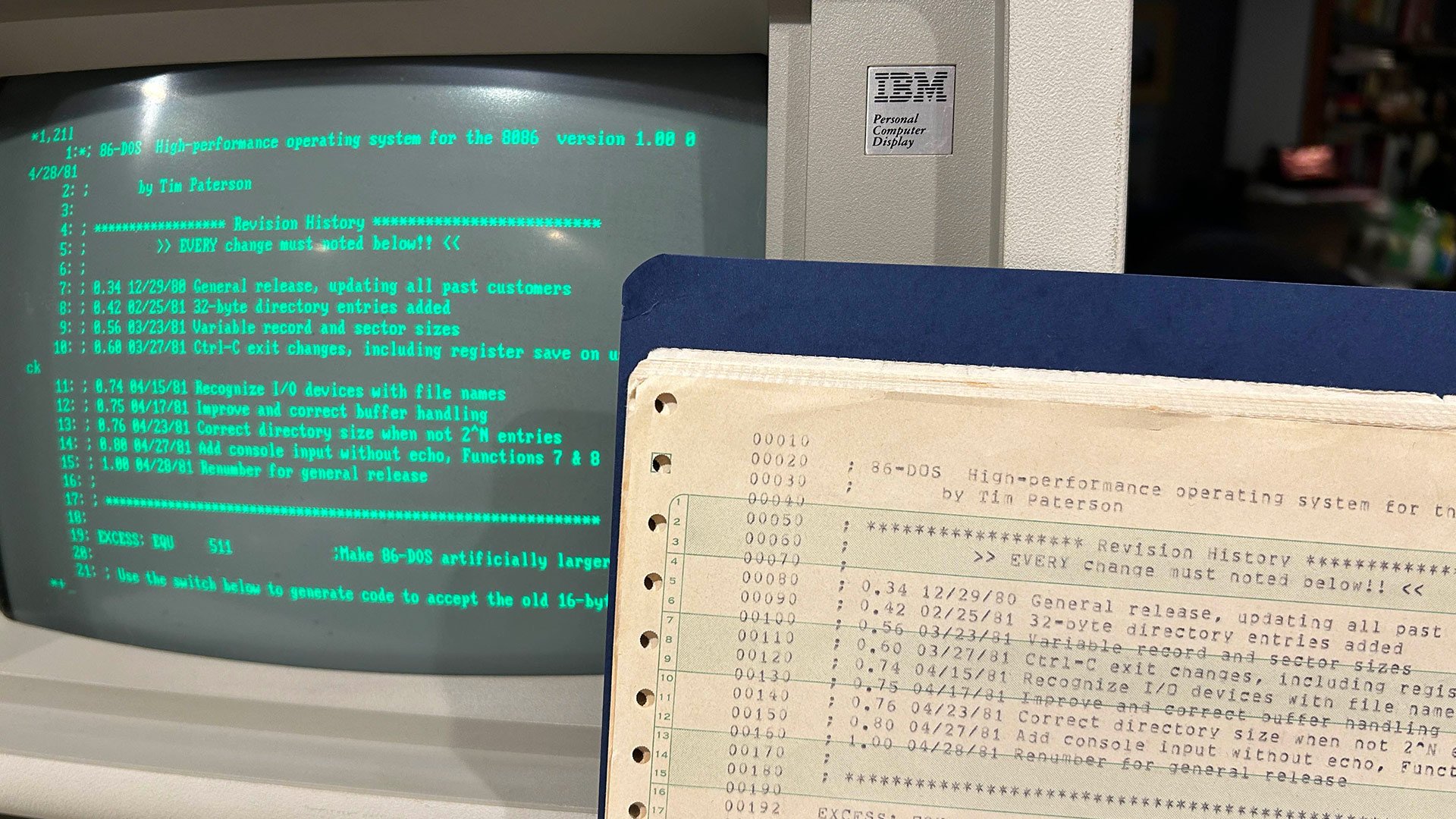
The release coincides with the 45th anniversary of 86-DOS 1.00 and represents a remarkable preservation effort. According to Microsoft VP Scott Hanselman, the transcribed code is "perfect, and recompiles byte for byte to the original binaries." This level of accuracy is particularly impressive considering the code was recovered from reams of yellowed dot matrix printouts that had been stored for decades.
The GitHub repository contains not only the recovered source code but also original scans of the printouts in PDF and PNG format, available through the Internet Archive. These documents include Paterson's handwritten notes, providing a rare glimpse into the development process of one of computing's most influential operating systems.
Historical Context and Technical Significance
86-DOS, originally developed by Tim Paterson at Seattle Computer Products in 1980, represents a critical juncture in operating system history. Microsoft's acquisition of 86-DOS for approximately $75,000 provided the company with its foothold in the OS market, which would eventually lead to the dominance of MS-DOS and later Windows.
The technical specifications of 86-DOS 1.00 reveal much about early personal computer operating systems:
- Written primarily in 8086 assembly language
- Occupied approximately 8KB of memory
- Supported floppy disk operations with a 160KB capacity
- Provided a basic command-line interface with approximately 20 commands
- Featured a file allocation system using 12-bit entries
The GitHub repository demonstrates the evolution of 86-DOS into PC-DOS 1.00, showing how Microsoft adapted the code for IBM's upcoming Personal Computer. The repository also includes source code for utilities that would become staples of DOS systems, including CHKDSK, FORMAT, and SYS.
The Microsoft BASIC-86 Compiler runtime library represents another significant component of this release. This compiler, one of Microsoft's early commercial products, helped establish the company's presence in the programming tools market, which would later expand to include languages like BASIC, COBOL, and eventually C.
Preservation Effort and Technical Challenges
The transcription process from physical printouts to digital source code presented considerable technical challenges. Each line of code had to be manually entered and verified, with special attention paid to:
- Preserving exact assembly mnemonics and operands
- Maintaining correct memory addresses and offsets
- Reproducing exact comments and annotations
- Handling handwritten corrections and modifications
The result is a digital archive that not only preserves the functionality of the original software but also captures the development process as it occurred in 1980-1981. This provides researchers and historians with authentic source material rather than later reconstructions or re-creations.
Microsoft's Open Source Initiative for Historical Code
This release is part of Microsoft's broader effort to make its early operating systems available for study and preservation. The company has previously open-sourced:
- MS-DOS 1.25 and 2.11 in 2018
- MS-DOS 4.00 in 2024
- Various other historical tools and utilities
Each release has followed a similar pattern of making historical source code available under permissive licenses, allowing researchers, educators, and enthusiasts to study and build upon early computing technology.
The technical documentation accompanying the DOS releases has improved with each iteration. Earlier releases included basic compilation instructions, while the current release provides more comprehensive guidance for building and running the historical code on modern systems.
Market Implications and Historical Context
The release of 86-DOS source code comes at a time when interest in historical computing systems is experiencing a resurgence. Vintage computer enthusiasts, historians, and security researchers increasingly seek access to original source code to understand:
- The evolution of operating system design
- Security vulnerabilities in early systems
- Performance characteristics of legacy software
- Development practices of the early microcomputer era
The commercial impact of Microsoft's early DOS decisions cannot be overstated. The $75,000 investment in 86-DOS ultimately helped Microsoft establish dominance in the PC operating system market, generating billions in revenue over subsequent decades. This historical context makes the source code particularly valuable for business and technology historians studying the evolution of the software industry.
Educational Value
For educators and students, the availability of original source code provides an unparalleled teaching resource. Early DOS implementations demonstrate fundamental concepts in:
- Operating system design
- File system implementation
- Memory management
- Hardware abstraction
- Command-line interface design
The relatively small codebase (approximately 8,000 lines for the core kernel) makes it manageable for students to study in its entirety, unlike modern operating systems which contain millions of lines of code.
Future of Historical Software Preservation
Microsoft's approach to historical software preservation offers a model for other technology companies. By making source code available under permissive licenses, the company enables:
- Academic research into software evolution
- Development of accurate emulators and simulators
- Creation of educational materials
- Restoration of historical computer systems
The company has indicated that additional historical releases may be forthcoming, though specific future projects have not been announced. Industry observers speculate that Microsoft might eventually release source code for early versions of Windows, though no timeline has been established.
The discovery and preservation of this code also highlights the importance of physical artifacts in computing history. In an increasingly digital world, the physical printouts stored in Paterson's garage represented an irreplaceable link to the early days of personal computing.
For those interested in exploring this historical code, the GitHub repository provides comprehensive documentation, build instructions, and links to the original scanned documents. The availability of both the transcribed source code and the original physical scans creates a multi-dimensional archive that preserves not only the software but also the context of its creation.
Comments
Please log in or register to join the discussion