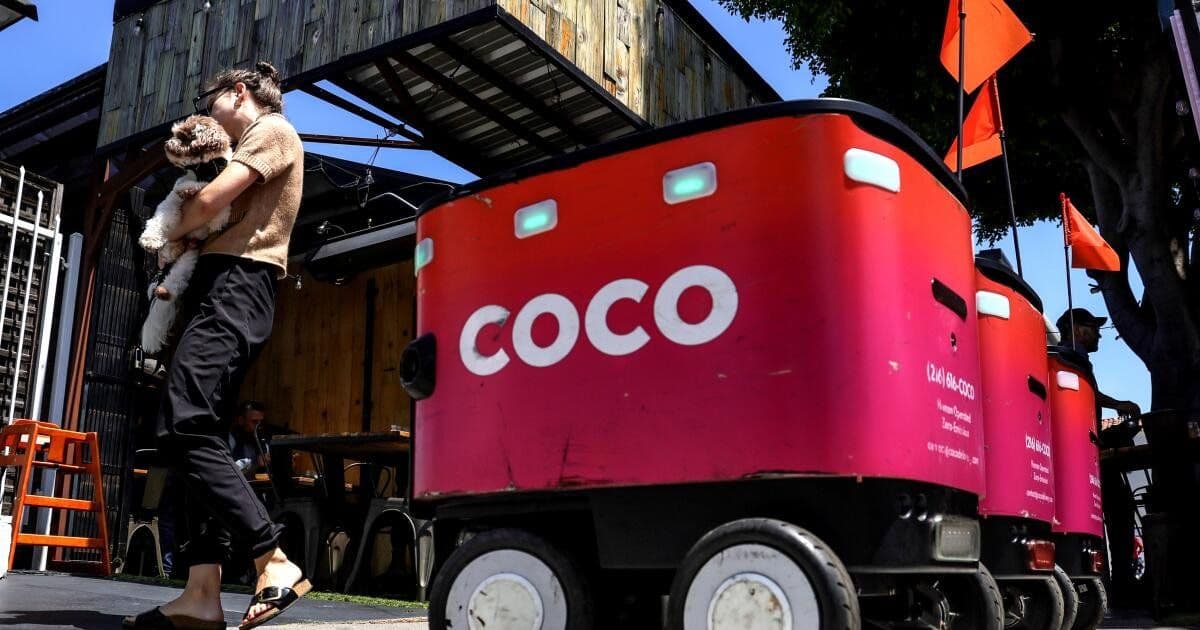
Autonomous delivery robots from companies like Coco and Serve Robotics are multiplying on city sidewalks, creating both convenience concerns and regulatory challenges as cities grapple with this new technology.
When we imagine the future of delivery, many picture autonomous vehicles gliding seamlessly through our cities. But in reality, the first wave of autonomous delivery has arrived in the form of knee-high robots navigating crowded sidewalks, creating both excitement and controversy.
Coco Robotics, founded in 2020 by two UCLA graduates, has expanded across the country with their distinctive delivery bots. The company recently announced their next-generation model, the Coco 2, representing a significant evolution in their autonomous delivery platform. Coco's website showcases their progress from initial prototypes to more sophisticated systems capable of handling complex urban environments.
These robots represent an attempt to solve the last-mile delivery challenge in urban areas. By replacing traffic-clogging, exhaust-spewing delivery vehicles with smaller, electric-powered autonomous units, companies like Coco and Serve Robotics aim to create a more environmentally friendly delivery ecosystem. Serve Robotics, another major player in this space, has deployed their LiDAR-equipped robots that navigate autonomously with minimal human intervention.
The market for autonomous delivery appears to be growing, with these companies securing funding to expand their operations. However, the rollout hasn't been without challenges. Early models struggled with basic obstacles like curbs, street signs, and unpredictable pedestrians, leading to stranded robots that became as much of an eyesore as the abandoned Bird scooters that preceded them.
Cities are responding with varying approaches. Chicago, Toronto, and San Francisco have instituted outright bans, while Glendale and Long Beach have implemented temporary moratoriums while officials develop regulatory frameworks. The debate centers on whether these robots are a harmless innovation or a sidewalk hazard that displaces human workers.
Proponents argue that delivery robots reduce traffic congestion, lower carbon emissions, and provide a novel solution to urban delivery challenges. Critics, however, point to safety concerns, accessibility issues for people with mobility challenges, and potential job displacement in the gig economy.
The technology continues to evolve, with newer models demonstrating improved navigation capabilities and durability. Serve Robotics has reportedly deployed dozens of their units in various cities, while Coco's expansion suggests they've secured sufficient funding to scale their operations beyond initial test markets.
As these robots become more common on our streets, we face fundamental questions about how we want our cities to function. The delivery robot represents more than just a technological curiosity—it's a test case for how we integrate autonomous systems into our shared public spaces while balancing innovation with community needs.
The future of last-mile delivery may very well include autonomous robots, but their success will depend not just on technological advancement, but on our ability to create regulations that protect pedestrians while allowing innovation to flourish. For now, these little autonomous delivery vehicles remain a symbol of both our technological aspirations and the practical challenges of implementing them in the real world.
Comments
Please log in or register to join the discussion