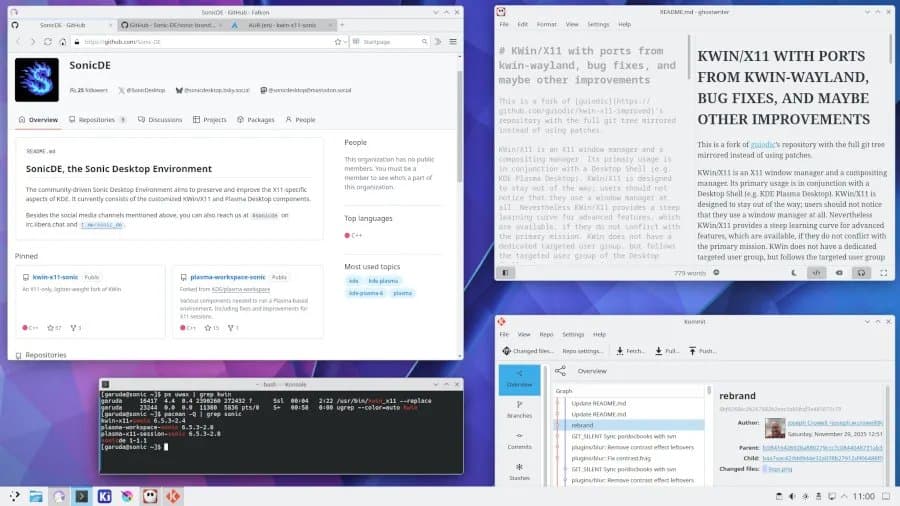
With KDE Plasma 6.8 dropping X11 support, the SonicDE project aims to maintain and enhance the X11-specific code through a community-driven fork.
The KDE community faces a significant transition as Plasma 6.8 prepares to drop X11 support entirely in favor of Wayland. This move has sparked the creation of SonicDE, a new community-driven project dedicated to preserving and improving the X11-specific code within the KDE desktop environment.
The X11 vs Wayland Divide
The decision by KDE to go Wayland-exclusive with Plasma 6.8 has created a rift in the Linux desktop ecosystem. While Wayland offers modern security and performance benefits, many users and organizations still rely on X11 for various reasons including legacy application compatibility, specific hardware support, and established workflows.
SonicDE (formerly known as "KDE-Lite") has emerged as the solution for those who want to continue using KDE with X11 support. The project has been actively developing over the past two months, focusing on maintaining the X11-specific portions of the KDE codebase that would otherwise be abandoned.
SonicDE's Technical Approach
The SonicDE project takes a targeted approach by forking only the X11-specific components of KDE rather than creating an entirely new desktop environment. This strategy allows them to preserve the familiar KDE experience while ensuring continued X11 support.
Core Components
- sonic-win: An X11-only lightweight fork of the KWin window manager
- sonic-workspace: A fork of KDE Plasma Workspace with X11 optimizations
- silver-sddm: Modified display manager code for X11 sessions
- Related infrastructure: Various supporting components and utilities
Current Development Status
SonicDE developers have been working diligently to clean up and enhance the X11 codebase. Their efforts include:
- Removing Wayland-only code that would otherwise complicate the X11 build
- Addressing deprecated elements within the codebase
- Improving performance and stability of X11-specific features
- Beginning work on a Vulkan back-end for the Sonic-Win code
The Vulkan back-end development is particularly noteworthy, as it could provide modern graphics acceleration while maintaining X11 compatibility - potentially offering the best of both worlds for users who need X11 support.
Availability and Distribution
Despite being in early stages, SonicDE has already made progress in terms of distribution:
- Source code is available on GitHub
- Arch Linux users can access SonicDE packages through the AUR
- OpenMandriva is working on official package integration
- The project hopes to expand to other distributions as development progresses
The Broader Context
The emergence of SonicDE highlights an ongoing tension in the Linux desktop world between innovation and legacy support. While Wayland represents the future with its modern architecture, X11 remains deeply embedded in many production environments and specialized use cases.
For users who depend on X11-specific features or have hardware that works better with X11, SonicDE provides a path forward that doesn't require abandoning the KDE desktop environment they know and prefer. This community-driven approach demonstrates how open source development can address diverse user needs even as upstream projects make strategic decisions about their future direction.
As Plasma 6.8's Wayland-exclusive release approaches, SonicDE's development timeline will be crucial for users who need a smooth transition plan. The project's success will depend on community support and the ability to maintain compatibility with KDE's ongoing development while preserving X11 functionality.
For those interested in following or contributing to SonicDE's development, the project maintains an active presence on GitHub where the source code and development discussions take place. As the Linux desktop ecosystem continues to evolve, projects like SonicDE ensure that users have choices that align with their specific needs and constraints.
Comments
Please log in or register to join the discussion