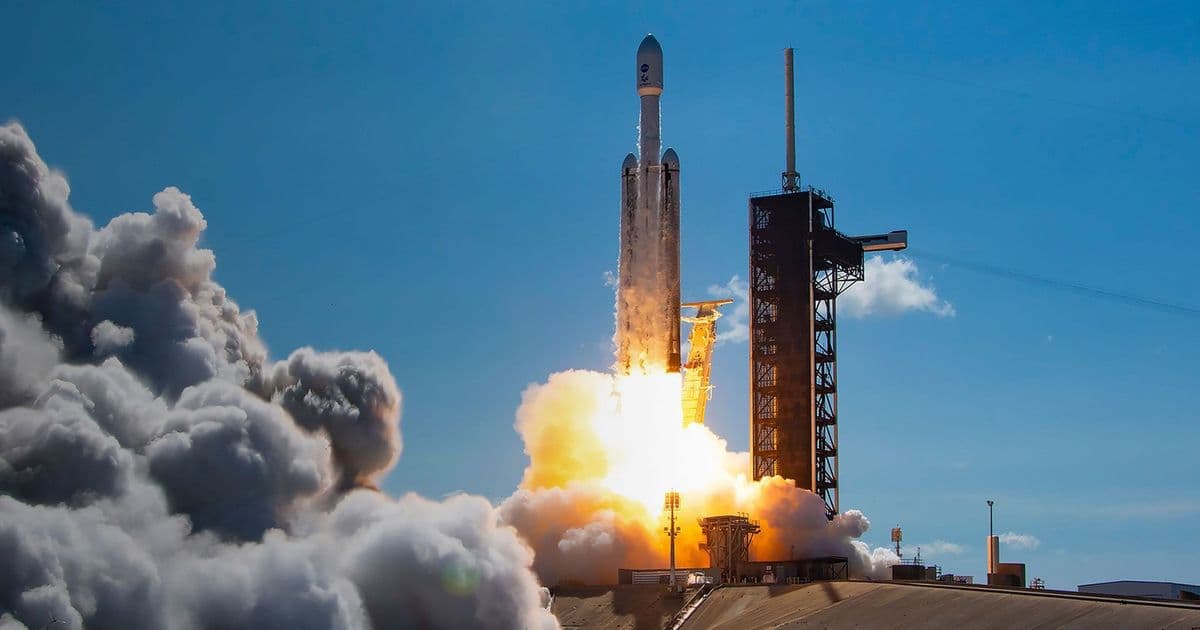
SpaceX's FCC filing reveals plans for a million-satellite orbital data center system to support AI and edge computing, but experts warn the massive constellation could trigger catastrophic space debris cascades.
SpaceX has formally outlined its ambitious plan to deploy one million satellites in low Earth orbit to create an Orbital Data Center System, according to an FCC filing that has raised both excitement and alarm within the space industry. The filing, submitted by the company, details how these satellites would support AI, machine learning, and edge computing applications while operating in sun-synchronous orbits between 500 km and 2,000 km altitude.
Technical Specifications and Scale
The proposed system would operate in narrow orbital shells spanning up to 50 km each, with the company claiming this spacing would leave "sufficient room to deconflict against other systems with comparable ambitions." SpaceX estimates that a million tonnes of satellites, each generating 100kW of compute power, would deliver 100 gigawatts of AI compute capacity.
This massive constellation represents a significant escalation from SpaceX's current Starlink operations, which already consists of approximately 9,000 satellites. The company positions this as a crucial step toward what it calls a "Kardashev II-level civilization" - one capable of harnessing the sun's full power directly in space without atmospheric interference.
The Kardashev Scale Context
The Kardashev scale, proposed by Soviet astronomer Nikolai Kardashev in 1964, measures a civilization's technological advancement based on energy consumption. A Type I civilization utilizes all available energy on its home planet, while Type II civilizations harness energy directly from their star. SpaceX's filing suggests that orbital data centers represent a pathway to this higher level of energy utilization.
Space Debris Concerns
However, the ambitious plan has sparked serious concerns among space debris experts. The risk of Kessler Syndrome - a cascading chain reaction of satellite collisions creating exponentially more debris - looms large over the proposal. This concern was underscored by a recent incident involving the Russian Luch/Olympic satellite, which fragmented in its graveyard orbit above 35,000 km altitude.
Recent Debris Event Highlights Risk
Ground observers documented the fragmentation of the decommissioned Russian satellite, producing additional debris that now orbits Earth. This incident serves as a stark reminder of how even single satellite failures can contribute to the growing space debris problem. With SpaceX proposing to increase the number of satellites in orbit by more than two orders of magnitude, the mathematical probability of collision events increases dramatically.
Industry Competition and Orbital Congestion
The concern extends beyond SpaceX's own plans. Multiple companies are pursuing large satellite constellations, creating a crowded orbital environment. Industry analysts note that the current 9,000 Starlink satellites already have experts worried about orbital congestion and collision risks.
Technical and Economic Implications
SpaceX claims that orbital data centers would be "far more cost-efficient than their terrestrial counterparts" due to the elimination of atmospheric interference and direct access to solar power. The company argues that 100GW/year of solar-powered AI satellites would require 100GW/year of AI computers, creating a self-sustaining orbital compute infrastructure.
Scientific and Regulatory Challenges
The proposal presents significant challenges for space traffic management and international space law. Current frameworks for orbital debris mitigation may prove inadequate for managing a million-satellite constellation. The FCC filing suggests that the 50 km spacing between orbital shells would provide sufficient deconfliction, but many experts remain skeptical about the practicality of such precise orbital management at this scale.
Long-term Consequences
Beyond immediate collision risks, the Kessler Syndrome scenario presents existential risks for space-based infrastructure. A cascading debris event could render certain orbital regions unusable for generations, potentially trapping humanity on Earth and derailing plans for interplanetary exploration. This creates a paradox where the very technology meant to enable humanity's multi-planetary future could instead constrain it.
Industry Response and Future Outlook
The space industry is closely watching both the regulatory response to SpaceX's filing and the company's ability to demonstrate responsible orbital management with its existing constellation. The success or failure of this proposal could set precedents for future mega-constellations and shape the future of orbital infrastructure development.
The tension between technological ambition and responsible space stewardship remains unresolved, with SpaceX's million-satellite plan serving as a critical test case for balancing innovation with the preservation of the orbital environment that all space-faring nations depend upon.

Comments
Please log in or register to join the discussion